

Sunnis and Kurds set conditions for backing Iraq’s next Prime Minister



 Messenger
 Whatsapp
 Threads
 Email
Email
 Print
Print
 X
X
 Facebook
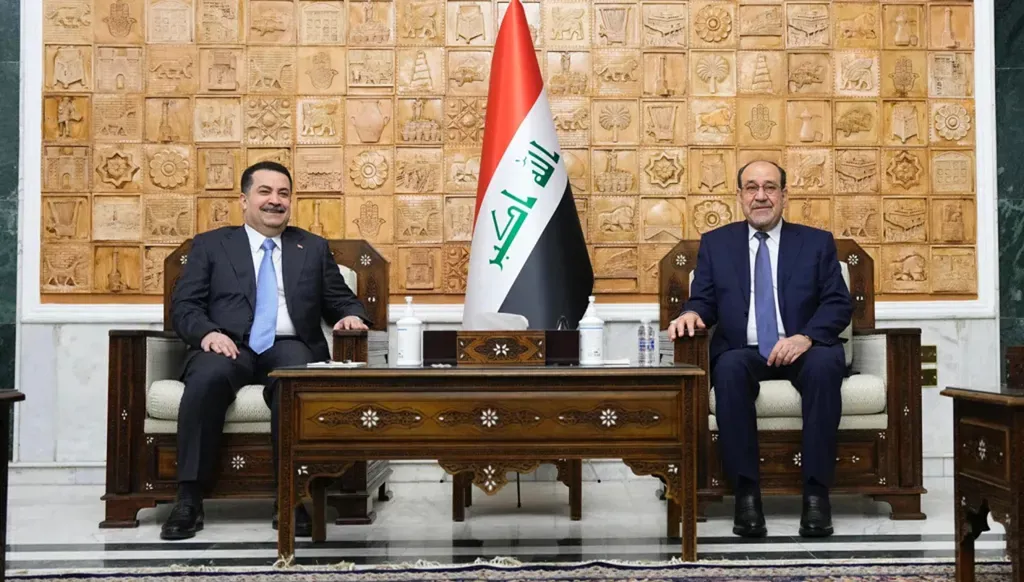


Amid rising debate over the identity of the upcoming political phase in Iraq, the positions of Sunni and Kurdish forces emerge as a decisive factor in the equation of choosing the prime minister and forming the new government.
While Sunni forces affirm their support for the path of consensus and favoring a service-oriented government and balanced partnership, Kurdish parties link their stance on any candidate to a set of postponed constitutional and legal demands, placing the Shia forces in a real test to pass their choices or head towards a consensual candidate that ensures passing constitutional entitlements with minimal complexity.
Amid the political stances regarding the formation of the next government, political forces are hinting at options of obstruction through reviving the scenario of the "blocking third," threatening the possibility of the country entering a new wave of political deadlock.
Azzam al-Hamdani, a leader in the Azem Alliance, told "Annahar" that "the Shia household is keen on choosing a non-controversial figure," noting that "the Azem Alliance's experience of withdrawing Muthanna al-Samarrai in favor of Haibat al-Halbousi was an inspiring experience for other blocs and helped prevent divisions."
Al-Hamdani adds that "the withdrawal of Mohammed Shia al-Sudani in favor of Nouri al-Maliki is observed in the same context," expressing hope for this experience to be repeated within the Kurdish household.
He explains that the Sunni political council is interested in "producing a service-oriented government capable of impacting the foreign policy file, prioritizing the state's higher interest over partisan and personal interests, and avoiding any internal influences or political polarizations."
Regarding Sunni entitlements, al-Hamdani emphasizes the importance of "achieving the principle of balance in all administrative, security, and economic state institutions, addressing the displaced persons file, revising the amnesty law, and working to release innocent prisoners, considering that the previous law was not a good one." He also calls for addressing the Jurf al-Sakhar issue, resolving the accountability and justice law, and handling the file of confining weapons to the state, allowing the establishment of a state and government where no security authority overrides the authority of law and state.
Ahmed al-Haraki, a leader in the Patriotic Union of Kurdistan, did not stray far from al-Hamdani's talk, saying that "the nomination of al-Maliki is left to the coordination framework," affirming to "Annahar" the union's respect for the framework's choice, but clarifying that "the nomination file has not yet been settled within the framework till this moment."
Al-Haraki states that "the equation of the prime minister is linked to other equations, including that the candidate of the framework must gain acceptability among Kurdish and Sunni parties within the national space," in addition to international acceptability which he described as "very important," as well as the candidate's ability to manage existing contradictions and balances.
Regarding Kurdish demands, al-Haraki notes that Kurdish parties have clear demands and share in several files, including Article 140 of the constitution, and the enactment of the oil and gas law, along with other contentious files that have been carried over in previous sessions without radical solutions.
Wafa Mohammed, a leader in the Kurdistan Democratic Party, presents the same demands, confirming that what his party is waiting for is the official announcement of the candidate's name, to discuss the constitutional and legal demands that the Kurdistan Democratic Party is keen to present when forming any government.
Mohammed told "Annahar" that "nominating any individual for the premiership by the coordination framework bloc is its legitimate right," pointing out that all other forces, whether Sunni or Kurdish, should respect this decision, whether the nominee is al-Maliki or any other figure.
Mohammed affirms that the most notable demands include enacting the oil and gas law, implementing Article 140 of the Iraqi constitution concerning the disputed areas, and the Kurdistan Region's share of the general budget, in addition to the need to amend the election law.
Informed political sources reveal movements led by political parties opposing the existing alliance between al-Sudani and al-Maliki, aiming to revive what is known as the "blocking third" inside the House of Representatives, to obstruct the pathway of the presidency and prevent the completion of government formation.
According to the sources, these efforts come to thwart any political concord that may lead to passing a candidate supported by al-Maliki, whether in the presidency or later in the premiership designation path.
The sources clarify that parties inside and outside the coordination framework, including deputies from the Hikma movement, "Sadiqoun" blocks, and the Badr organization, alongside independent figures, have shown their readiness to engage in this path.
According to observers, the success of this scenario may lead the country toward another political stalemate amidst escalating disagreements within the Shia household, placing the current alliances in a tough test, with the scene open to the choices of consensual settlement or prolonged political obstruction.