

Lebanon reads Graham’s remarks as pressure to speed up arms restrictions



 Messenger
 Whatsapp
 Threads
 Email
Email
 Print
Print
 X
X
 Facebook
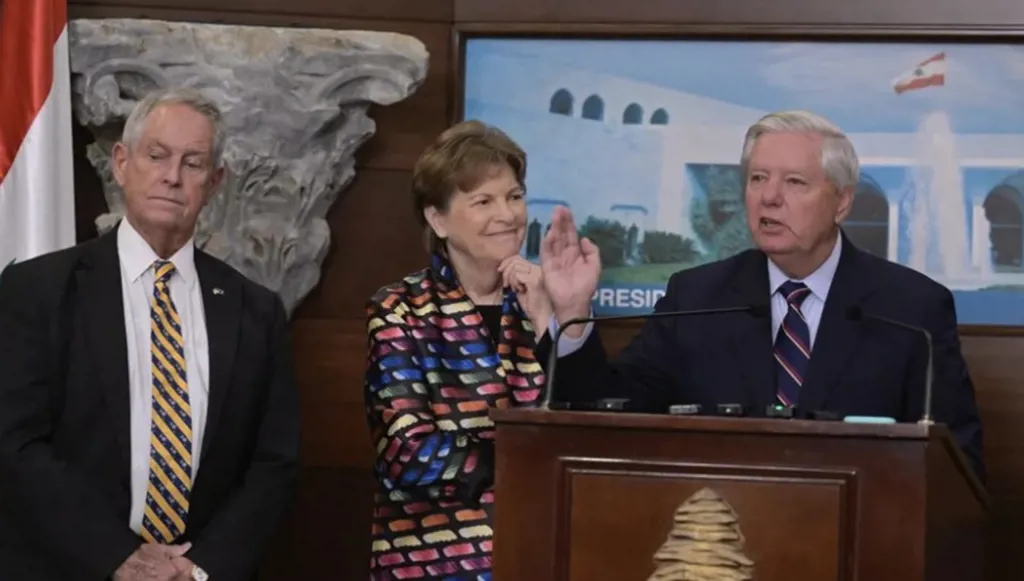


Informed sources reported on the meeting between President Joseph Aoun and the US Ambassador to Lebanon, Michael Issa, two days ago. The meeting came just hours after Army Chief Gen. Rudolf Haykel met with US Senator Lindsey Graham, chairman of the Senate Foreign Relations Committee.
The “morning gathering” between the President and the ambassador was accompanied by multiple conclusions, interpretations, and readings. However, sources said the atmosphere was broadly positive, marked by exceptional candor and an in-depth discussion of all that surrounded the army chief’s meetings with American officials.
Issa reportedly dispelled doubts by stressing that Graham’s stance was not surprising. He had signaled as much during a previous visit to Lebanon alongside former US envoys Morgan Ortagus and Tom Barrack, when he spoke harshly about Lebanon’s situation.
Observers of the meeting said Graham’s remarks were a clear message to Lebanese officials to accelerate efforts to limit weapons north of the Litani River — and across Lebanon more broadly.
Beyond that, there were no indications of any negative outcome from the army chief’s visit to the United States, a point expected to be confirmed during upcoming sessions of the army support conference.
The conference may be postponed for a few weeks for technical and administrative reasons, or it may remain scheduled for March 5. Arrangements are underway, as French Foreign Minister Jean-Noël Barrot reportedly conveyed to Lebanese officials during his recent visit to Beirut. Washington’s participation, therefore, is considered settled.
In a related context, the meeting between Aoun and Issa focused on a deep examination of Lebanon’s overall situation. Issa is widely viewed as a minister plenipotentiary, given the scope of his authority and his close relationship with US President Donald Trump, as he works to pave the way for Aoun’s planned visit to Washington. Positive news on this front is expected soon.
Former MP Wehbi Katisha, who is familiar with military meetings in the United States, told Annahar that “the visit was militarily successful, and the army chief and all army commanders execute the political decision.”
“This is what Gen. Rudolf Haykel does. He does not engage in political affairs, but implements the Lebanese government’s decision. For this reason, the visit was not a failure at all — particularly on the military level,” Katisha said.
“As for the political aspect, he cannot make any decision. Likewise, the US senator does not represent the US administration. He has his position in Congress and is enthusiastic about Israel,” he added.
On the president’s possible visit to the United States, Katisha said Issa “has his role, presence, and authority.”
“He is a friend of Trump, so it is natural that the expected visit was discussed without scheduling it yet. It is too early to explore the course of the meetings, but Ambassador Issa is following up on this visit, and then it will be built upon as needed,” he said.