

Lebanon’s environmental crisis in 2025: When climate, corruption, and public rights collide
A year marked by illegal construction, deforestation, and waste mismanagement shows how environmental degradation has become a governance failure.




 Messenger
 Whatsapp
 Threads
 Email
Email
 Print
Print
 X
X
 Facebook


As the end of 2025 approaches, Lebanon’s environmental reality has emerged as one of the country’s most pressing challenges - not as an abstract ethical debate or theoretical concern, but as a matter of public rights and national responsibility.
The environment is no longer a marginal issue to be postponed until after political and economic crises; it has become a direct reflection of governance, of the state’s stewardship of its resources, and of its commitment to the rights of citizens and future generations. This urgency is heightened as Lebanon begins to experience firsthand the growing impacts of global warming and climate change.
In the south, a particularly notable incident involved a violation by the Ministry of Defense that openly challenged the judiciary, after it proceeded with construction works for a military club within the buffer zone of a sensitive environmental reserve. The project was halted approximately two months after Major General Rodolphe Haykal assumed command of the army. Notably, an urgent ruling issued by Judge Yolla Ghoutaymi in Tyre - ordering the suspension of all construction on several properties adjacent to the city’s coastline and its reserve - coincided with Haykal’s assumption of office in March 2025. The ruling came weeks before the work was eventually stopped, and construction remains suspended to this day.
Similarly, within the buffer zone of the Abbassieh Reserve, unlicensed human activity and construction were observed throughout the year, posing potential threats to local biodiversity. The area serves as a seasonal breeding ground for endangered sea turtles, heightening the environmental risk. More broadly, environmental violations in the south cannot be discussed without noting the recurring damage caused by Israeli bombardment of valleys and forests, which has triggered fires and widespread destruction. Mount Rihan has been among the hardest-hit areas, where at least 100 ancient gum trees - mostly pines - were burned in November of last year.
Moreover, the waste crisis worsened this year as the government failed to reach a lasting solution or establish viable alternatives for waste management. The Jdeideh landfill reached full capacity last September, prompting authorities to expand it - once again resorting to temporary measures that have repeatedly proven ineffective. At the same time, illegal dumps have proliferated in many areas in clear violation of the law, with the government turning a blind eye amid its continued inability to implement a comprehensive and sustainable waste management strategy.
Many environmental and human rights organizations have documented numerous violations of many environmental sites, most notably sites belonging to the Litani River National Authority and violations of Thoum Beach in the Batroun district, where parts of the public maritime domain were backfilled in August 2025.
Widespread tree felling across several areas also cannot be overlooked, most notably between Bkerke and the town of Daraoun, where large numbers of gum trees - both oak and pine - were cut down. Similar violations were recorded with the cutting of yew trees in Harabta in the Baalbek district and in the highlands of Jbeil, particularly in the town of Afqa.
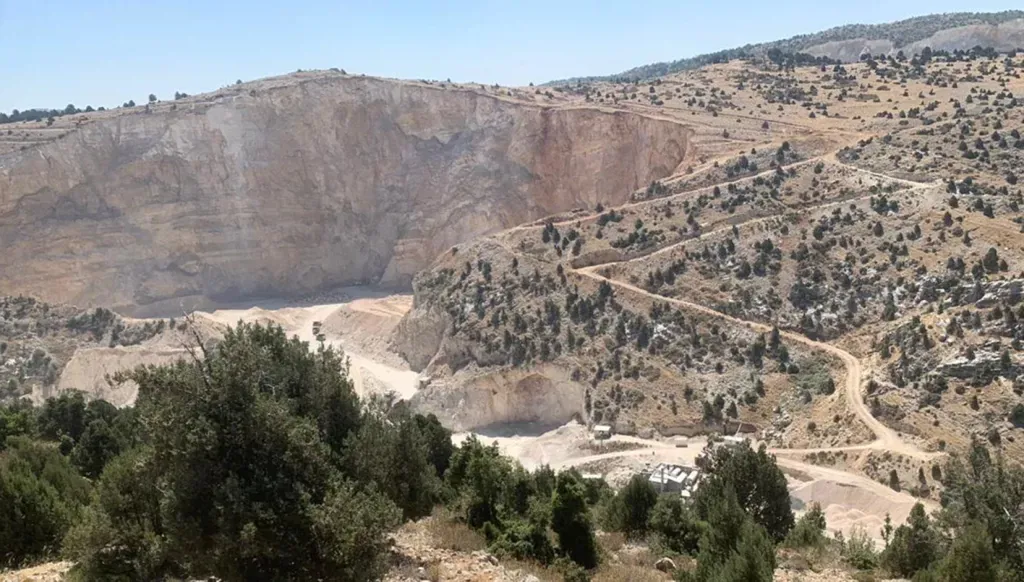
Finally, the continued operation of illegal quarries and gravel pits across the northern regions, the Bekaa, and Mount Lebanon cannot be overlooked, although Environment Minister Tamara El Zein has neither issued licenses for any quarries or gravel pits nor extended operational deadlines for existing ones.
It is worth noting that all of these violations contravene Environmental Law No. 444, enacted in 2002. As such, the government must place environmental issues at the top of its agenda as it enters 2026. Without coordinated action among state institutions—particularly the Ministries of Environment, Agriculture, and Interior, which are tasked with enforcing decisions on the ground following judicial, gubernatorial, or ministerial orders—curbing these violations will remain unattainable.