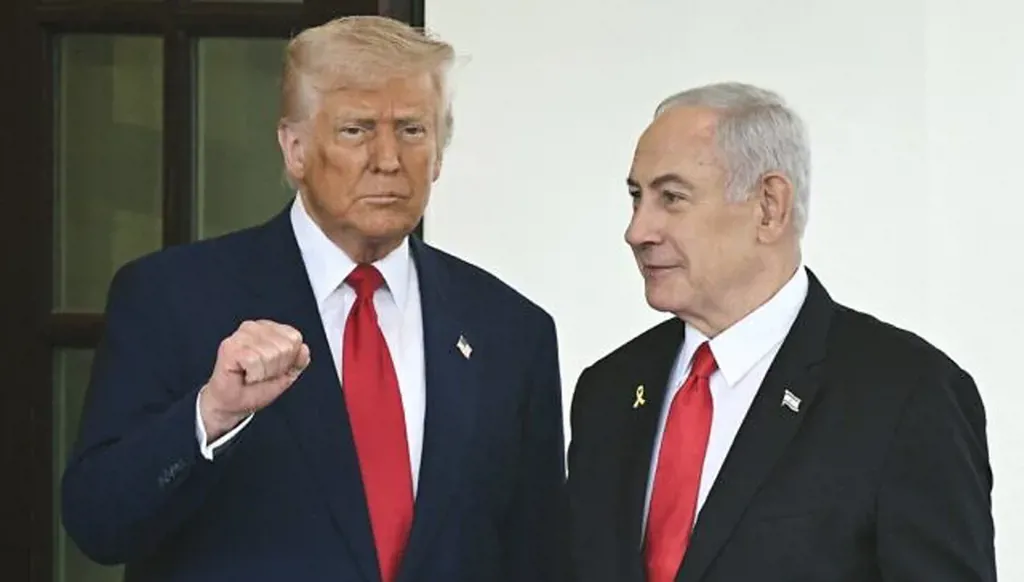
A War of Shifting Goals: Inside the U.S.–Israel Gap on Iran
When the U.S.-Israeli war on Iran broke out on February 28, 2026, and perhaps for a short time afterward, some envisioned complete harmony and full alignment between Washington and Tel Aviv regarding the objectives sought from launching this war and the goals intended to be achieved.
This was especially the case because both countries openly declared, on multiple occasions and through the voices of several senior officials—including the American President and the Israeli Prime Minister in the early stages of the war—that it would not cease until the current regime in Tehran was overthrown and replaced with an entirely new and decisive system.
However, as the war progressed, its escalation increased the complexities and broadened its scope. As days and events unfolded with no clear vision of its end, two things became apparent: first, there were differences between the U.S. and Israel regarding the war’s objectives; and second, for each side, goals shifted, adjusted, and changed over time in a “pendulum” manner, making it difficult to predict which objectives would remain fixed, which might change, and the timing, direction, magnitude, or depth of such changes.
Secondary contradictions
Acknowledging these differences, it is crucial not to fall into the trap of exaggerating them or relying on them to potentially undermine the U.S.-Israeli alliance against Iran, as they ultimately constitute what political science terms “secondary or subsidiary contradictions,” not “fundamental or core contradictions.” The shared ground between both parties remains, at least so far, and under the current administration in Washington and government in Tel Aviv, significantly broader and deeper than the areas of dissent.
American objectives have shifted between advocating for the overthrow of the ruling regime in Tehran and selecting a preferred alternative from within Iran or among options in the President’s mind, or allowing the Iranian people, according to the American administration, the freedom to choose their new leadership and political system; to weakening Iran by destroying its missile capabilities and nuclear program, targeting its air defense systems, and adding its naval forces to the list; expanding to include destroying Iranian infrastructure, conducting an airborne operation to control the strategic Iranian island of Kharg and ending Iran’s control of the Strait of Hormuz, and targeting Iran’s oil facilities and installations. Broader discussions have included military actions needed to render Iran incapable of threatening its neighbors, Israel, or Western interests in the future, returning to dismantling Iran’s nuclear capabilities, and insisting that Iran cut the “umbilical cord” through which it provides military, logistical, and financial support to allied regional groups.
On the Israeli side, although discrepancies and shifts in positions have been less rapid and variable than those of their American counterparts, they have not been absent. Israeli objectives have ranged from completely eliminating the Iranian regime and “liberating” the Iranian people from it, to ensuring the total destruction of Iran’s military capabilities—particularly nuclear, ballistic, and air systems—so that Iran cannot threaten Israel in the future, and breaking the close alliance between Iran and allied groups in Lebanon (Hezbollah), Iraq (Iran-aligned Shia armed factions), Yemen (the Houthi movement), and Palestine (Hamas and other armed Palestinian groups with fundamentalist Islamic orientations).
An observer of these shifts in positions can easily link them to several considerations: addressing domestic public opinion in both the United States and Israel; engaging with governments and publics in Western countries; dealing with governments and peoples in the Middle East and the Gulf; and responding to states whose interests may compete with, if not contradict, those of the United States, such as China and Russia. It also involves considering how changes in objectives relate to the evolution of military operations on the ground, which have experienced ups and downs over the past weeks since the war began. Of course, it includes the effort to exert pressure and threaten Iran to compel it to accept certain demands from Washington and Tel Aviv, and, at least partially, to acknowledge the objectives for which the war was launched—or some of them, at a minimum.
This brings us to the extent and clarity of the differences that have crystallized and become more apparent over time between U.S. and Israeli objectives in the war on Iran.
It is certain that the American President, for personal reasons—primarily his style of handling matters, his strong focus on media and social networks, and his personal image both domestically and abroad, as well as his desire to appear victorious—and for other objective reasons, foremost among them avoiding blame for a potential Republican loss in the November 2026 midterm Congressional elections, and not wanting to join the list of previous U.S. Presidents criticized for entangling the country in unwarranted external wars, such as Lyndon Johnson in Vietnam and George W. Bush in Afghanistan and Iraq, which ended catastrophically for the United States. Furthermore, the President does not want the war to extend into a period where he would depend on Congress for authorization beyond the first 60 days, nor does he wish to be held responsible for financing the war, further burdening the already inflated American debt.
A month after the war
Thus, the current reading of American objectives in the war on Iran, a month into the conflict, indicates that the goal of overthrowing or fundamentally changing the existing regime in Tehran has significantly receded, and some even consider it to have disappeared. Objectives now focus on securing commitments and guarantees that Iran will not produce nuclear weapons, potentially moving toward curbing, if not dismantling, its nuclear program, and exerting pressure to gain concessions regarding its ballistic missile program, including range limitations at minimum. Finally, the objectives include obtaining Iranian commitments to halt, at least partially, its military, logistical, and training support to allied groups and organizations in the region, such as Lebanese Hezbollah, the Houthis in Yemen, Islamist political groups in Palestine, and Iran-aligned armed Shia factions in Iraq, including the Kata'ib Hezbollah and Popular Mobilization Forces, among others.
On the Israeli side, the picture is slightly different. The Israeli government, under certain pressures from the current U.S. administration, may accept the American demands outlined at the end of the previous paragraph without considering the war over or any ceasefire final. This is due to repeated statements by senior Israeli officials throughout the war’s various stages, asserting that Israel views the very existence of the current regime in Tehran—with its declared positions against Israel—as a threat to the state’s survival itself, not merely to its security, regional integrity, or borders. Some, however, question the credibility of this claim, seeing it as motivated by Israel and its current political leadership’s desire to prevent other regional powers from emerging, coveting regional dominance to remain the sole regional authority—similar to the role of Iran under the Shah before 1979. The difference may be that Israel does not seek this role on behalf of another international actor, even the U.S., its closest and most vital ally, but rather for its own interests, aspiring to rise from being the sole regional power in the Middle East to becoming one of the major international powers, as stated by its Prime Minister.
Finally, we should not overlook a personal aspect related to the current Israeli Prime Minister, where the prolonged state of war, even if it may not serve the interests of his people or country, helps extend his tenure in power, shielding him from legal challenges and potential prosecution on internal corruption charges.
We should observe what the coming days reveal regarding the widening or narrowing of the gap between American and Israeli objectives in the war on Iran. Yet, in both cases, it is important to reiterate what was stated at the beginning of this article: from a strategic perspective, and under the current administration in Washington and the government in Tel Aviv, any differences between the two countries remain secondary and subsidiary, not fundamental or core.
Disclaimer: The opinions expressed by the writers are their own and do not necessarily represent the views of Annahar.