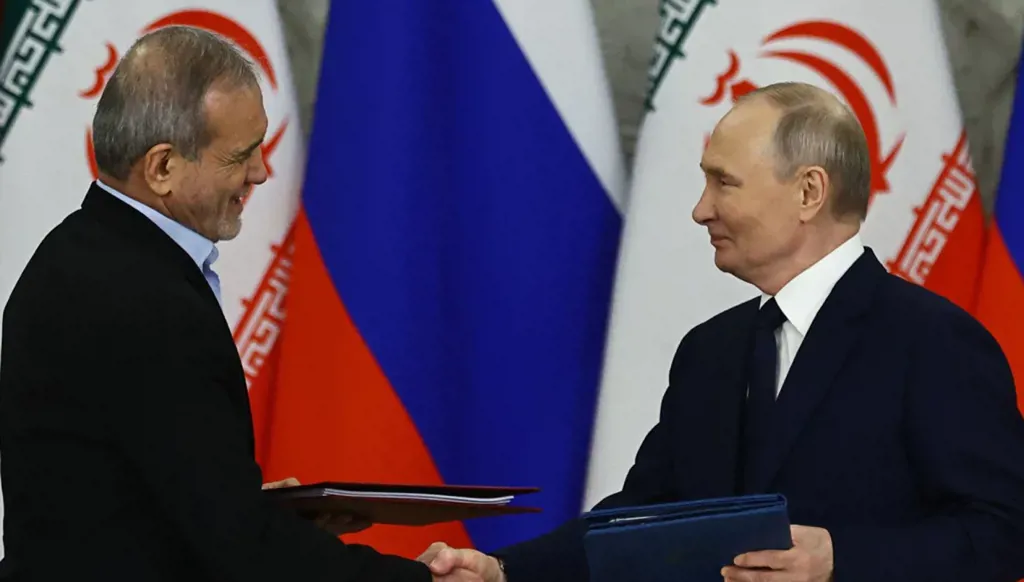
In the short term, Russia might be seen as one of the beneficiaries of the Third Gulf War, given the rise in oil and gas prices and U.S. President Donald Trump’s temporary exemption of Russian oil from American sanctions.
The increase in oil markets caused by Iran's closure of the Strait of Hormuz, which handles about 20% of global energy exports, undoubtedly brings more money to the Russian treasury, providing additional resources not anticipated to finance the war in Ukraine, which has lasted over four years.
Moreover, America’s need to use many munitions and weapons in Iran will deprive Ukraine of some of this equipment that was on its way there, prompting Ukrainian President Volodymyr Zelensky to seek European assistance and consider compensating for the shortage of weapons imports.
However, this is not the whole story, as there are long-term strategic calculations as well. For instance, Iran will emerge from the war militarily and economically weakened and significantly devastated. Iran was among the countries with which Russia signed strategic partnership agreements in recent years. Russia circumvented many international sanctions imposed by the U.S. and European countries through Iran, which itself is under strict American sanctions.
Major realignment
In 2024, Russia lost its ally, the Bashar al-Assad regime. It now faces the possibility of another loss in the Middle East, implying a significant geopolitical realignment between the United States and Russia.
Notably, history is repeating itself, as when U.S. President George H. W. Bush launched the war on Iraq to expel it from Kuwait in 1991, marking the transition between two global systems: the one that existed during the Cold War and the one that emerged after the fall of the Berlin Wall, followed by the collapse of the Soviet Union.
Russia’s support for Iran doesn’t extend beyond verbal backing, as President Vladimir Putin, mired in the Ukrainian quagmire, cannot risk angering Trump by providing military assistance to Tehran. The Russian stance calls for halting the war, considering it illegal and contrary to international law, and advocates for diplomatic solutions. Putin offered Trump that the Kremlin could play a mediating role to de-escalate tensions. Moscow consistently calls for the Bushehr nuclear plant, where several Russian experts still operate, not to be targeted.
In recent decades, Russia has also established strategic cooperative relations with Gulf Arab states. These countries remained neutral regarding the Russian-Ukrainian war and have undertaken mediations on humanitarian issues, such as prisoner exchanges, and even hosted negotiations between Russian and Ukrainian delegations.
As much as Russia opposed the American-Israeli war on Iran, it also called for an end to Iranian attacks on Gulf states. Putin contacted leaders from Saudi Arabia, the United Arab Emirates, Qatar, and Bahrain.
De-escalation efforts
The events in the Gulf are not far from Russia’s borders, and accordingly the Russian role needs to be more effective in de‑escalation efforts. Despite the temporary gains Russia might reap from America’s preoccupation with Iran, no country in the world will be spared the impacts of this war.
Although Russia is weaker than it was before its involvement in Ukraine, Moscow, as a permanent member of the Security Council, can play a more influential role in ongoing efforts to stop the war and return to diplomacy.
Disclaimer: The opinions expressed by the writers are their own and do not necessarily represent the views of Annahar.





 Messenger
 Whatsapp
 Threads
 Email
Email
 Print
Print
 X
X
 Facebook