From the very first moment of the establishment of the “Islamic Republic” in Iran, the Hashemite Kingdom of Jordan expressed concern over this significant event, which had repercussions for the entire region.
It is impossible to ignore that the slogan raised by the “Islamic Republic” since its inaugural day was “exporting the revolution.” This came at a time when Ayatollah Khomeini, the founder of the “Islamic Republic,” saw no geographical borders for that republic, seeking to extend his revolution to the countries of the region, foremost among them Iraq, from a sectarian perspective.
Khomeini believed, from a purely sectarian standpoint, that Iraq would be easy prey. At the core of this ideology he advocated, and which carried real-life implications, lies an explanation for the outbreak of the Iran–Iraq War, which lasted eight years and ended in 1988 with a ceasefire often seen as leaving Iraq in a relatively stronger position.
The late Saddam Hussein did not capitalize on the near victory achieved. Arrogance and a lack of awareness of political, regional, and international balances led him to invade Kuwait in the summer of 1990. The Iraqi occupation of Kuwait, which lasted less than six months, can be seen as a step that helped rehabilitate the “Islamic Republic,” rather than continuing to press it to face a united Gulf front supported by Arab countries such as Jordan.
The Hashemite Kingdom played a crucial role in helping Iraq withstand the Iranian assault for eight years. The port of Aqaba effectively became an Iraqi port. Moreover, King Hussein, may he rest in peace, sought to salvage what could be saved in the aftermath of Saddam Hussein’s invasion of Kuwait, despite the damage inflicted on Jordan on various fronts.
In clearer terms, Jordan has never abandoned its regional role, particularly in maintaining caution regarding Iranian policies in the region—especially after President George W. Bush decided to hand Iraq over on a silver platter in 2003, without understanding the implications for the existing regional balance, of which Iraq was a core component.
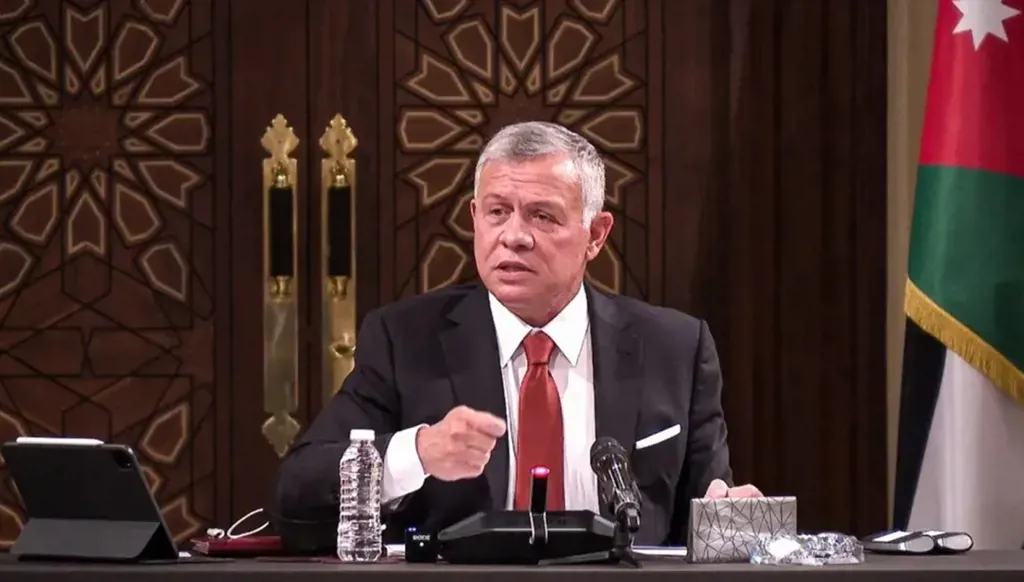
The recent tour conducted by King Abdullah II was merely an expression of a coherent Jordanian stance that was not born yesterday. The Jordanian monarch met with UAE President Sheikh Mohammed bin Zayed Al Nahyan in Abu Dhabi, then with the Emir of Qatar Sheikh Tamim bin Hamad Al Thani in Doha. He subsequently traveled to Manama to meet King Hamad bin Isa Al Khalifa.
Significantly, the tour came as Iranian missiles and drones targeted three peaceful countries that share historical, political, security, and military ties with Jordan. King Abdullah II demonstrated notable courage by traveling to Abu Dhabi, Doha, and Manama to affirm that the Hashemite Kingdom’s solidarity with these three countries is not merely verbal, but also demonstrated through concrete actions.
It is no secret that the Hashemite Kingdom itself is subject to unjustifiable Iranian attacks. The simple fact is that Iran believes expanding the war serves its interests. The attacks on the countries of the region, including the Oman—which has sought from the outset to prevent the war—are merely proof of Iranian bankruptcy beyond measure. Where is the logic in broadening the war, an expansion that has led the Arab Gulf states to begin issuing warnings to the “Islamic Republic”? This is evident in the actions of Saudi Arabia, which has distanced itself from Iranian diplomats.
Iran is pushing, knowingly or unknowingly, the Gulf Arab states toward greater cooperation among themselves and deeper coordination with Jordan, which has always been present in every aspect concerning Gulf security.
King Abdullah II’s recent Gulf tour was nothing but a continuation of a consistent Jordanian policy rooted in caution toward Iran following the overthrow of the Shah. Events, beginning with the Iran‑Iraq war and extending to the current ongoing conflict, have demonstrated the validity of the policy adopted by King Hussein and his successor, showing that caution in dealing with Iran is a necessity.
Nothing has changed since the establishment of the “Islamic Republic” in 1979 up to the war in 2026. Similarly, Jordan has not changed: it supported Iraq during the eight-year war from 1980 to 1988, warned of the “Shiite Crescent” in 2004, and still remains a depth for the Arab Gulf in a war where Iran has launched missiles and drones on GCC countries far more than on Israel.
Disclaimer: The opinions expressed by the writers are their own and do not necessarily represent the views of Annahar.





 Messenger
 Whatsapp
 Threads
 Email
Email
 Print
Print
 X
X
 Facebook