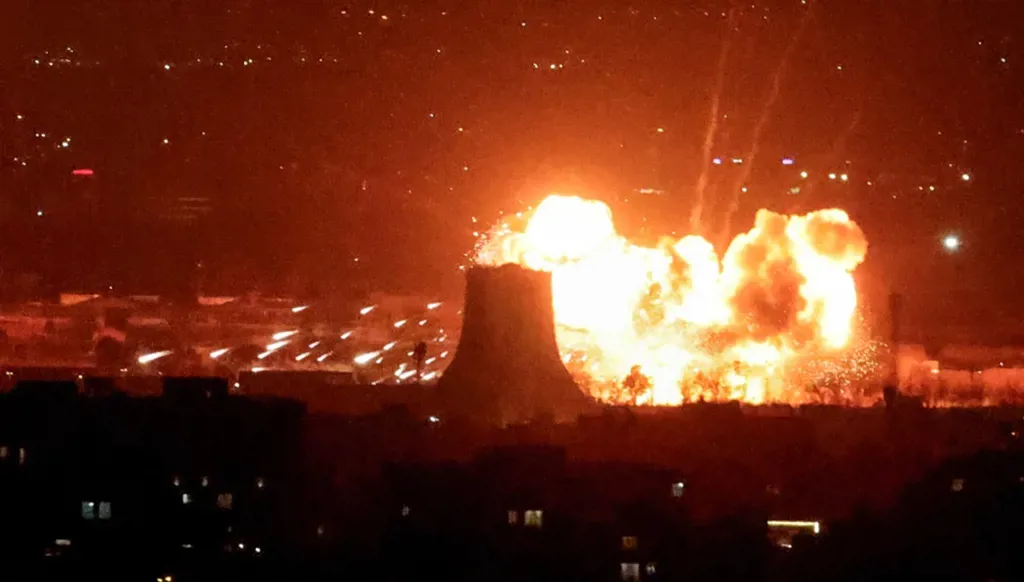
Massive explosion after airstrikes near Azadi Tower, close to Mehrabad International Airport on March 7, 2026. (AFP)
The American-Israeli war on Iran, which erupted in early March 2026, represents one of the most severe geopolitical threats the world has faced in recent years due to its implications for the balance of the international system. This war is not merely a regional conflict in the Middle East; it has become a true test for the future of the global order among major powers, especially amid the growing rivalry between the West and both Russia and China.
Since the outbreak of the war on Iran, the confrontation has taken on an increasingly international dimension, leading to significant disruption in global energy markets and threatening navigation in the Strait of Hormuz, a passage through which around a fifth of global oil trade passes, causing energy prices to rise and unsettling international markets.
The war is part of a broader struggle between two models of the international system: one led by the United States and its allies, and the other that powers like Russia and China are trying to establish by reducing Western influence in strategic areas such as the Middle East. This war could accelerate the reshaping of the international system and prompt more countries to reevaluate their strategic alliances.
China adopts a relatively cautious stance on the war, condemning the American attack on Iran and calling for de-escalation and a return to diplomatic solutions. Chinese officials have emphasized the need to respect Iran's sovereignty and to reject the use of force as a means of resolving international disputes.
Despite this, Beijing is keen to avoid direct military involvement in the conflict, as China relies heavily on the stability of the Gulf region to secure its energy imports and seeks to maintain its role as a diplomatic mediator in the Middle East rather than becoming a party to the conflict.
Thus, it can be said that Chinese policy is based on a mix of political support for Iran and diplomatic pressure to stop the war, while being careful not to engage directly with the United States.
For its part, Russia has taken a clear political stance in condemning the American and Israeli strikes against Iran, calling for an immediate cessation of military actions and a return to the diplomatic track.
Moscow has not yet shown a willingness to engage directly militarily in the war, despite its strategic relations with Tehran. Russia prefers to provide political and diplomatic support, and possibly technical support, to Iran, while avoiding a direct military confrontation with the United States. This is due to Russia's preoccupation with other strategic issues and its desire to avoid expanding the conflict into a direct confrontation between major powers.
Despite the political support provided by both Russia and China for Iran, the likelihood of their direct military involvement in the war remains weak at this stage. Both states realize that any direct military confrontation with the United States could lead to a serious escalation threatening international stability.
However, this possibility could change if the war expands to include other strategic areas. In such scenarios, Moscow and Beijing might seek to enhance their support for Tehran in different ways, either through indirect military assistance or political actions in international institutions.
Although tensions have increased, it is unlikely that the world will move toward a third world war at this stage. Nuclear powers, despite their differences, still understand that any direct confrontation between them could be catastrophic for the entire international system. The continuation of the war and its expansion could lead to increased international polarization and the widening of regional conflicts, creating a more tense and dangerous international environment in the coming years.
The Iran war reflects a new phase of transformations in the international system. While Western countries seek to maintain their influence in the Middle East, Russia and China are trying to bolster their positions in a multipolar global order.
Although the current conflict does not seem likely to evolve into a global war in the near term, it clearly indicates that the world is entering a new phase of geopolitical competition that could reshape the features of the international system toward a multipolar order in the coming years.
Disclaimer: The opinions expressed by the writers are their own and do not necessarily represent the views of Annahar.





 Messenger
 Whatsapp
 Threads
 Email
Email
 Print
Print
 X
X
 Facebook

