Despite the opening of diplomatic channels with Iran, U.S. President Donald Trump continues to push military reinforcements to the Middle East, as if war is inevitable. His goal is to convince Tehran of Washington's seriousness about resorting to force if the Iranian government does not demonstrate seriousness in the negotiations scheduled for Friday in Istanbul.
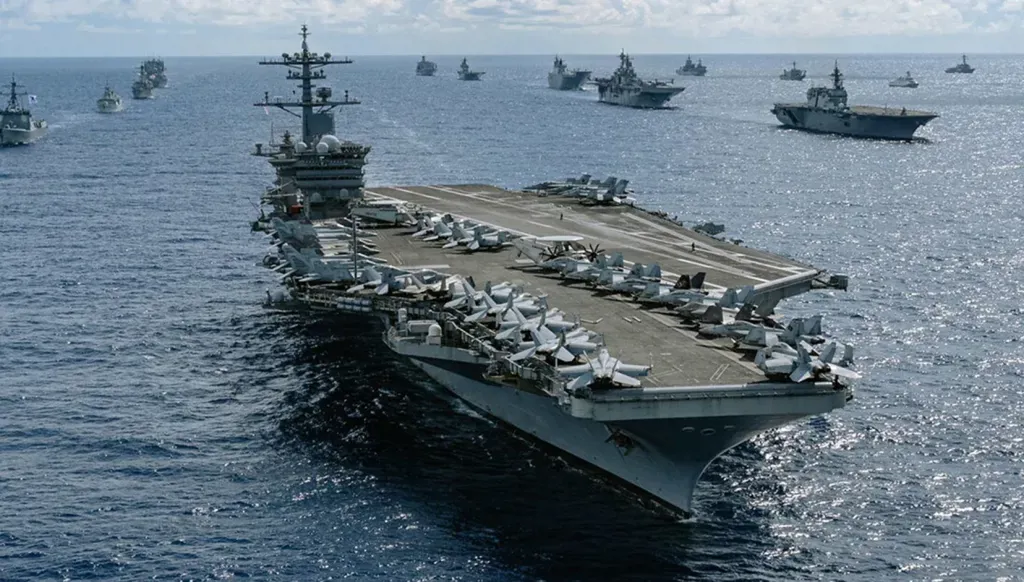
Trump often pairs discussions about the chance to reach an agreement with references to the “great fleet” sailing toward Iran, aligning with his slogan of “peace through strength.” He boasted after the June strike on Iranian nuclear facilities in Operation “Midnight Hammer” and similarly after the night arrest of Venezuelan President Nicolás Maduro in “Operation Resolve” on January 3.
In addition to the aircraft carrier Abraham Lincoln, nine American destroyers are deployed across the Indian Ocean, the Arabian Sea, the Red Sea, and the Mediterranean. U.S. forces have also deployed F-35 fighters in the region, along with F-35E fighters at Al-Salt Air Base in Jordan. Additionally, strategic bombers B-2 and B-52 can take off from both U.S. soil and the Diego Garcia base in the Indian Ocean.
Moreover, the U.S. has established an air bridge to strengthen its air defenses in the region with missile systems such as Patriot and THAAD. The latter system is known for intercepting missiles in the upper atmosphere and played a key role during the June conflict, when Israeli Arrow missiles nearly ran out. The U.S. produces 96 batteries of these missiles annually, and Trump has ordered production to increase to 400 batteries per year to meet growing U.S. military needs worldwide.
Western military analysts agree that the U.S. still needs several weeks to complete the preparations necessary for war. They believe that Iran’s response this time will be harsher than in its confrontations with Israel in 2024 and during the 12-day war in June. In that conflict, 14% of the 550 missiles Iran fired at Israel were intercepted, while Iran launched 14 missiles at the U.S. base Al-Udeid in Qatar, all but one of which were intercepted by American and Qatari Patriot missile defense systems.
The potential upcoming war is expected to be more severe on both sides. As a result, Israel asked Trump to hold off on striking Iran after he threatened military action three weeks ago if Iranian authorities continued to suppress protesters harshly. The Israeli request was based on their insufficient readiness to intercept potential Iranian missile launches in retaliation for any U.S. attack.
In recent days, Israeli military officials have been visiting Washington continuously, including Chief of Staff General Eyal Zamir and Head of Military Intelligence Aman, Shlomi Bender, to discuss preparations for a potential war with Iran. This comes as Iranian officials emphasize that their response to any U.S. strike, no matter how limited, would target Israel as well as American bases and ships in the region. U.S. Special Envoy Steve Witkoff, who is expected to participate in the upcoming negotiations with Iran, arrives in Israel today.
The incomplete American buildup was one of the main reasons Trump delayed orders to strike Iran. During this period, he is exploring the possibility that diplomatic efforts could yield results, potentially eliminating the need for a military confrontation.
Additionally, Trump has yet to clearly specify his exact demands from Iran. It remains uncertain whether he will be satisfied with a strict nuclear agreement that prohibits Iran from enriching uranium on its soil, or whether he will insist that any agreement also curtail Iran’s missile capabilities—recently labeled an “existential threat” by Israel, similar to concerns over Iran’s nuclear program. Will the agreement also address Iran’s regional influence?
All of this reflects the Middle East’s ongoing oscillation between war and peace.
Disclaimer: The opinions expressed by the writers are their own and do not necessarily represent the views of Annahar.





 Messenger
 Whatsapp
 Threads
 Email
Email
 Print
Print
 X
X
 Facebook