

Hezbollah’s Secretary-General signals readiness to attack as Trump threatens 'armada'
As Washington cranks up the pressure, Hezbollah signals readiness to strike on Irans behalf, a sign of weakness as the party looks to maintain its principle lifeline.



 Messenger
 Whatsapp
 Threads
 Email
Email
 Print
Print
 X
X
 Facebook
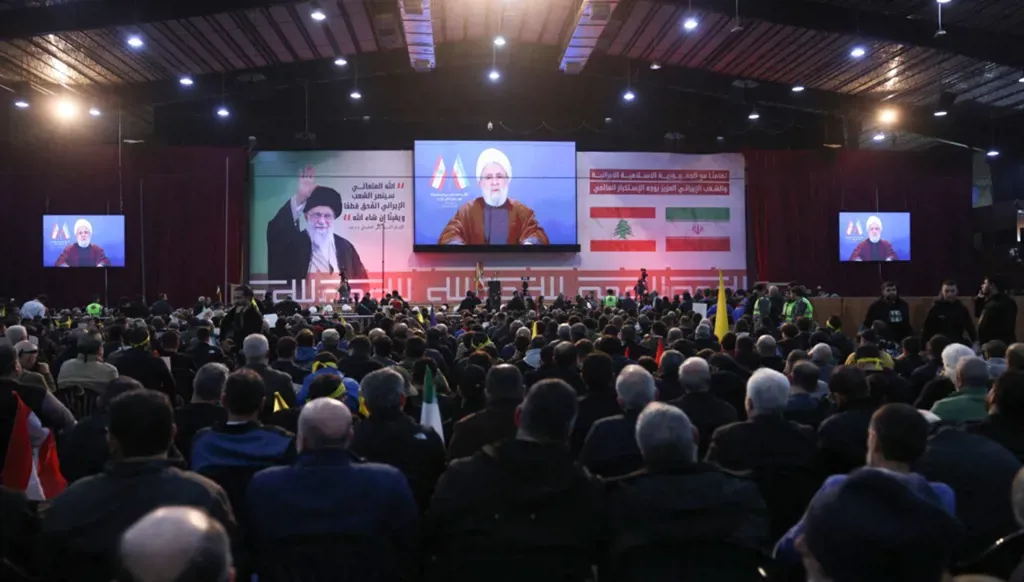


When Hezbollah Secretary-General Naim Qassem threatens action in any war involving Iran, he reveals the party's position of weakness. Qassem speaks in terms of possibilities, preserving Iran's tactical flexibility without committing the leadership to specific ultimatums. His statements are likewise consistent with those of pro-Iran factions in Iraq, showing the concerted effort Tehran is making to mobilize its remaining assets across the region.
This message from the party must also be seen in the context of disarmament. Recent statements made by President Joseph Aoun are categorical in the face of the party's mixed messages, which ranges from discontent to denial about their growing impotence. The only point of agreement appears to be the blending of crude, personal and political attacks against the President’s office, information campaigns which have prompted hearings and investigations.
As Parliament Speaker Nabih Berri and President Aoun present an increasingly united front, Qassem is forced to focus on quite different developments: the commotion caused by Trump’s “armada” in the region’s waters and the tense days leading up to possible strikes against Iran.
Having failed to repel attacks over the last few years, the Islamic Republic’s army and Revolutionary Guard Corps appear to be in a position of weakness. Indications include Supreme Leader choice to leak minutes of a session with late-Hamas official Ismail Haniyeh, condemning the “Al-Aqsa Flood” operation—which set off Israels war in Gaza. Nor has Iran stepped in to protect the Houthis in Yemen, or its affiliated factions in Iraq. When Bashar al-Assad’s regime in Syria reached the precipice of collapse, Tehran turned its back.
It is natural for Iran to act in accordance with its own interests. With fewer resources they must prioritize the home front over secondary theaters. The 1979 revolution in Iran embraced the cause rhetoric of the oppressed against an arrogant oppressor. Irony dictates that the modern-day oppressed would, in turn, repay the favor and seek to extinguish the regime it brought to power. While the Sheikh in Lebanon follows Iran's script, the Islamic Republic regards Hezbollah a marginal concern, to be sacrificed on the altar of the Republic’s security and the prosperity of its rule.
The opinions of Lebanon, its people, and its various factions—even among party’s base of largely Shiite supporters—do not matter. The decisions of the country’s government and president do not matter, and there is no room for discussion in Parliament, even as Qassem threatens war for a cause tens of thousands of kilometers away.
The party’s representative speaks his piece and departs. Meanwhile, the United States’ “armada” puts Lebanon on the map of potential targets, promising the country further malicious devastation and endless destruction. Lebanese Army Commander General Rodolphe Haykal, preparing for a previously delayed visit to Washington, will have to inform the armada’s operators that he, the army he commands, and Lebanon’s institutions disavow any responsibility for carrying Iranian messages delivered via a courier from Beirut.
Rational observers may not take the Sheikh’s words seriously. Since the official announcement of the end of its “support,” the party continues to suffer losses at Israeli hands—from the highest levels of field leadership down to the lowest-ranking fighters. The party lacks the means to respond. While its members remain unaware of the political significance and practical obsolescence of their leader’s threats, Iran only requires that the Sheikh speak the words—stuttered and confused, as if they were his last.
Disclaimer: The opinions expressed by the writers are their own and do not necessarily represent the views of Annahar.