

Lebanon’s Speaker Nabih Berri: We are all targeted in a volatile region



 Messenger
 Whatsapp
 Threads
 Email
Email
 Print
Print
 X
X
 Facebook
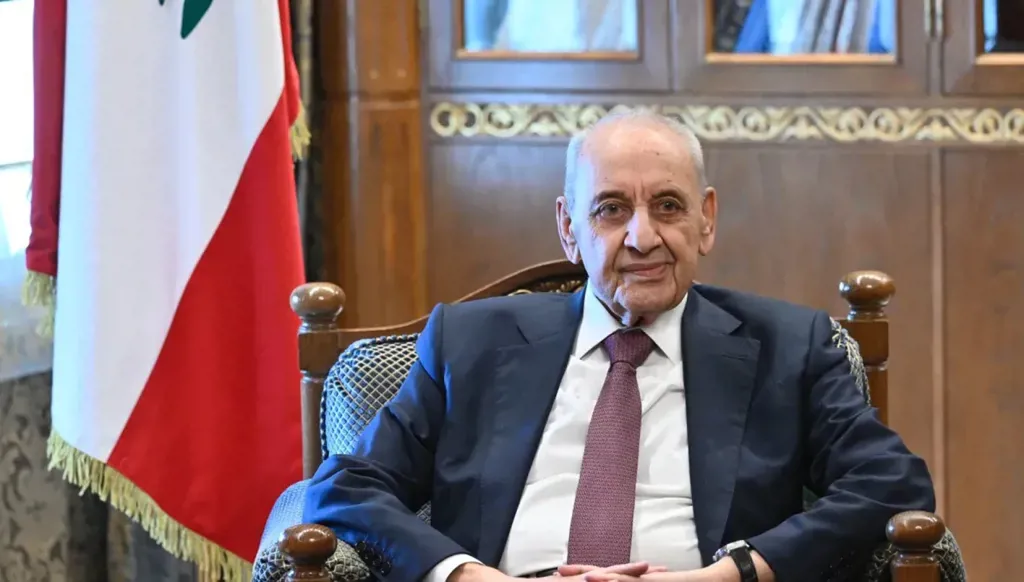


In a moment fraught with danger and amid a landscape riddled with security and political challenges, Lebanon's Speaker Nabih Berri has no choice but to urge all parties to “take the medicine of national unity” and forge a collective will to confront Israeli threats, while once again emphasizing the importance of holding parliamentary elections on schedule.
In the span of a single minute, Berri shifts from discussing Israel’s destruction of a building in Kfarhatta to addressing President Donald Trump’s policies, the ongoing demonstrations in Iranian cities, and the future of Venezuela.
A series of difficult questions weighs heavily on him at a time that is unfavorable for both the country and the region, as the Israeli balance of power shifts in the area. Yet this compels him to call on all parties - partly as a message - that while Israel may target the Shia, it poses a threat to all Lebanese, emphasizing that “we are all targeted.”
In response to a question from Annahar about whether he feels anxious
Berri neither denies this reality nor attempts to conceal it. He asserts that the weapon of national unity "remains the sharpest, and we should all resort to practicing it." He calls on all Lebanese to embrace this approach, fully aware of the existing divisions among parties, while emphasizing that "we must prevent Israel from continuing to violate the country. Everyone should understand that Israel threatens all of us, and if we stand united, we can confront these open threats and acts of aggression."
While Berri does not oppose the role or tasks of the “Mechanism” committee, he directs pointed remarks at them, criticizing their focus on merely observing Israeli breaches without enforcing adherence to the ceasefire agreement. “Hezbollah, on the other hand, has not violated the agreement in the slightest. Yet the Mechanism has failed to demonstrate the effectiveness required, and we can see how the French are being gradually sidelined from their role in it. While we will not abandon the Mechanism, it has, from its inception until today, failed to fulfill its intended function - especially given that Israel pays it no heed."
In response to critics of the “resistance,” he says, “It arose out of the occupation and the state’s inability to protect the people of the south. It would be unjust to deny what it has provided and the sacrifices made to liberate the south and all of Lebanon.”
He adds, “We [the Shia] are not war enthusiasts; like all Lebanese, we value life and seek stability. But Israel forced us into this confrontation, and our opposition was driven by national motives - not by external agendas. We will not accept the occupation of our land."
Despite all the unsettling circumstances, he agrees with President Joseph Aoun that Israel is not heading toward a major war - without, of course, relying on Benjamin Netanyahu’s plans.
Berri does not directly target the government or its head, Nawaf Salam, yet his words and quick responses hint at his concerns. He urges them to take a more active role in meeting citizens’ needs, to work on providing relief, and to implement the commitments outlined in their ministerial statement - particularly focusing on the reconstruction of the south and other affected areas.
On another note, Berri is closely following the deliberations of the Finance and General Budget Committee, aiming to see them completed and approved before the end of the month.
He emphasizes the importance of holding parliamentary elections on schedule, noting that the Ministry of Interior is overseeing the necessary preparations. He avoids commenting on remarks about voter entitlements “here and there.” Concerning the government’s draft amendment to the electoral law, he firmly reiterates his rejection, reminding them of the commitments made in the ministerial statement and stressing that the amendment should not affect voter rights. He insists that the current law be applied as is and rejects the proposed changes outright.
Araghchi "reassures" Berri
Berri closely monitors developments on the Iranian street, paying attention to both loyalist and opposition movements. He listened carefully to the explanations provided by Foreign Minister Abbas Araghchi, who “reassured me.”
Berri did not downplay the “economic disruptions” Iran has endured under a 45-year embargo, affecting everything “from olives to aircraft spare parts.” When asked about the future of the regime, Berri responded: "They have always supported us. They will remain Shia, and our creed is one."