

Lebanon on the brink: Hezbollah’s arsenal, Iranian pressure, and the shadow of Israel



 Messenger
 Whatsapp
 Threads
 Email
Email
 Print
Print
 X
X
 Facebook
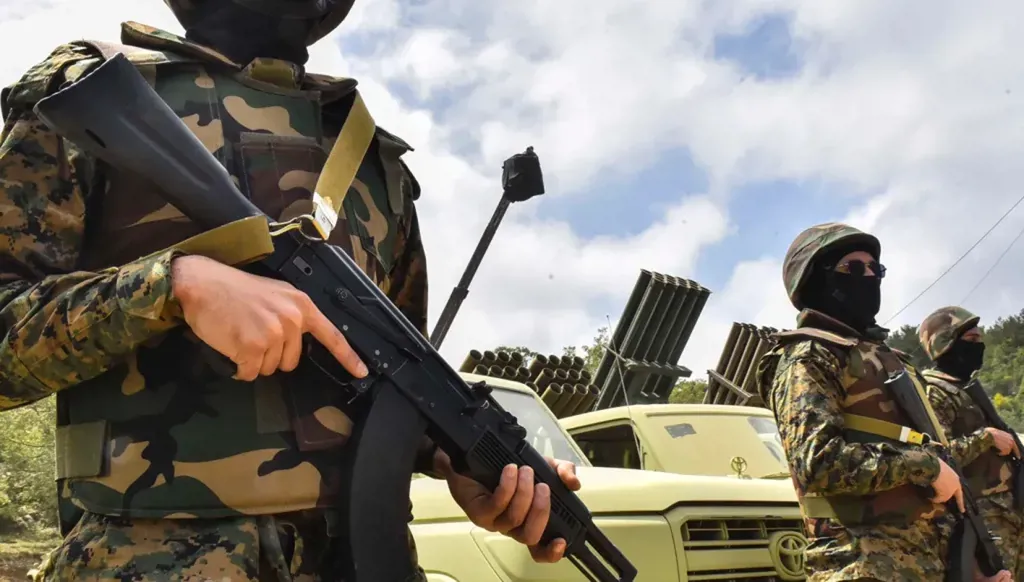


As the new year begins, the Lebanese government confronts a series of existential challenges, chief among them the issue of disarming Hezbollah. Reaching a decisive outcome on this sensitive matter required several months of negotiations last year, amid delicate internal political balances and mounting regional and international pressures.
The government has demonstrated a firm commitment to implementing its plan to disarm Hezbollah in the area between the Litani and Awali Rivers, viewing this move as both a reflection of public will and an international imperative. Official sources warn that the continued presence of weapons outside the state’s authority creates a dangerous status quo in Lebanon, one that could ultimately push the country toward undesirable outcomes, including forced normalization with Israel under the weight of security realities.
However, many observers argue that progress in curbing the proliferation of weapons remains too slow, while Hezbollah has openly refused to surrender its arms in the region. The Lebanese army faces an extremely challenging task, hindered by shortages in personnel, equipment, and resources, making it impossible to dismantle the group’s weapons both north and south of the Litani River simultaneously.
In response, the government, following the army leadership’s plan, opted for a policy of "containing" unauthorized weapons north of the Litani River. However, this containment strategy is not a substitute for full disarmament, prompting questions about whether it is merely a temporary, preliminary measure pending the complete dismantling of the group’s arsenal.
Hezbollah has agreed in principle to the concept of exclusive state control over weapons south of the Litani River. However, the group rejects the full implementation of 2024 Security Council resolutions and the ceasefire conditions, which explicitly call for the disarmament of all illegal weapons across Lebanon. The group has threatened civil war if the state presses forward with its plan, a rhetoric echoed by Iranian officials, widely seen as overt political pressure on the Lebanese government.
According to political sources, Tehran aims to use this period to reorganize Hezbollah and continue arming it, ensuring the group maintains its influence and control over Lebanese decision-making. This raises key questions: can the Lebanese Armed Forces confront the group if necessary, and what are the prospects for Lebanese-Israeli peace amid this complex and tense situation?
Legally, Lebanon remains in a state of war with Israel, meaning that any discussion of peace is contingent upon formal negotiations.
At the same time, the government is working to restore strong ties with countries that respect Lebanon’s sovereignty, prioritizing efforts to curb Iranian interference in domestic affairs, given that Tehran continues to be the main financier and backer of Hezbollah.
Relations with the United States remain strong, offering broad support to both the Lebanese government and armed forces, and acting as the only party capable of influencing Israel to refrain from targeting civilian infrastructure. However, Washington has expressed frustration over what it perceives as the slow pace of progress.
Observers note that Hezbollah is unlikely to relinquish its weapons without an explicit directive from Iran, which explains Secretary-General Sheikh Naim Qassem’s insistence on retaining the arsenal despite the clear risks. The group is aware that holding onto these weapons leaves Lebanon vulnerable to the possibility of a new war with Israel, which is determined to neutralize the threat along its northern borders.
This raises a crucial question: under what circumstances would Iran agree to relinquish Hezbollah’s arsenal? Would such a step require a comprehensive agreement between Washington and Tehran?
The alternative scenario could involve a large-scale Israeli escalation, potentially with tacit support from the U.S., international actors, and Arab states, which would be devastating for Lebanon. Even if Israel fails to fully disarm Hezbollah, such an operation could severely restrict the group’s ability to rebuild, while imposing a new political trajectory that pressures Lebanon toward significant settlements.
Disclaimer: The opinions expressed by the writers are their own and do not necessarily represent the views of Annahar.