

Carlos Ghosn to Annahar: “If Anyone Can Rescue Nissan, It’s Me”
In an exclusive interview, the former Renault-Nissan chief says he is ready to return, blames weak leadership for the automaker’s decline, and argues that politics, not law stands in the way of his comeback.



 Messenger
 Whatsapp
 Threads
 Email
Email
 Print
Print
 X
X
 Facebook
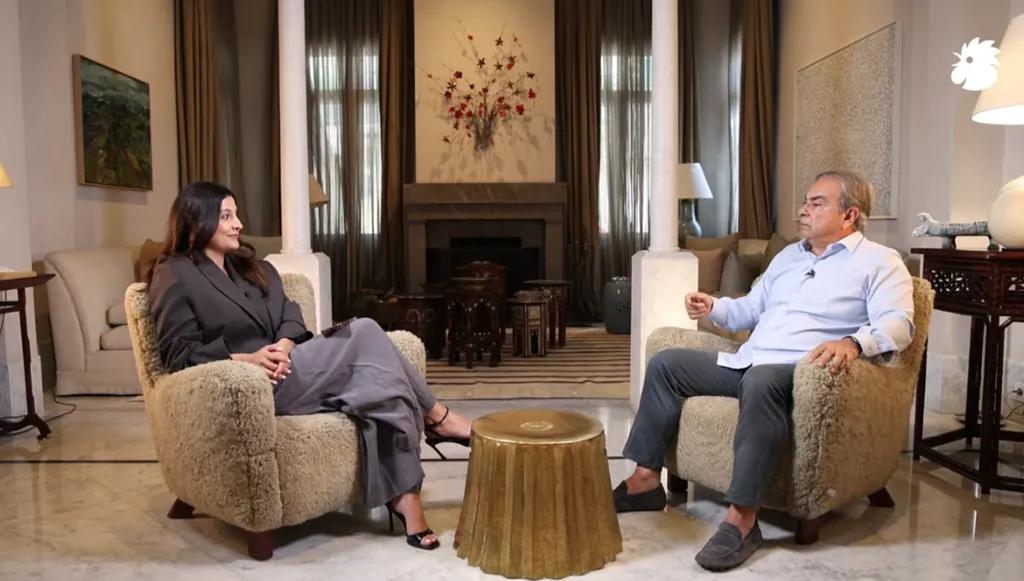


Years after his dramatic departure from Japan, Carlos Ghosn’s name has once again resurfaced at the center of Nissan’s crisis not merely as part of its past, but potentially its future. During a heated shareholders’ meeting, some frustrated investors called for the return of the former chairman of the Renault-Nissan-Mitsubishi Alliance, reflecting the scale of Nissan’s decline since 2019: a steep drop in its share price, falling sales, factory closures, and thousands of layoffs.
To recap, Ghosn’s legal troubles began in 2018 when he was arrested in Tokyo on financial misconduct allegations related to the alleged underreporting of compensation and misuse of Nissan funds—charges he continues to deny. No final criminal conviction has been issued against him in Japan, as he fled to Lebanon in late 2019 before trial. One of his former aides, Greg Kelly, was partially convicted in Japan for assisting in concealing Ghosn’s income and received a suspended sentence, but that ruling did not apply to Ghosn himself.
In France, Ghosn faces a separate case involving financial transfers and consulting arrangements within the Renault-Nissan Alliance. He has not been convicted there either. He is scheduled to stand trial in France in September 2026 on charges including corruption, influence peddling, and breach of trust, while maintaining his innocence.
In this interview, Ghosn speaks with a mixture of bitterness and confidence, arguing that Nissan’s current predicament is not the result of a temporary crisis but of what he describes as a “strategic mistake” and weak management. He believes the alliance that once dominated the global automotive industry has become an organization without real effectiveness.
While insisting he is innocent of the Japanese allegations, Ghosn says his return to Nissan may be politically difficult but is not practically impossible. He argues that he knows the company, Japan, and today’s automotive market better than ever and believes he could rebuild Nissan if given the opportunity.
After a shareholder suggested your name again for a return to the chairmanship of Nissan, can it be said that there are those who are indirectly admitting that your removal was a strategic mistake, not a legal or administrative one?
This reaction is normal, although it has come much later than expected. Many of the shareholders who attended the recent annual meeting are retired Nissan employees. They know the company intimately. They spent their careers there and, in many cases, even their children worked there. Nissan’s future matters deeply to them.
Between 2019 and 2026, they have watched Nissan’s share price collapse by roughly 80 percent. The stock traded at around $1,200 and is now worth about $30. Vehicle sales have fallen from approximately 5.5 million units to around 3 million annually—a loss of nearly 40 percent. When sales fall that dramatically, fewer factories are needed, which means fewer employees. Nissan has already announced the closure of seven factories and the dismissal of around 20,000 workers.
Meanwhile, the alliance with Renault exists largely in name only. The brand has weakened, the company’s strategy lacks clarity, and nobody really understands what the current management is trying to achieve.
Shareholders are simply saying, “Enough.” The company has spent six or seven years trying to rebuild itself without success. Naturally they ask: why not bring back someone who knows how to run it? That person is the executive who arrived in Japan in 1999, led Nissan for 17 years and delivered measurable results: profits, growth, and a rising share price.
I am saddened by what has happened to the company to which I devoted 19 years of my life, and I also feel for the employees I know personally. Around 130,000 people now worry about their future, and I am equally saddened for the communities where factories have been shut down and for the 20,000 employees who lost their jobs unnecessarily.
The fundamental mistake was that those who planned my removal believed Nissan would remain strong on its own, failing to realize that my departure was accompanied by the departure of more than 20 of the strongest executives I had personally selected and trained, since then the company has fallen into the hands of bureaucratic managers and slow decision-makers with no clear vision. Frankly, it reminds me of Nissan between 1990 and 1999, before I took over.
Some people say that your return to “Nissan” is politically and legally impossible, but it is necessary from a managerial perspective. Are you really ready to return if you are invited, or do you prefer to remain a witness to the collapse of the model you built?
Politically, returning would certainly be difficult, given how I left Japan and how well known that situation is. Legally, however, there is no real obstacle because none of the accusations against me have ever been proven. I left Japan before trial, so no verdict established my guilt.
If you look at the related Japanese court cases, the core allegations that were widely publicized were never ultimately established as originally claimed. For that reason, I believe this has always been more of a political case than a legal one. We even asked that the case be transferred to Lebanon so I could be tried here and bring the matter to a close, but that request was refused on the grounds that jurisdiction would not be appropriate and that the case should remain in Japan. If the judiciary functions independently I have no legal concerns, but if politics interferes with justice that becomes a different matter.
As for returning to save Nissan, I will be perfectly clear: yes. If anyone can rescue Nissan, it is me because I have the necessary experience for that and I have already done it once. I know the company, I know Japan, and I know today’s market far better than I did in 1999. The first time I became CEO I knew nothing about Japan, Japanese culture, or Nissan from the inside. Today I understand all of those things and, if I am given the opportunity, the task would be easier than the first time. Yes, I am prepared to do it, not because I want a title but because I feel a responsibility toward the company, its employees, its shareholders, the communities harmed by factory closures, and my own reputation after years of systematic attacks. Do I expect it to happen? Politically, it remains difficult. Those responsible have lost more than $30 billion through this entire episode, yet they continue insisting on the same course rather than admitting they were wrong.
There was clear chaos at the shareholders’ meeting, along with attempts to oust the current management led by Ivan Espinosa. What do you say today about the legal process and the cases related to ‘Nissan’?
If I had been sitting in that room as a shareholder, I would also have demanded that management be replaced because there is no clear strategy and no satisfactory performance at Nissan. The current CEO has held the position for about a year and a half but he was already part of the management team before taking the top job so he cannot pretend to have no connection to what has happened. For seven years management has repeatedly promised that factory closures and workforce reductions would improve performance yet the results never improved, and even worse they continue blaming Carlos Ghosn for everything which is simply false.
Between 1999 and 2018, Nissan did not post a single annual loss and the company grew continuously. We increased annual sales from around 2.3 million vehicles to 5.5 million and achieved record profits and record cash reserves. When I left, Nissan held approximately $20 billion in cash, while today the company is burdened by debt.
What troubles me most is the refusal to accept responsibility. When they make a mistake they don’t say, “We will fix it for the good of the company, the employees, the country, and Japan’s reputation.” Instead they persist in repeating the same mistake because admitting it would cost them politically and morally.
How severe is Nissan’s internal crisis if shareholders are openly demanding Carlos Ghosn’s return?
My return does not depend solely on Nissan but also on the Japanese government, and after everything that has happened I cannot simply decide to return on my own. What I can say is that I am capable of saving the company if the necessary conditions exist. When I became Nissan’s CEO in 1999, Renault’s chairman asked me what I thought my chances of success were, and I answered, “Fifty percent,” and we ultimately achieved extraordinary success.
Today I believe my chances would be greater than 50 percent because many of the obstacles that existed then no longer exist. I know Nissan and I know exactly what it needs, and I could assemble a world-class management team within days. The size of the challenge does not concern me, but what concerns me is the possibility that certain political and administrative actors involved in what happened previously could interfere again. I love Japan and I believe deeply in the Japanese people and Japanese employees, but some individuals behaved very badly, and while some have left the company, others remain within Nissan or around Renault, and they bear significant responsibility for dismantling everything we built.
Do you still believe the Renault-Nissan-Mitsubishi Alliance was a global economic powerhouse? Who bears responsibility for dismantling it?
Absolutely. In 2018, the Renault–Nissan alliance was the world’s number one automotive alliance. Today the alliance is no longer even among the top five or six, and everything we built was destroyed within six years, with responsibility lying with those who dismantled it.
The executives who succeeded me failed to deliver meaningful results, and Renault also bears responsibility, particularly its chairman and its representatives on Nissan’s board. Renault owned 43 percent of Nissan and watched the company deteriorate without taking meaningful action, which amounts either to negligence or complicity. Renault should have insisted that the alliance continue working together for mutual success, but instead its leadership accepted a weak and fragile relationship, and today I describe the alliance as a “zombie” that still exists on paper but has no real vitality.
The decisions that dismantled the alliance hurt not only shareholders but employees and entire communities. When you shut down a factory that employs six or seven thousand people, you put 15,000 to 20,000 people under stress and uncertainty because families, suppliers, and the entire local economy are all affected.
Why have shareholders, particularly small investors, revived your name?
Large institutional investors who lose confidence usually sell their shares and move on. Those who remain are typically smaller shareholders or people who still believe the company can recover. At Nissan, the shareholders speaking out are mainly small investors and retired employees whose hearts remain with the company. For them this is not simply an investment, it is the company to which they devoted the best years of their lives, which is why they finally said: “Enough,” and I believe they are right.
If you returned as Nissan’s chairman today, could you restore the company? What would your first priorities be?
Yes. I believe I could restore Nissan and perhaps make it even stronger than before, but the first step would be understanding the full extent of the damage from inside the company. I know Nissan’s capabilities because I helped build them, but today’s situation requires a fresh assessment.
The first priority would be rebuilding the Nissan brand. Second, I would assemble a strong leadership team capable of making fast decisions. Today’s management simply does not make the right decisions quickly enough. Given China’s rapid advances in technology, products, and vehicle design, hesitation is fatal. If you encounter difficulties in Europe, you do not abandon the market, you fight for your market share. A competitor who defeats you in Europe will eventually challenge you in Japan, China, and everywhere else. A company cannot keep retreating from every difficult market, and that mentality leads only to decline and, ultimately, death.
In your view, what is Nissan’s biggest problem today: strategy or decision-making?
The problem is both strategic and managerial at Nissan. I honestly do not know what Nissan’s strategy is, nor do I see management clearly explaining how it interprets today’s market or intends to compete. The CEO of a car company must monitor the market every day, understand competitors, and prepare for future developments, but that is not what we see today. Each new CEO arrives promising a new strategy, and two years later the plan collapses with nobody accepting responsibility.
When I took over Nissan in 1999, I made public commitments, saying: “If I do not deliver profits in the first year, I will resign,” “If I do not cut the company’s debt in half during the second year, I will resign,” and “If I do not achieve an operating margin above four percent, I will resign,” because that is how companies should be managed, with measurable objectives and direct accountability. What does not work is saying, “If this plan fails in America, we’ll try something else. If another market becomes difficult, we’ll simply withdraw,” and that approach cannot succeed in today’s intensely competitive automotive industry.
Finally, what message would you like to send to Nissan, its shareholders, and its employees?
Nissan still possesses enormous potential, but it needs clear leadership, a strong management team, rapid decision-making, a coherent strategy, and genuine accountability. The company cannot continue blaming the past for today’s problems. Everything that has happened in recent years stems from decisions made by the management teams that have led Nissan since 2019. If they truly want to save Nissan, they must admit that the current path leads nowhere and return to a culture based on responsibility and measurable results.
Nissan is a great company with a proud history, its employees are talented and its shareholders remain loyal, but great companies are not rescued by speeches; they are rescued by decisive leadership, by delivering on promises, and by accepting responsibility when those promises are not fulfilled.