

Ibrahim Nasrallah: Writing as resistance and the guardian of Palestinian memory
The acclaimed Palestinian novelist reflects on literature, history, and the power of storytelling to preserve identity and confront erasure.



 Messenger
 Whatsapp
 Threads
 Email
Email
 Print
Print
 X
X
 Facebook
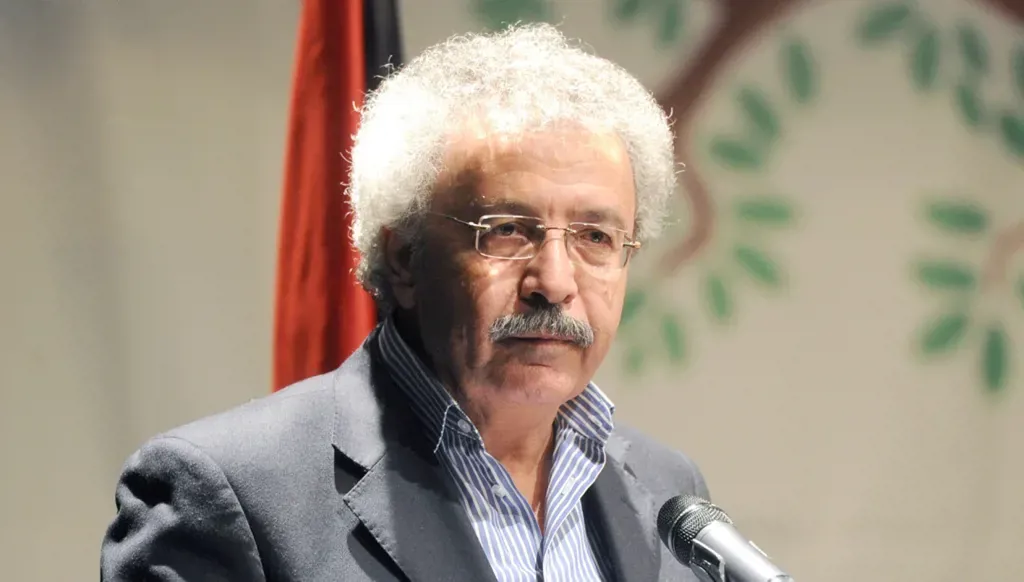


In the presence of Ibrahim Nasrallah, all you can do is listen, enjoying his storytelling and his opinions on various issues as much as his literature draws you in. You realize that his writings mirror his personality in clarity and biases, without fear of any loss.
He is the novelist who made his literature a guardian of Palestinian memory, tracing and refining it, refusing to allow history to be falsified. He reconstructs the Palestinian villages and cities destroyed by the occupation, so even if they disappear geographically, he is determined to revive them in his novels, turning his work into documentation and memory for generations.
It was not surprising that he became the first Arab writer to receive the Neustadt International Prize for Literature (the American Nobel) in 2025, awarded to those entrusted with memory and identity. This joins a long list of accolades, including the International Prize for Arabic Fiction, the Katara Prize for Arabic Novel, and the Sheikh Zayed Book Award, among others.
How did you receive the Neustadt Prize, and what does this recognition mean to you?
- The prize was established in 1970, and this is the first time it has been awarded to "a writer who writes in Arabic." I did not expect us to be part of this major award, as we are used to "international prizes" not being for us for many reasons. So it was a wonderful surprise, especially when I learned that many of the writers who won or were nominated were central to my personal culture: García Márquez won it, while Pablo Neruda and the great José Saramago were nominated but did not win. It is also different from all other world prizes in terms of its nomination and selection mechanisms.
Your award coincided with the genocide and aggression in Gaza. What did this timing mean to you?
- One reason for my great happiness with this prize is the context of its granting. The statement noted that it is based on my writings rooted in identity, exile, and resistance. Resistance is a term that is no longer mentioned in our Arab world or is expelled from our discourse. In addition, it is awarded to the "trustee" of collective memory, a description that had a deep impact on me, as we are waging a memory war with the Zionist enemy, who controls all forms of memory—whether journalism, media, or cinema—to cement its narratives and myths. Meanwhile, the prize’s shield carries the symbol of the "feather," referring to the Native Americans in Oklahoma who faced genocide.
Is resistance through writing a path imposed on you, or did you choose it?
- There are no pre-made decisions in writing; but when you begin, you discover that you are writing before you even know what you are writing. I started writing at the age of thirteen to express what I was experiencing in the camp, a place that symbolizes the world’s tragedies on a small scale—exile, uprooting, threats, and an uncertain fate. All the questions that trouble humanity were concentrated in this small spot.
Here, writing is not so much a choice as a need that grows with the development of awareness, driven primarily by the expression of a self that has been trapped and threatened since childhood and that develops over time. The worn-out shoes, the mud scattered along the path to school, hunger, and what friends, parents, and grandparents endure—all these details shape identity; they are the first and most critical elements that form a person’s identity in their early years.
Your journey is rich in places, and your memory of cities is deep. You were born in the Al-Wehdat camp in Jordan to parents displaced from the village of Al-Burj, educated in UNRWA schools in Jordan, and your life involved many travels. Which cities influenced you and left their mark on your literature?
- Every city certainly leaves its mark. I was connected to Cairo, which shaped us artistically and culturally through its extended civilizational dimension; its presence is part of our childhood and consciousness. Other prominent cities include Jerusalem, and I lived for two years in the Saudi desert, in the Al-Qunfudhah area, a place where one faces death many times. The camp also had a profound impact on me, alongside the absent village of Al-Burj, located a few kilometers from Jerusalem, one of the completely destroyed villages, built over with airports and Zionist weapons factories, sometimes hard to reach. When I could not reach it, I rebuilt it in the novel The Time of White Horses, as it was essential for me to see how my father, mother, grandfather, and the Palestinian people lived there. A destroyed or absent place must be reconstructed through effort so that it cannot be destroyed again.
Travel also left its mark, reflected in some works, such as the poetry collection The Fox’s Scandal, inspired by a visit to America, Just the of Us, from a harsh and tragic visit to an Arab country, and My Childhood Until Now, in which the place is represented by the camp. I wrote all of this in The Flying Biography, covering my writing journey over twenty-five years. Travel helped shape my awareness and exposed me to alternative perspectives, teaching me to meet and engage with foreigners, to be honest and direct, and to speak with them openly without fear.
You wrote The Flying Biography and My Childhood Until Now as autobiographical novels. When will you write a full biography of your life, and in what form, novelistic or otherwise?
- I once wrote, “In the novel, we confess, and our secrets remain ours.” There is a space that, if written in a traditional biography, can sometimes create a “problem,” but it can be expressed freely in a novelistic form. In The Flying Biography, I recounted part of my travel experiences, and I wrote about my childhood in the camp up to 1970 in Birds of Caution, which I consider the first part of My Childhood Until Now, a work more aware of the nature of biography. Generally, I avoid the traditional biography, as I did not want those who influenced my life to be mere passengers in successive chapters; I wanted them to be protagonists with me throughout the novel. I was pleased that readers considered its characters the heroes, and that the appreciation for these characters reached the audience. For this reason, I doubt I will write a biography in the conventional sense.
Your novelistic project The Palestinian Comedy covers more than 250 years of Palestinian history. After all these decades of writing, do you feel that the novel succeeded where official history failed?
- I believe much of Arab history, ancient and modern, is falsified. The falsification has reached catastrophic levels, because the scale of false heroism in narratives of the Palestinian cause is frightening: everyone was a hero, all armies victorious, so why was Palestine lost?
When you revisit Palestinian history before the Nakba, you realize that even distinguished historians overlooked many details. As a writer, when you read Palestinian history, you cannot accept what has been written about that period. For example, the most troubling figure I encountered was Fawzi al-Qawuqji in The Time of White Horses: everyone considered him a hero and revolutionary leader, but when I read about him and followed his biography from World War I onward, I discovered he was a careless, irresponsible figure, entrusted with his soldiers, and involved in opposing the Palestinian revolt in 1936 alongside Arab leaders. He was celebrated as a hero in Amman, then went to Iraq, and during the Nakba was appointed commander of the Salvation Army despite all this!
I wondered how no historian noticed this great theater. I feared the novel might fail because of this perspective, but Dr. Salman Abu Sitta, now a dean among historians, told me: “Ibrahim, you saw what we did not see.” That’s when I realized that we, as novelists, must monitor history, and history itself should fear the novel and benefit from it. The novel is no longer mere imagination and adventure—it is a way to read the world and historical periods responsibly. There is a major national and creative responsibility placed upon the writer.
With all the horror and genocide that has occurred, how does Ibrahim Nasrallah manage to write despite the psychological pain?
- This silence toward what is happening in Gaza, especially in the Arab world, cannot be met with silence—it is not a value but the peak of neutrality. Personally, I believe strongly in the power of writing, because other writers have changed me, and some books have reshaped my life. I owe Ghassan Kanafani for influencing me and changing my path when I read his books while teaching in Saudi Arabia; without him, I might not be who I am today.
Today, when I see the direct impact of what I write on people, I understand the meaning of this power. For example, receiving a message from a girl in Gaza saying she hesitated between buying bread or my novel and chose the novel—that moment outweighs all the awards in the world. Or when prisoners tell me my books made them feel outside the prison, or a girl read The Time of White Horses nine times in solitary confinement. All of this leaves me no doubt about the power of writing, and I believe in it as a reader even more than as a writer.
From your perspective, what do we lack to assert our existence and present our true image to the world?
- We exist when someone sees us and accepts the existence of another beside them. The Zionist entity does not accept another existence; we are not considered present on this land. Therefore, the struggle with it is a cultural, physical, and economic “struggle of erasure,” forcing us to be subordinate because it does not see us as equal human beings.
Still, the Palestinian experience offers the clearest example: the whole world may be against you, and yet you remain present. A hundred years of killing, neglect, and genocide did not erase this existence; rather, it confirmed that the insistence on presence is itself an act of resistance, and writing is one form of this insistence to be seen and recognized.
At present, which character would you like to write a novel about? Is there still a Palestinian voice that has not yet found its way onto paper?
- It is not important to write about a famous figure; the real heroes are countless, more important than many officially designated as heroes before us. Every prisoner, many Palestinian mothers, every child who has lost limbs—each carries a story worth writing. True heroism lies in its distribution among people, but writing gives them a chance to be powerfully present. The value of a character in a novel is that they are given enough depth to represent thousands of people, and when readers engage with them, they can say, “This is me.” This is where the importance of writing is revealed.
Works such as Gaza Weddings, Under the Midmorning Sun, and The Spirit of Kilimanjaro, which I consider central to my life, were written many years ago but still speak to the present moment. I wrote a work about Gaza twenty-two years ago, yet readers today feel it was written about Gaza now. When I revisit the scenes of drifting tents in My Childhood Until Now, they reflect what is happening today in Gaza. Writing allows you to capture more than one time period, and even the shifting tastes of generations of readers. Still, in the end, you are an “individual writer” who cannot cover everything. The project The Palestinian Comedy is an attempt to expand this horizon across a span from the 18th century to today: some chapters we write, others are written by different people, each striving according to their capacity.
How do you see the role of the Arab intellectual and writer at this critical stage of our contemporary history? What is expected of them toward the reader?
- The writer’s role is to produce literature that is good and honest, capable of reaching the reader’s heart—not only the Arab reader but everywhere. Writing is part of our history, memory, consciousness, and future. I am not pessimistic about the level of readership; there is a notable reading audience in the Arab world, and I believe the core reading power comes from women, followed by men.
By the way, Arab writers have paid heavy prices: some were imprisoned, others dismissed from work or pressured economically, and some even shot at. When newspapers, television, and school textbooks were tools of the state, the Arab writer belonged only to the people. This is what must always be relied upon: having essential writers capable of changing our lives. Imagine Palestine without Ghassan Kanafani, Mahmoud Darwish, Jabra Ibrahim Jabra, Emile Habibi, Samih al-Qasim, Tawfiq Ziad, or Ibrahim Tuqan—it would be a barren desert. The greatness of any nation lies in its culture and is measured by the number of its great creators.
You have a prominent role in writing the Palestinian narrative, which still relies on individual efforts, whereas the Zionist narrative has broad institutional support. Are you thinking of a project to gather these efforts within an institutional framework?
- We existed primarily because institutions did not; I cannot wait for an institution to act for the Palestinian cause and its memory. Every individual is responsible and must start from their own position. This is how I began The Palestinian Comedy project in the mid-1980s, without worrying about the results. The project grows when you are dedicated to it, not when you calculate its outcomes in advance.
We must start to confront this official and oppressive devastation without thinking about consequences—prison, travel bans, restrictions, or dismissal from work. If there is an idea that must be written, it should be written, and then you move forward. That is why I believe more in the power of the individual than in the power of institutions, especially in a world where the official often conspires against freedom and creators. If we do not act as individuals, our situation will worsen. I salute the brave ones who moved the world, starting from American universities and elsewhere, being expelled and paying heavy personal prices, making the condemnation of genocide a reality. Silence kills us as individuals and as a collective. Honestly, everyone must pay a “price” for everything to change.