

Finding Humor in a Broken Country: John Achkar on Lebanon, Life, and Laughing Anyway
In a candid interview, the Lebanese comedian reflects on the evolution of Arabic stand-up, the responsibility of satire in times of crisis, and the future he still sees for Lebanon.



 Messenger
 Whatsapp
 Threads
 Email
Email
 Print
Print
 X
X
 Facebook
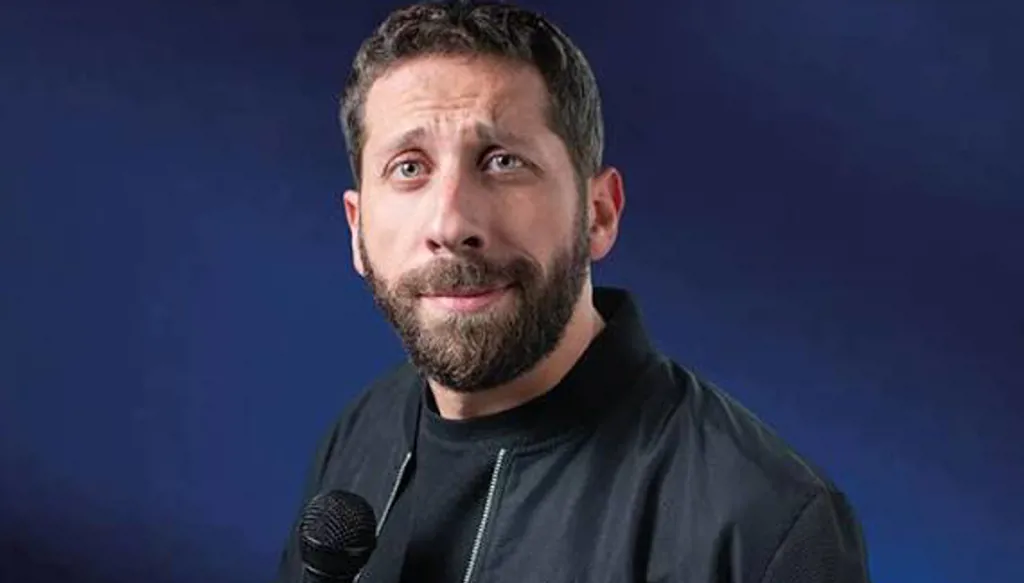


John Achkar, the comedian who is redefining Arabic stand-up with humor based on vulnerability and a critical look at Lebanon in crisis.
An economist by training, a graduate of Sciences Po Paris, and holder of an MBA, nothing destined John Achkar to become one of the essential figures of Middle Eastern stand-up. Yet, from Beirut to Dubai, by way of his consecration on the Shahed platform, the comedian is charting his path with one obsession: abandoning easy jokes at the audience's expense to tell the naked truth, even if it means shaking up the codes of a Lebanese society in perpetual crisis.
Filter-Free Encounter
The snowball effect: from MBA to the stage:
For many, becoming a comedian is a maturely considered life choice. For you, it looks more like a career accident...
I am not even sure I ever made the decision to become a comedian. I rather feel like I endured it! Everything happened through such a natural progression that I never took the time to evaluate this decision. It all started in 2011, during a fundraising project for the scouts: it was the first time I tried stand-up. Then, in 2017, I joined the Awkward Community collective which was launching the local scene in Beirut. When my videos went viral on social media, the snowball effect was immediate and totally unexpected. I had to stop everything I was doing in parallel, without realizing that this was going to become the profession of my life.
Interview:
Yet, your academic and professional background destined you for very different circles...
(Smile) Absolutely nothing to do with it! I did a bachelor's degree in economics at USJ (Saint Joseph University of Beirut), a master's in international relations with an exchange at Sciences Po Paris, then an MBA shared between Singapore Management University and Madrid. I then worked from 2012 to 2015 in the NGO world, notably for the Danish Refugee Council and Search for Common Ground. I even started my own company, Everything, which designs board games.
You also continue to lead leadership workshops in corporate settings. How do these two worlds cohabit?
In the beginning, the companies that hired me for facilitation workshops or keynotes told me: "John, please do not mention that you are a comedian, it doesn’t look very professional." Today, the momentum has completely reversed. These same companies demand me precisely because I am a comedian. They understood that this is exactly the vehicle that allows people to connect. For me, art and entrepreneurship go hand in hand. My comedy club is a business in itself, with its management hassles, its menus, its security... I spend 50% of my time doing show business entrepreneurship. You cannot be a comedian in the Arab world today just complaining about the lack of spaces; you have to create your own stage time.
The Death of "Crowd-work" and the Choice of Vulnerability
"Crowd-work has destroyed a very powerful thing in stand-up: community building. People today think that going to see a show means coming to be intimidated by a comedian."
Today you display a very firm position against "crowd-work", this practice which consists of interacting with and mocking the audience in the front row. Why this disillusionment?
I am in an open war against crowd-work. It is a shortcut that is too easy. Today, it is enough to mock a spectator, cut the video for TikTok, and you go viral. But this has destroyed the very essence of stand-up. Because of this, people enter the room on the defensive. If you spend your time on social media showing only that, the public comes to see a clash. Then, when they sit down and discover that you do storytelling, they are disappointed. Real stand-up is an hour or an hour and a half of narration. We don't make jokes, we tell stories. Without a deep and personal story to share, it's not stand-up, it's "joke making".
You have chosen to replace attack with vulnerability, by talking about your doubts, turning thirty, fatherhood. Is the Arab public ready to see a man crack his armor?
Vulnerability is a very recent form of leadership, inspired by figures like Brené Brown. The world is tired of macho, narcissistic leadership, à la Donald Trump. What I try to promote on stage is time for reflection. I go on stage at 35 years old and I say honestly: "Guys, I have no idea what I am doing." I have a two-month-old little girl, I don't know how to manage the end of my tour, and the public appreciates this honesty. People imagine that because you are viral, you have all the answers. It's false. My goal is to build a relationship of trust. If this trust is there, the public follows you everywhere, even onto the slipperiest slopes.
The Lebanese Absurd and the Syrian Scene
Can one be a happy artist in Lebanon, or is suffering the mandatory fuel for humor?
I have often been told that happy people have no story. I don't think that's true, because everyone has problems, whether it's a dispute with a valet parking attendant, an illness, or a war. What changes is the level of reflection that one applies to these problems to extract all their absurdity. If people laugh, it's because they realize that someone else has felt the same absurdity as them regarding what they experience on a daily basis.
Your writing sharpened in Beirut before exporting to Dubai in 2021. How do you handle this wide gap between the local audience and the diaspora?
Beirut taught me everything, notably to say things as they are. The scene there is extremely daring, especially since the 2019 revolution which broke many tabous. By settling in Dubai, I had to learn to make my content universal and "exposable". Abroad, my audience is composed of 50% Lebanese and 50% other Arab nationalities: Palestinians, Egyptians, Jordanians... and especially Syrians, who represent my largest audience. Last year, I played six shows in Damascus and two in Aleppo, in front of 500 people each time.
Playing in Syria right now is a bold choice...
(Laughter) To be honest, I find the security and political situation in Lebanon much more uncertain than in Syria! And then, I have immense affection for this audience. I often say, half-joking, that "all beautiful stories begin in Syria."
Breaking the Codes: From Religion to Pop-Culture
On stage, you spare no one. You scratch the pope of MTV etiquette Carmen Hajjar just as much as your wife's fertility tracking apps... Where does the red line stop?
If trust with the audience is solidly established during the first minutes, there is no longer any taboo subject. I talk about my very Christian education, my past with the scouts, and even the time when I was close to the Lebanese Forces. Today, I am married to a Shia woman. This sectarian contrast is the core reactor of our society, and I love playing with it to point out our contradictions. Some very conservative believers write to me to tell me that I am "close to the devil" because I shake up dogmas. But in reality, the most serious thing I can be blamed for is spending too much time on Instagram observing my followers!
You are the first Arab comedian to have a full one-hour show (*Amjadri) broadcast on the streaming platform Shahid (MBC). Is this a consecration?
It is a historical step for stand-up in the region. Moving from small 30-second viral clips on TikTok to a one-hour production on the largest Arab streaming platform is giving stand-up its letters of nobility. It proves that our dialect and our stories have a global cultural value. Today, I am testing my new show, Fina Nehke, in my own comedy club in Achrafieh, the Hidden Cellar.
The Political Fight Through Laughter
Lebanon is going through major systemic crises. What role must the comedian play in this stagnation?
I do not think there is a more powerful tool for social critique than humor. Politicians and bankers are afraid of ridicule. Today, we are fighting three crucial battles in Lebanon: against the corrupt banking sector, against Hezbollah, and against the suffocating weight of religious institutions. Comedians have a front-line role to play in these three fights.
Do you still believe in the future of this country?
My only hope lies in the current government of Nawaf Salam. It is a type of rational leadership that speaks to me. When he says honestly on television "I don't know how to fix this problem immediately, but let's think about it together", I believe him. That is why I refuse to see Lebanon as a simple attraction for expatriates lacking exoticism, who come to spend five days saying "Wow, Lebanon is a James Bond movie". No, the reality is hard. It is a market of broken dreams where, every two or three years, you are given a little hope before everything is taken back from you.
To finish, a crucial question: if you had to summarize the thirty-something crisis in Lebanon in one sentence?
It is the title I had given to my show in 2023: "Où est Aïch ?" (Where is life?). We spend our time looking for it, between two crises, a power outage, and a burst of laughter.
Identity Card (Unofficial):
Real date of birth: November 10, 1990 (Scorpio).
Official date of birth (on the ID card): October 1st. "My mother wanted to save me a school year. Result: it was useless, except to create an astrological identity crisis for me every year. I categorically refuse to become a Libra!"
Place of birth: Beirut, Lebanon.
Current show: Fina Nehke (played at the Hidden Cellar, Beirut) and on international tour. English show planned for the prestigious Edinburgh Fringe Festival in Scotland throughout the month of August.