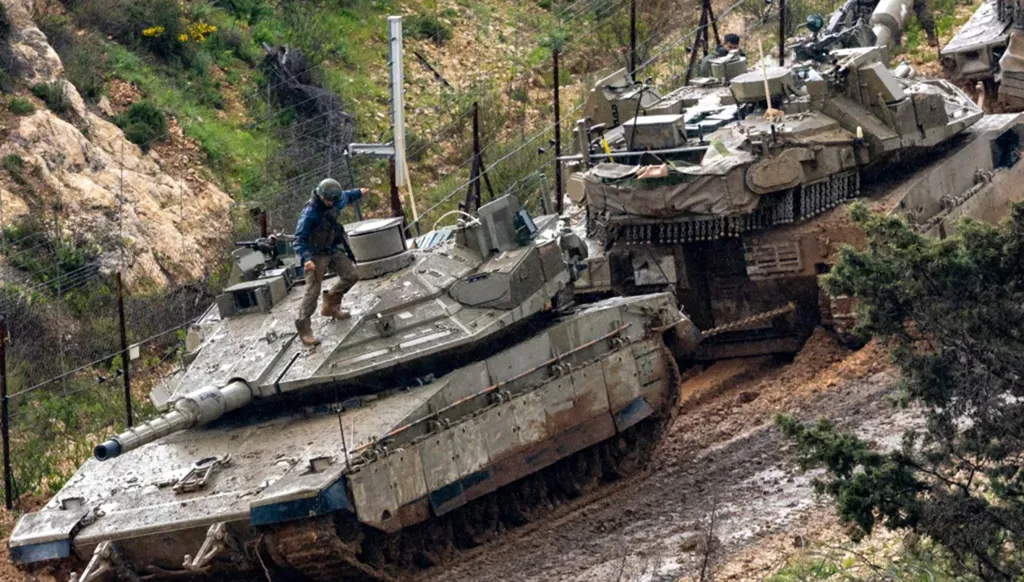
French President Emmanuel Macron expressed his view that Israel cannot disarm "Hezbollah," and that Israeli military operations on the ground and airstrikes in Lebanon are unacceptable under international law and do not serve the long-term security interests of either Lebanon or Israel. He noted that similar operations were carried out by Israel a few years ago with no results.
Macron also stated that France is working to support the Lebanese government in finding a solution and has taken steps, in coordination with the United States, to encourage both sides to engage in dialogue.
In addition, French diplomatic sources indicate that the U.S. administration is taking a wait-and-see approach regarding the Lebanese issue, as it has other priorities, and that its level of engagement should be higher. France has made efforts at the presidential level, with Emmanuel Macron in constant contact with U.S. President Donald Trump, and Foreign Minister Jean-Noël Barrot reaching out to his American counterpart Marco Rubio before traveling to Lebanon and Israel in an attempt to revive U.S. involvement. However, according to sources, the Americans appear to view managing the situation as Israel's responsibility, and the United States has yet to demonstrate a willingness to pressure Israel into engaging in discussions with Lebanon.
On the Lebanese side, Parliament Speaker Nabih Berri’s refusal to appoint a new delegation for negotiations with Israel—including a representative from the Shiite community—represents a major obstacle, according to diplomatic sources. These sources report that, while Berri did not oppose the principle of negotiation, he told the French minister that he sees no need to form a delegation representing various sects. He noted that there is a specific negotiator, Simon Karam, already assigned, and that expanding the talks to a team representing multiple sects is unnecessary. After all, can negotiations realistically be conducted with a group including representatives from 18 different sects?
Paris supports any Lebanese framework for negotiations in this regard, but its efforts have not yet resulted in a ceasefire. Separately, Barrot’s visit to Beirut prompted an increase in France’s humanitarian aid, raising it to 17 million euros.
The essence of the French analysis of the current Israeli stance is that Israel will not agree to a ceasefire in Lebanon even if the conflict with Iran ends. However, Paris believes that, despite Israel’s position, there is still room for negotiations between Lebanon and Israel. Accordingly, coordination with the United States will continue, and the remaining obstacles on both the Israeli and Lebanese sides can be overcome, as this is seen as the only way to end the war in Lebanon.
Paris confirms that Barrot told the Israeli side that any permanent occupation of southern Lebanon or any large-scale operation on Lebanese soil would be a serious mistake due to its disastrous humanitarian consequences. Such actions could also strengthen the unification of parts of the Lebanese population behind "Hezbollah," thereby reinforcing its legitimacy.
Among the key topics Barrot raised during his visit to Lebanon was the vision of the leaders he met regarding the deployment of the Lebanese army and the creation of an alternative to UNIFIL, which is scheduled to withdraw at the end of this summer and end its mandate in 2027. Discussions also focused on what should follow UNIFIL’s departure. It should be noted that 2027 marks the end of President Macron’s second term, and the future regarding his successor remains uncertain. There are concerns about the possibility of the far-right National Rally reaching the presidency, which could significantly alter France’s stance toward Lebanon.
Disclaimer: The opinions expressed by the writers are their own and do not necessarily represent the views of Annahar.





 Messenger
 Whatsapp
 Threads
 Email
Email
 Print
Print
 X
X
 Facebook