

Anghami’s CEO made a terminal for open-source intelligence: Iran put it to the test
Elie Habib’s World Monitor aggregates thousands of data points into a single intelligence feed, offering users the ability to navigate breaking news on their own terms.



 Messenger
 Whatsapp
 Threads
 Email
Email
 Print
Print
 X
X
 Facebook
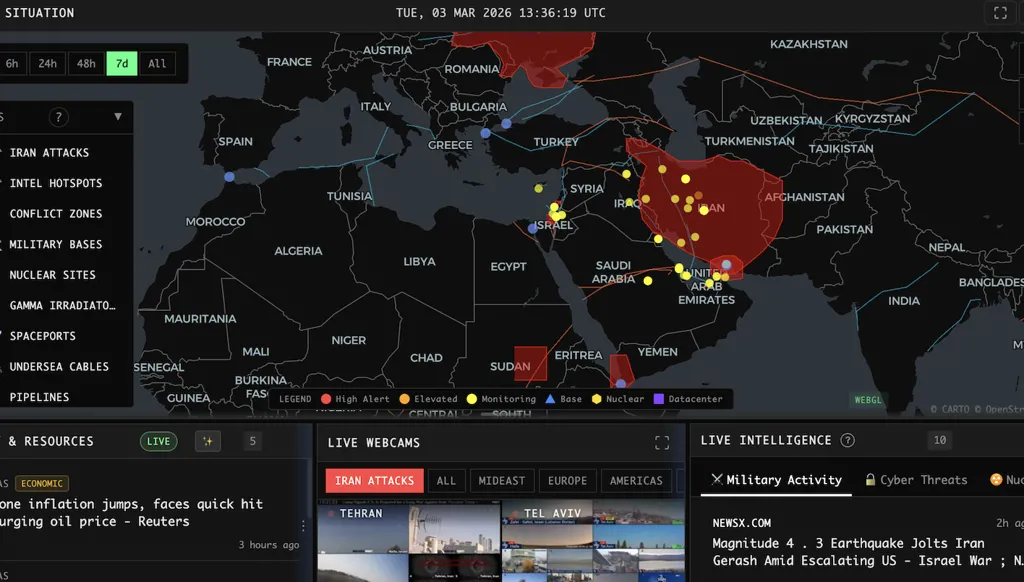


Curious what would happen if Iran closed the Strait of Hormuz? Want to map air-strikes against maritime traffic, commercial flights, and troop deployments?
On the first day of the war, over 150,000 people were answering these questions in the affirmative, navigating global developments with Elie Habib’s new World Monitor interface. The platform, which started as the Anghami CEO’s self-described weekend project, looks like something out of a Mission Impossible film. In an increasingly passive consumer landscape, it may represent a new way to consume media.
‘Zero editorializing’
Constantly refreshed by a series of AI-driven processes, World Monitor is part Bloomberg terminal, part Nasa control room, with a driving ethos of “zero editorializing.” Here’s how it works:
A series of confidence and severity scores sorts breaking news and data into discreet, credible signals for the heads-up display. The interface also conducts its own analysis, tracking correlation between patterns like shipping delays and naval maneuvers.
When World Monitor starts to notice a trend, the system surfaces an alert. In Habib’s words, “One signal is noise. Three or four converging on the same geography is worth watching.”
Habib describes World Monitor as a ‘tool’ in the traditional sense of the word, with users able to apply filters and track patterns on the console’s world map. Habib told Annahar he was shocked by the number of uses the community had found for World Monitor, from tracking data center clusters to air traffic over war zones. He even mentioned “a sports bar that has it instead of sports when there are no games on.”
Fast adoption
Habib told Annahar he released World Monitor last month and “almost forgot about it.” Ten days ago it started “blowing up” and has now had over a million visitors, with a sharp uptick since the war with Iran.
Habib said “we’ve been blown away by the community response” with the program seeing usage in 174 countries. In keeping with his emphasis on transparency, Habib has decided to make the platform open-source, meaning its code is publicly available for anyone to view, modify, and redistribute.
Still, the Anghami CEO told Annahar he is constantly adding new features himself—integrating Telegram sources, GPS jamming-detection, and Israeli siren alerts, all in the last week. Habib hopes the app will soon pivot “away from war,” and draw conclusions from patterns in peacetime. Until then, the application will serve as a helpful tool for anyone seeking to make sense of rapidly escalating regional developments.