

Gold regains status as global uncertainty deepens




 Messenger
 Whatsapp
 Threads
 Email
Email
 Print
Print
 X
X
 Facebook
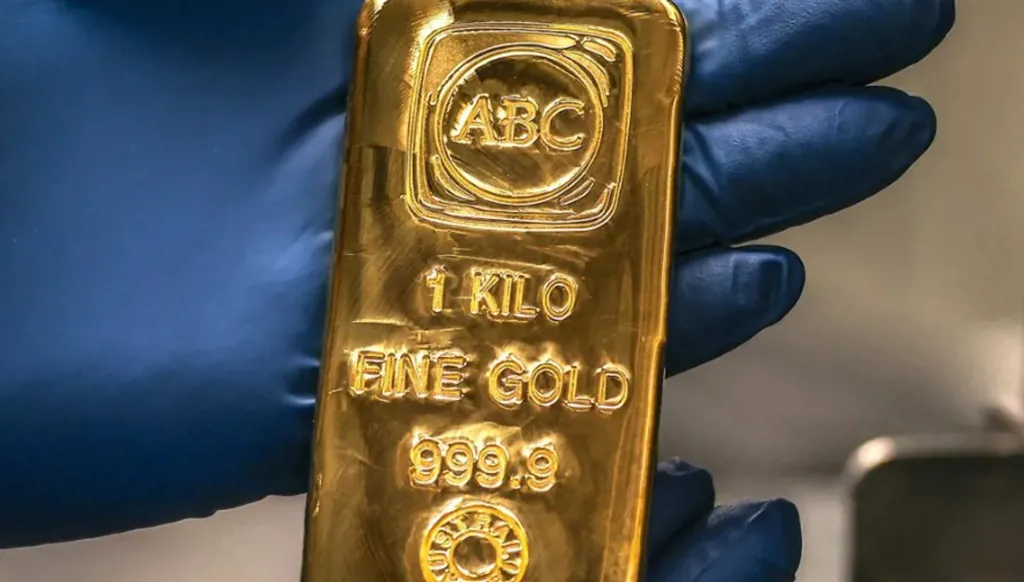


Historically, gold has maintained its position as a sensitive indicator of disruptions in the global system, with its price movements reflecting the level of anxiety and uncertainty that accompany major shifts. In every financial crisis or surge in international tensions, the yellow metal re-emerges—not merely as a traded commodity, but as an analytical signal of deeper disturbances affecting the structure and direction of the global economy.
Since 2023, global markets have witnessed a notable rise in gold prices, a trend closely linked to structural changes in the geopolitical and geo-economic landscape. Several analyses suggest that geo-economic factors have become the primary driver of gold’s trajectory, surpassing traditional political considerations amid the reshaping of global power balances and growing concerns over financial stability.
According to economist Ziad Nasreddin, these factors include “global tariffs imposed within the context of the U.S.-China conflict, particularly in the production, technology, and digital currency sectors. Added to this are the intensifying competition between the yuan and the dollar and the transformations associated with the digital economy, all of which have created an unstable global environment that has pushed investors toward safer hedging tools.”
From a supply-and-demand perspective, gold’s strategic value has clearly increased, driven largely by central banks—particularly in BRICS countries—which have purchased significant quantities of the metal in anticipation of risks linked to the U.S. economic outlook. At the same time, investment funds have strengthened their exposure to gold amid a decline in the U.S. dollar of between 11% and 13%, a widening U.S. budget deficit, and previous interest-rate hikes. Together, these factors have made gold a preferred instrument for both hedging and investment.
This trajectory is inseparable from geopolitical developments. As Nasreddin explains, “Uncertainty is tied to ongoing conflicts in the Middle East over vital corridors, as well as renewed tensions in Europe. The European economic slowdown and the unprecedented global debt crisis have also played a role.” U.S. debt has reached approximately $37 trillion, compared with a gross domestic product of about $25 trillion, while China is grappling with domestic debt pressures and a real estate crisis that signals economic slowdown. In Europe, total debt has exceeded €13 trillion, with Germany and France bearing a significant share.
These combined factors have reinforced gold’s status as a haven, particularly in 2025, when its market value recorded a sharp increase, and accumulated trading profits reached an estimated $14 trillion. According to Nasreddin, gold has evolved beyond a mere store of value to become a secure investment refuge.
The trend toward lowering interest rates in the second half of 2025 also played a pivotal role in supporting gold prices, with rates gradually easing from 4.25% to 4%, and then to 3.75%. This came amid political and economic tensions within the United States, expectations of leadership changes at the Federal Reserve in line with U.S. President Donald Trump’s policies, as well as new tensions related to Greenland and the Arctic and the imposition of tariffs on Europe, Nasreddin notes.
Nasreddin advises gold holders not to sell. “Gold may undergo correction phases or temporary declines, but historically it tends to return to an upward trajectory,” he says. He distinguishes physical gold and gold-related stocks, noting that “the latter are more vulnerable to sharp declines, while tangible gold delivers gains over the medium and long term.”
Projections also point to further interest-rate cuts in 2026, possibly more than once. This, according to Nasreddin, “supports demand for gold,” particularly as investment funds alone purchased around 699 tons last year, with expectations of continued buying at even higher levels. Some emerging-market central banks are also joining this trend, seeking profit differentials amid growing uncertainty about the future of the dollar.
Nasreddin believes that “2026 presents challenges similar to those of 2025, reinforcing the shift of investments toward gold.” He adds that rumors of selling and decline are largely tied to gold equities, while holding physical gold remains both a defensive strategy and an investment choice.
Historically, gold has experienced sharp downturns, but it differs fundamentally from silver in terms of the scale and drivers of global demand. Today, the United States holds about 8,122 tons of gold and still values the ounce at $43 in its official budget calculations—a figure unchanged since the dollar was decoupled from gold under former President Richard Nixon.
Against this backdrop, gold’s future raises fundamental questions about the possibility of linking it to digital currencies or re-anchoring it to the dollar, in line with moves by Europe, China, and the BRICS bloc to reduce reliance on the U.S. currency through local and digital alternatives. Meanwhile, oil price developments—particularly amid changes involving Venezuela—remain an influential factor shaping the dollar’s trajectory, and by extension, gold.
In summary, Nasreddin concludes: “Trade conflicts, supply chain disruptions, competition over sea routes, alongside debt, inflation, and wars, remain powerful forces. Together, they continue to reinforce gold’s status as a safe-haven investment, ultimately governed by the supply-and-demand equation in an increasingly turbulent world.”