

For Egypt's low-income workers, buying a burial plot can take longer than a lifetime
An analysis of advertised cemetery prices shows that even disciplined saving at the government minimum wage leaves burial plots out of reach for many Egyptians, highlighting the widening gap between incomes and asset prices.



 Messenger
 Whatsapp
 Threads
 Email
Email
 Print
Print
 X
X
 Facebook
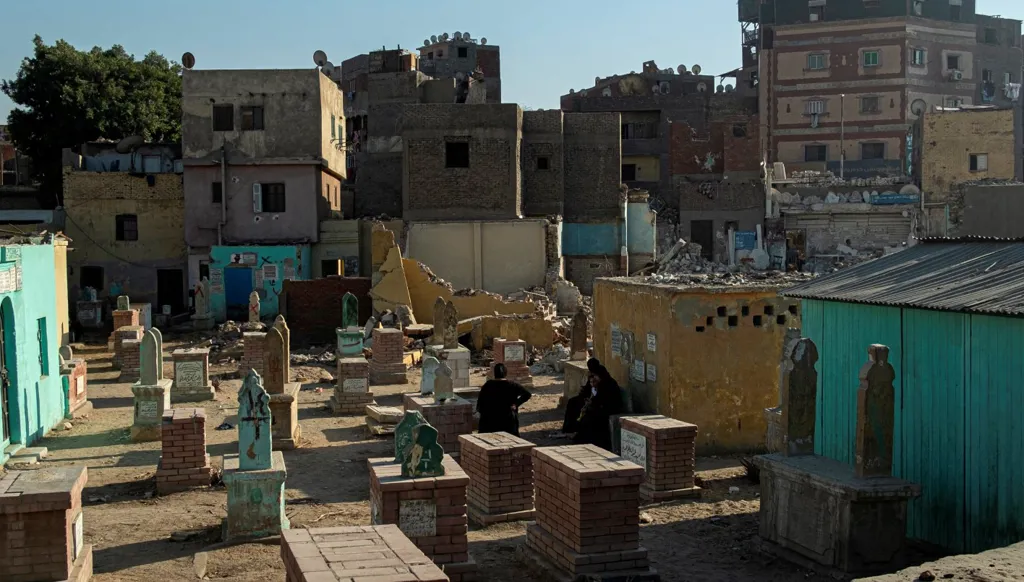


A sample of advertisements from Egyptian cemetery companies such as Al Rahman Al Rahim, Al Rawda, and Al Masria for Cemeteries and Burial Grounds reveals that the cost of a single burial plot could consume decades of savings for a low income worker and may even exceed an entire working lifetime.
Based on a monthly income of EGP 8,000 (about USD 161), which has been the minimum wage for employees in state institutions since July 2026, saving 10 percent of the salary, or EGP 800 (about USD 16) per month, means that the cheapest burial plot in the sample, priced at EGP 240,000 (about USD 4,840), would require 25 years of saving.
A burial plot at the median price of EGP 575,000 (about USD 11,600) would take around 60 years, while a burial plot costing EGP 1.8 million (about USD 36,300) would theoretically require more than 187 years.
These calculations do not take into account future price increases or the costs of finishing, transportation, and documentation. They also assume that the saver will not face any health or family emergencies during the saving period.
A Market Starting at About USD 4,840
The analysis was based on 16 advertised prices listed by the companies mentioned above after excluding listings that did not specify a burial plot price and instead left it to be negotiated between the customer and the company.
Prices for smaller burial plots ranging from 20 to 25 square meters varied from EGP 240,000 (about USD 4,840) in Geneva to EGP 600,000 (about USD 12,100) near Ain Sokhna Road and New Cairo's Fifth Settlement. The average price for this category was about EGP 450,000 (about USD 9,080).
Burial plots measuring 40 square meters ranged from EGP 350,000 (about USD 7,060) in Al Robiki to EGP 800,000 (about USD 16,100) in the Oasis Road, Tenth of Ramadan City, and Fayoum Road areas. The average price for this category was about EGP 681,000 (about USD 13,730), while the median price stood at EGP 750,000 (about USD 15,120).
.jpg)
Across the entire sample, the average burial plot price was about EGP 637,000 (about USD 12,840), while the median price stood at EGP 575,000 (about USD 11,600). The price per square meter ranged from EGP 8,750 (about USD 176) to EGP 30,000 (about USD 605), with an average of approximately EGP 20,000 (about USD 403).
The previous calculation assumes that burial plot prices remain unchanged throughout the saving period, an assumption that is difficult to sustain in an economy where prices continue to rise rapidly.
Annual consumer price inflation in Egyptian cities reached 14.3 percent in June 2026, down slightly from 14.6 percent in May, according to Reuters.
Egyptian economist Yasser Gharib told Annahar that this does not necessarily mean burial plot prices will increase at the same rate. He noted that household budgets remain under pressure and that many families have a declining ability to set aside a fixed portion of their income for savings.
If burial plot prices rise faster than wages or savings returns, the target price may remain out of reach even with consistent saving, turning the purchase into a race between income growth and the increasing value of the asset.
A Right of Use Rather Than Full Property Ownership
Gharib added that an advertisement stating "burial plot for sale" should not be viewed in the same way as an advertisement for an apartment or a residential land plot. Law No. 5 of 1966 governing cemeteries classifies public cemetery land as public property. Local councils are responsible for establishing cemeteries, regulating rights of use, and setting the applicable fees and rules.
He explained that in such cases, the transaction generally involves the transfer or assignment of a right of use, subject to approval by the relevant authority, rather than the outright ownership of the land as private real estate.
Therefore, before paying any down payment, buyers should verify that the cemetery is properly licensed, confirm which authority has jurisdiction over the land, examine the legal nature of the documents being offered, ensure that the right of use can be officially transferred, and register the new beneficiary with the relevant governorate or city authority. Buyers should also confirm that the quoted price includes construction, finishing, utilities, and administrative fees.
The Cost of a Final Resting Place Exceeds an Entire Working Life
According to Gharib, a worker earning the government minimum wage and saving 10 percent of their income would need between 25 and 188 years, based on the prices examined in the study, to purchase a burial plot outright.
The scenario that best represents the sample indicates that it would take around 60 years to save enough for a median priced burial plot, while purchasing a 40 square meter burial plot at the median price of EGP 750,000 (about USD 15,120) would require more than 78 years.
Gharib concluded: "Burial plot prices no longer reflect only the cost of land and construction. They also reveal a much wider gap between asset prices and Egyptian household incomes, a gap that makes securing a burial place a long-term financial commitment, one that is just as difficult for low-income families as saving for a home down payment."
Disclaimer: The opinions expressed by the writers are their own and do not necessarily represent the views of Annahar.