

Syrian People’s Council inaugurates new transitional phase of institutional representation



 Messenger
 Whatsapp
 Threads
 Email
Email
 Print
Print
 X
X
 Facebook
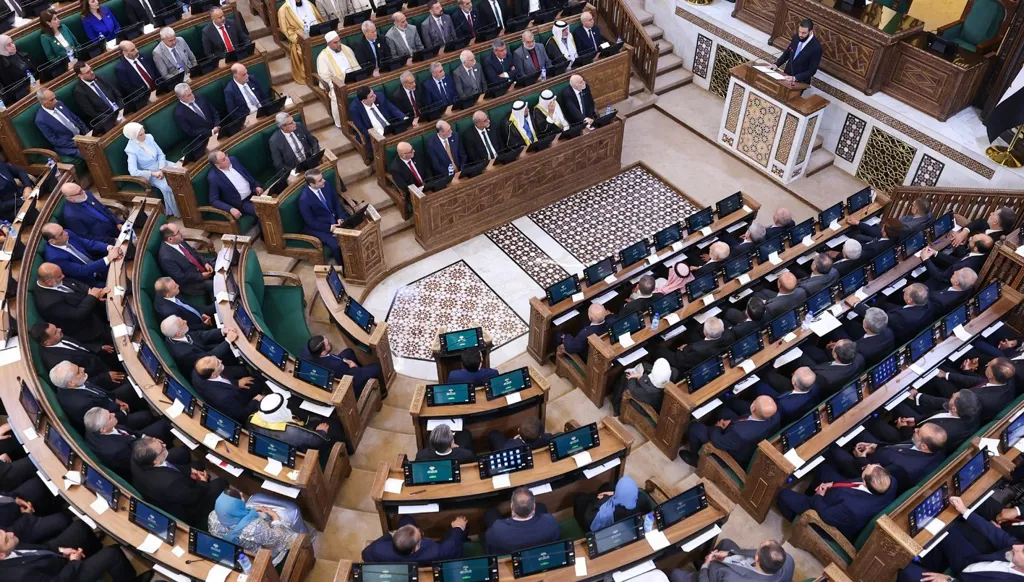


The first session of the Syrian People's Council carried significance beyond the election of a president, vice-presidents, and a secretary. It completed a key pillar in the institutional structure of the transitional phase, following the presidency, government, and constitutional declaration. It also provided Damascus with an opportunity to present itself externally as an authority gradually moving from governing the country through executive decisions toward constitutional and legislative institutions.
The session generated two opposing interpretations. Supporters viewed it as a step toward stability and the revival of state institutions, highlighting the absence of applause and chants that had characterized the councils during Bashar al-Assad’s era. Critics, however, argued that completing the institutional framework does not necessarily guarantee institutional independence, warning against the reproduction of a centralized authority that could restrict legislative independence, freedoms, and fair representation.
The council consists of 210 seats, with 206 members attending the session and four seats remaining vacant. President Ahmad Al-Sharaa appointed one-third of the members. The authorities justify this arrangement by citing the difficulty of holding general elections after years of war, while critics see it as an entry point for expanding presidential influence within the council.
External Gain and Testing Texts
The convening of the council received international and Turkish approval as a milestone in Syria’s political transition and institution-building process. However, the session, which was expected to establish an authority capable of safeguarding constitutional texts, began with procedures that raised legal questions.
Activists circulated instructions on managing the opening session before it was held. Later, the head of the Supreme Election Committee, Mohammad Taha Ahmad, opened the session and called on members to take the oath collectively before handing over the chairmanship to the senior member. This occurred despite Article 39 of the electoral system assigning the task of administering the oath to the senior member.
Members used the shortened oath formula stipulated in the constitutional declaration instead of the longer formula outlined in the electoral system, which includes commitments to respect the constitution and the law and preserve the unity of the country. While collective oath-taking is not explicitly prohibited, it does not allow for public verification that each member has taken the oath required to acquire their status and immunity.
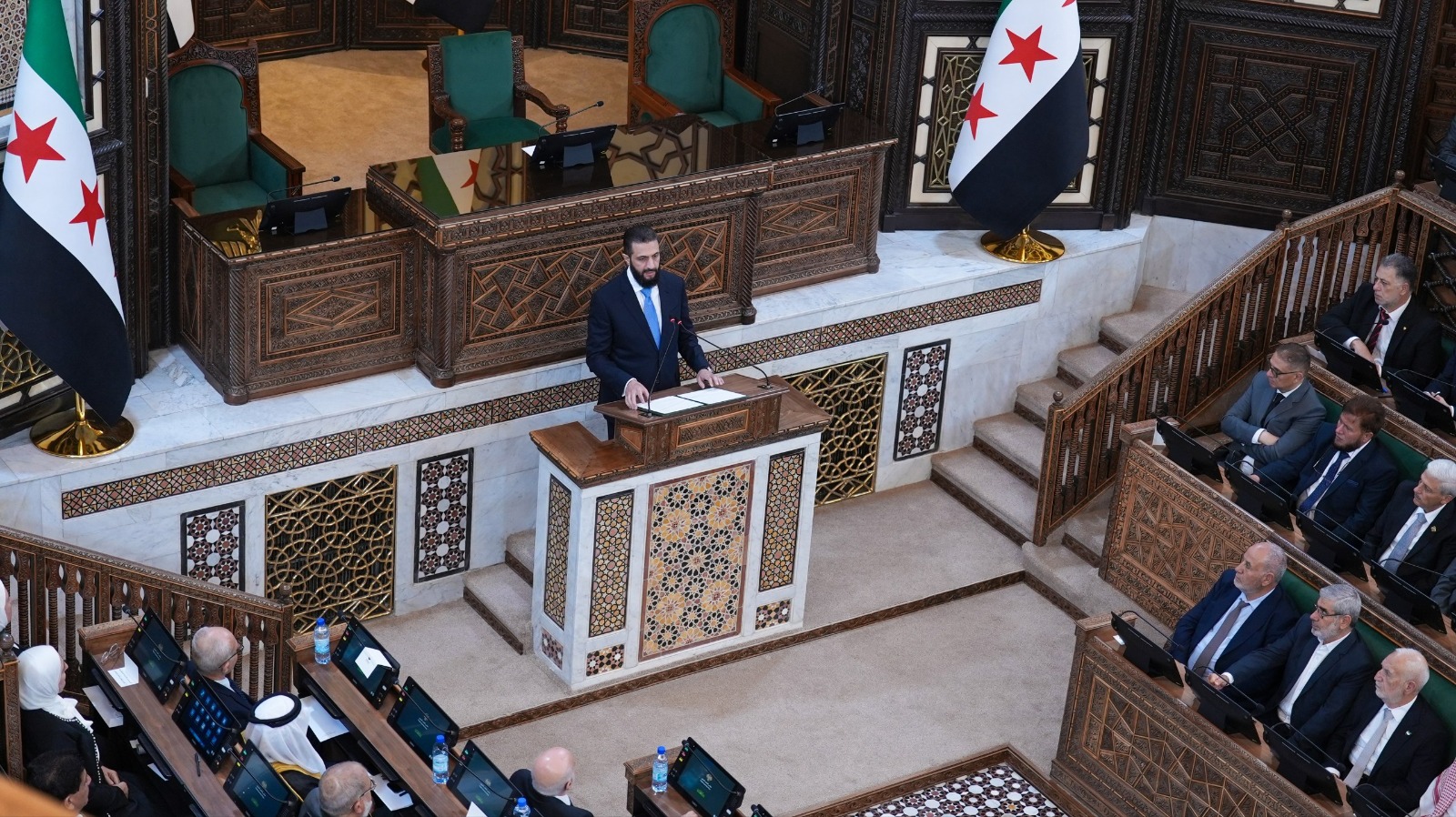
Ahmad also attended the session and delivered his speech during the first meeting, although Article 40 stipulates that the elected president of the council should invite him to the second session. These developments do not prove an intentional violation of the law, but they reveal a selective approach to managing texts that were intended to guarantee the council an independent formation.
Competition within the Circle of Power
The election of the council president appeared as a competition between three candidates. Abdulhamid Al-Awak received 99 votes, Moeid Al-Qablan 75 votes, and Muhammad Ramiz Kourj 31 votes.
However, Al-Awak and Al-Qablan, who secured the highest number of votes, were among the 70 members appointed by Al-Sharaa. Al-Awak chaired the Constitutional Declaration Committee and is associated with the authorities, while Al-Qablan is known for his proximity to them and his media defense of their policies. As a result, the main competition appeared to be between two figures from the same circle rather than between the authorities and an independent candidate.
Leaks published by Jeanbot Shaqay and Mohammad Saboubi before the session, regarding meetings and pressure to withdraw candidates and reach a consensus list for the council’s leadership body, also emerged. Saboubi reported, citing his sources, that “members’ phones were confiscated during a meeting with Al-Sharaa,” and that the president “criticized cliques and regionalism and proposed a list of names to choose from.”
While there is no independent confirmation of all these details, the withdrawal of candidates, the postponement of the session, and efforts to form a prior consensus lend some credibility to the general direction of these accounts. Figures close to the authorities justify such intervention as an attempt to prevent quota-based arrangements and polarization, while critics argue that blocs are a natural method of organizing work within any parliament.
Representation that Raises Questions
Aleppo, which holds the largest bloc in the council with 46 members, was excluded from the leadership body after Azam Khanji and Mohammed Yasin withdrew, leaving Kourj as the remaining candidate. Accusations were directed at Khanji over alleged links to an organizational decision by the Muslim Brotherhood, although no clear evidence has been presented to support this claim.
The Muslim Brotherhood itself welcomed the convening of the council and called for a permanent constitution, a party law, and pluralistic elections, without endorsing a candidate or objecting to the results.
Damascus was absent from the leadership body, while Moeid Habib represented the city of Daraya in the position of secretary, the least influential of the council’s leadership posts. Al-Awak is from Hasakah, in the east, a region already represented in senior positions, while his rival Al-Qablan is from Daraa, which did not secure a prominent sovereign position despite its symbolic importance in the revolution.
The first vice-presidency went to Mustafa Mousa, the former president of the General Shura Council in Idlib, while the election of Christian academic Madonna Beshara as the second vice-president added female and Christian representation.
The absence of a Kurdish member from the leadership body revived criticisms raised by 24 Kurdish parties regarding the mechanism through which the council was formed, arguing that Kurdish representation was limited to only four seats. This issue becomes more significant amid the continued implementation of the agreement between Damascus and the Syrian Democratic Forces (SDF), which is under international monitoring, and as Security Council statements emphasize the integration of Kurdish representatives into state institutions.
If the representation of a component with political and organizational weight, whose integration process is being followed internationally, remains absent from the council’s leadership, then guarantees for less influential groups and regions become increasingly unclear.
These imbalances do not call for ethnic or sectarian quotas, but they highlight the absence of declared standards for evaluating representation based on population size, geographic weight, and political influence.
The session achieved an institutional gain for the authorities and opened a space for competition, but many of its boundaries were drawn before the ballot boxes opened. The absence of applause represents a symbolic break with the past, while political change begins when differences, blocs, and oversight become recognized rights rather than viewed as sources of suspicion.