

Sheikh Mohamed bin Zayed's Kuwait visit signals new Gulf security doctrine
Coming just hours after Iran's attack on Kuwait, the UAE President's visit underscored Gulf unity, collective security, and the need for a stronger regional response.



 Messenger
 Whatsapp
 Threads
 Email
Email
 Print
Print
 X
X
 Facebook
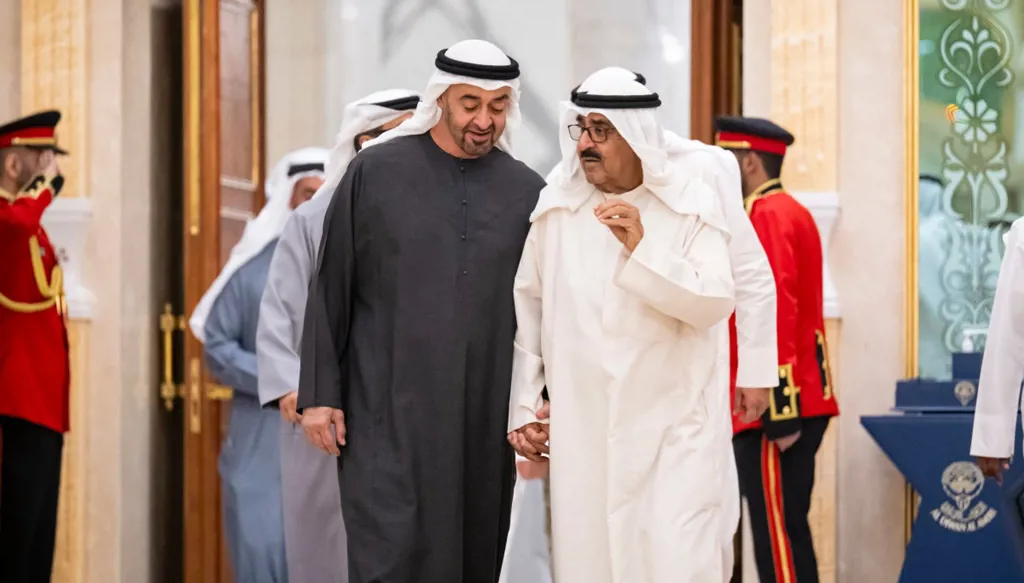


The visit of His Highness Sheikh Mohammed bin Zayed Al Nahyan, President of the United Arab Emirates, to Kuwait came just hours after the unjust Iranian attack, carrying significance that extended far beyond solidarity between two brotherly nations.
In the difficult hours following the attack, the UAE chose to demonstrate its support at the highest level, reaffirming that Kuwait's security is an integral part of Gulf security and that communication among Gulf leaders continues even amid heightened threats.
The relationship between the UAE and Kuwait has deep historical roots tied to the founding vision of the Gulf Cooperation Council and its journey since its inception. The importance of the visit also lies in what it represents for the Gulf states during and after the war. The conflict has exposed the scale of threats facing cities, critical infrastructure, and maritime routes, making it clear that the Iranian threat extends to all GCC members, regardless of their individual approaches toward Tehran.
For that reason, speaking candidly is more appropriate than merely discussing the restoration of Gulf relations. Those relations remain intact, but recent events call for an honest review of the positions taken during the most serious security crisis the GCC has faced. While every state has the sovereign right to make its own decisions, attacks on Gulf countries require a stable minimum level of political, media, and security coordination. Sovereignty carries the same value for every state, and the notion of a shared destiny loses its meaning if it remains confined to statements.
At the same time, unity of position does not require GCC states to adopt identical policies or rhetoric. What is needed is agreement on the fundamental principles that govern responses to a common threat, foremost among them clearly identifying the aggressor, rejecting any violation of a Gulf state's sovereignty, sharing information, and coordinating diplomatic and media efforts during times of crisis. Differences in assessing certain issues are natural, but hesitation in the face of a direct attack only enables the adversary to exploit divisions and weaken the Gulf position.
The Gulf divergence during the war was not between supporters of peace and supporters of war. All Gulf states share a direct interest in preserving stability and protecting their development projects. The difference lay in assessing the cost of confrontation versus the cost of de-escalation. Recent attacks have demonstrated that flexibility alone does not alter Iranian behavior, and that dialogue without leverage provides the Iranian regime with additional room to maneuver.
The challenge with Tehran extends beyond its diplomatic rhetoric. Iranian Foreign Minister Abbas Araghchi speaks of de-escalation and good neighborly relations, while the Revolutionary Guards continue targeting commercial vessels in the Strait of Hormuz and launching attacks against Gulf states. This contradiction between words and actions undermines the credibility of any future understanding and makes conduct on the ground the true measure of future relations.
Iran now faces a choice: either integrate into the region based on the principles of sovereignty and shared interests or continue down a path of isolation and attrition.
Reorganizing the Gulf house begins with developing the concept of collective security, particularly in air defense, the protection of maritime routes, and military and cyber capabilities. These areas require faster integration that goes beyond traditional coordination mechanisms. The concept of deterrence must also expand to include diversifying energy routes, linking ports and rail networks, protecting supply chains, and developing defense industries, thereby translating the lessons of war into lasting policies.
The UAE's model offers a compelling formula that combines effective military strength with a successful development strategy: a strong national state, a diversified economy, broad international partnerships, and determination when required. Development is not a substitute for strength, nor is strength an obstacle to development. Bringing the two together gives the Gulf a stronger voice in a global order that is reshaping its priorities in energy, trade, defense, and technology.
The visit of Sheikh Mohammed bin Zayed to Kuwait spoke volumes through its timing, level, and implications. The Gulf now has an opportunity to transform the lessons of war into a serious reassessment of its operational framework, strengthening its ability to protect its states and safeguard its interests. Strength creates the conditions for peace, and Gulf solidarity finds its true meaning when it is demonstrated in times of hardship and translated into both words and action.
Disclaimer: The opinions expressed by the writers are their own and do not necessarily represent the views of Annahar.