The Strait of Hormuz becomes the battleground for a broader US-Iran Showdown
With Tehran and Washington locked in a struggle over freedom of navigation, retaliation, and nuclear negotiations, the fate of the Strait of Hormuz has become the key obstacle to diplomacy and a potential trigger for a wider regional war.



 Messenger
 Whatsapp
 Threads
 Email
Email
 Print
Print
 X
X
 Facebook


There is no common ground between the United States and Iran regarding the Strait of Hormuz. Both sides are engaged in rounds of reciprocal strikes that have significantly reduced the chances of reaching a new ceasefire and entering negotiations that could lead to a final agreement, including on Iran’s nuclear program.
At present, it is difficult to reconcile US President Donald Trump’s demands to reopen the strait to commercial vessels along all routes with Iran’s refusal to allow any passage except through the northern route designated by the Islamic Revolutionary Guard Corps. The diplomatic efforts quickly launched by Qatar, Pakistan, and other mediators do not appear likely to produce positive results.
Rapid escalation on the ground
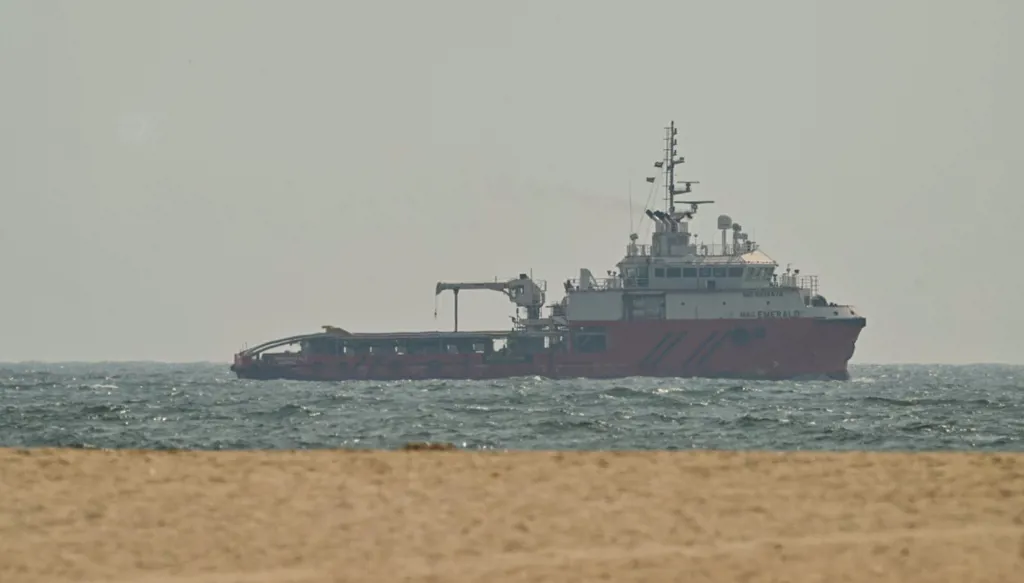
The situation now stands as follows: Iran rejected on Friday the US request to issue a statement on Saturday announcing the reopening of the strait to unrestricted maritime traffic. Early Sunday, the Islamic Revolutionary Guard Corps bombed a Cypriot container ship with missiles and drones as it attempted to sail through the southern route adjacent to Oman, causing a major fire on the vessel and the death of one crew member.
US forces responded with a wave of strikes targeting 140 Iranian sites, according to a statement from the US Central Command, known as CENTCOM. In response, the Revolutionary Guard launched a barrage of missile and drone attacks against Kuwait, Bahrain, Qatar, Oman, the United Arab Emirates, and Jordan.
It is worth noting that Iran had previously excluded Qatar, the UAE, and Oman from its responses on the previous Tuesday and Wednesday. Its latest attacks, however, indicate an expansion in the cycle of retaliation and counter retaliation, raising fears of a broader escalation and the possibility of a full-scale war.
The escalation is not limited to the battlefield, as it is also reflected in statements coming from Tehran and Washington. Supreme Leader Mojtaba Khamenei pledged in a message on Saturday to seek “revenge” for his father, former Supreme Leader Ali Khamenei, who was killed in the recent war. Meanwhile, Trump announced that there are “a thousand missiles” ready to be launched at Iran if it attempts to assassinate him.
This confirms that the United States and Iran have put the 14 provisions of the memorandum of understanding behind them, and that any diplomatic efforts currently underway will need to be based on new understandings, starting with a clear determination of the future of the strait.