

From Baghdad to Beirut: Can Iraq’s Anti-Corruption Drive Inspire Lebanon’s Reform?
With Iraq reshaping its political and financial landscape, Lebanon faces renewed pressure to confront corruption and rethink its role in a changing Levant.



 Messenger
 Whatsapp
 Threads
 Email
Email
 Print
Print
 X
X
 Facebook


For the first time, Ali Al-Zaidi’s government in Iraq has dismantled the deep-state infrastructure that was established after 2003 by targeting the financial corruption system at its core.
Through this step, it has introduced a model for confronting the mutually beneficial relationship between domestic political forces and external interests, a system that developed along the margins of sectarian and factional divisions, reinforced by external protection and a destructive approach toward state institutions. This bears clear similarities to Lebanon’s financial landscape, where banks were shielded by sectarian political forces to facilitate the theft of people’s money, alongside files and brokerage deals that benefited from the weakening of judicial institutions and the continuation of mafioso-style impunity to this day.
The same political and sectarian structure governs both Lebanon and Iraq through a rentier system and sectarian quota arrangements that drain state resources while benefiting from legal protection through harmful consensus. This undermines the institutions responsible for development, while both countries remain constrained by regional dependencies and political and sectarian leaders’ quotas distributed among their networks. This is particularly significant as both nations face major economic, political, and energy challenges — challenges that position them, alongside Syria, as key pillars in the development of supply chains, oil and gas pipeline routes, and electricity interconnections for countries across the Middle East.
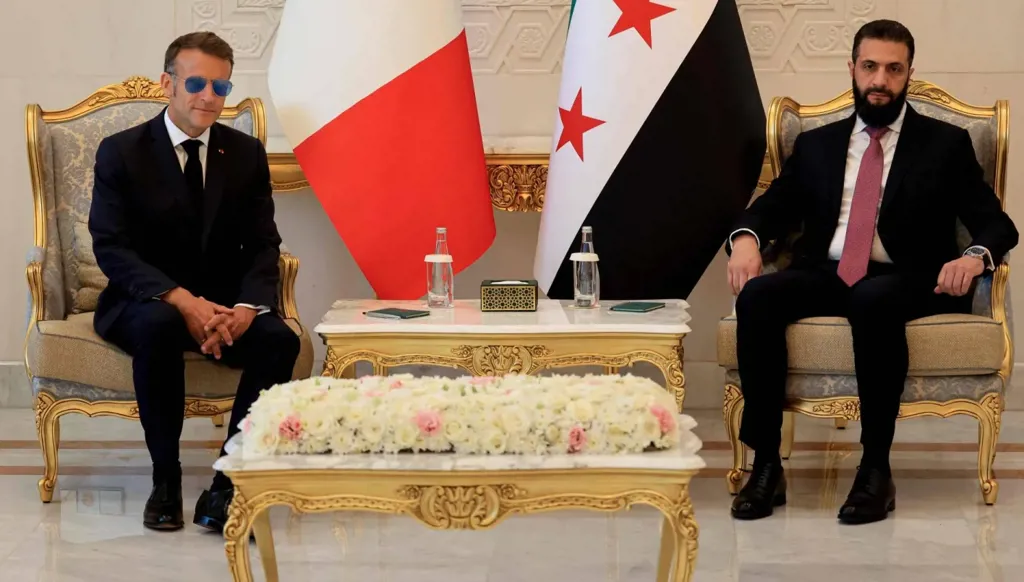
The rush in adopting positions and pursuing rapid deals has further exposed Lebanon’s vulnerabilities and fragmented its political approach. This was evident when French President Emmanuel Macron visited Syria to meet President Ahmed Al-Sharaa, without making a stop in Lebanon, despite Beirut’s significance to Paris. “France, the nurturing mother,” appears disappointed with Lebanon for excluding it from negotiations with Israel and from participation in the mechanism committee. Meanwhile, ahead of US President Donald Trump’s visit to Ankara for the NATO summit, Israeli Prime Minister Benjamin Netanyahu moved quickly to request a meeting with the American president at the White House, amid growing US opposition and mounting disagreements over Netanyahu’s approaches. The international effort to isolate Netanyahu due to his wars and policies is expected to be reflected during the NATO summit.
Lebanon is awaiting the outcome of the NATO summit, as well as the implications of President Joseph Aoun’s visit to Washington. The United States is re-entering the Levant through energy companies, oil pipelines, and export routes. In this context, Syria and Iraq emerge as economic and geographic hubs for Lebanon, extending beyond the critical security dimension to reconnect Baghdad and Damascus with the Mediterranean. This would provide Washington with new avenues of influence in a region filled with competing interests from Iran, Turkey, and Russia.
The timing and substance of Iraqi Prime Minister Ali Al-Zaidi’s visit to Washington in the middle of the month will be crucial. It is also expected that Syrian Foreign Minister Assad Al-Shaibani will visit the US capital during the same period. This comes as a US-Iraqi statement announced that President Donald Trump looks forward to welcoming Al-Zaidi to the White House.
A US-driven movement is expanding between Baghdad, Damascus, and Beirut under the banner of energy, infrastructure, export routes, and long-term economic influence. Washington now views Iraq, Syria, and Lebanon not only through a security lens, but also through economic interests capable of reshaping the regional balance in the Levant.
This requires a renewed approach to Lebanese policies, based on confronting corruption as Iraq has attempted to do, regardless of whether it is concealed behind sectarian or religious labels. It also calls for developing new, interconnected and complementary relations among economic sectors amid the Middle East’s transitional phase, ensuring that Beirut maintains its influence and role in the region.
Disclaimer: The opinions expressed by the writers are their own and do not necessarily represent the views of Annahar.