

The science, psychology, and history behind the 'french fries' obsession
From brain chemistry and childhood memories to sensory pleasure and globalization, French fries have become a universally loved food shaped by biology, culture, and human history.



 Messenger
 Whatsapp
 Threads
 Email
Email
 Print
Print
 X
X
 Facebook



People around the world, regardless of their cultures or ages, share a love for French fries. This global consensus is not merely a coincidence of taste, but rather the result of a precise interaction between food chemistry, human biology, childhood psychology, and historical development.
Biological aspect
The human brain has been programmed through evolution to prefer energy rich foods to ensure survival. French fries offer a rare combination of fast carbohydrates (starch) and fats (frying oil). This combination immediately stimulates the brain’s reward system, leading to the release of the hormone dopamine, which creates an instant feeling of satisfaction and a desire to repeat the experience.
.png)
Sensory and physical contrast
French fries have physical characteristics that stimulate the senses in a complete way. Their ideal preparation relies on “dynamic contrast”: a crispy outer layer created by the evaporation of water during frying, combined with a soft and tender interior. This textural contrast prevents the brain from experiencing sensory boredom.
In addition, the chemical “Maillard reaction,” caused by the high temperature of the oil interacting with amino acids and sugars, gives French fries their golden color and appealing aroma to the human nose, while salt enhances the intense umami taste.

Psychological and Behavioral
This strong connection begins in childhood. French fries are among the few foods that provide children with “sensory security” because their flavor is predictable and neither sour nor bitter. They are also classified as “finger food,” which gives children, during their developmental stage, a sense of independence and motor control, free from the limitations of utensils such as spoons and forks.
Over time, French fries become, in the unconscious minds of adults, a form of “comfort food” that evokes memories of rewards and childhood. They temporarily allow people to escape the pressures of daily life and the constant consideration of calorie intake.
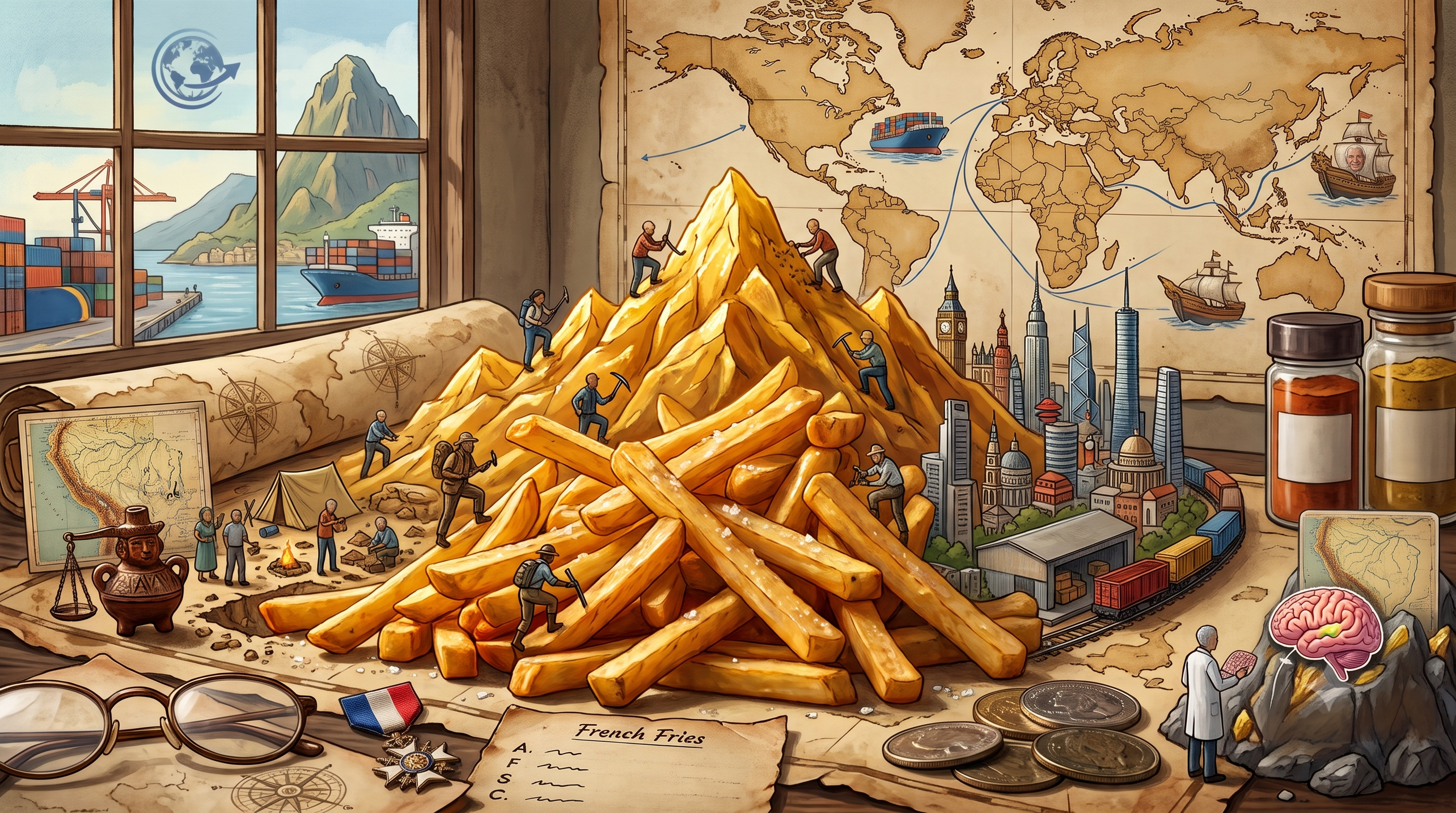
The historical factor and globalization
History played a central role in spreading this crop. After it moved from its original homeland in the Andes Mountains to Europe in the 16th century, it was adopted as a major defense against famine thanks to its efficient cultivation and high yields. The recipe then evolved locally among the Belgians and the French before soldiers in World War I introduced it to America under the name “French Fries.” In the mid 20th century, fast food chains transformed it into a globalized product with standardized specifications that was easy to distribute.
Ultimately, we do not love French fries simply because they are delicious, but because they are a product that has been biologically and culturally shaped to satisfy our “primitive” desires, our emotional memories, and our shared history in a single meal.