

Netanyahu’s annexation claims rejected by Christian border villages as Israeli threats mount
Christian border communities deny seeking Israeli protection, while drone strikes, military warnings, and political tensions deepen uncertainty in southern Lebanon.



 Messenger
 Whatsapp
 Threads
 Email
Email
 Print
Print
 X
X
 Facebook


The remarks made by Israeli Prime Minister Benjamin Netanyahu in an interview with Fox News, claiming that "some Christian villages in southern Lebanon have asked to be annexed to Israel for protection from Hezbollah fighters," drew widespread attention in Lebanon. The comments came amid accusations that such statements are intended to inflame sectarian tensions and provoke divisions, at times involving Christians, Druze, and the residents of Sunni border villages.
A statement signed by the municipalities, local figures, and mukhtars of the Christian border villages in southern Lebanon categorically rejected Netanyahu's claims, describing them as "fabricated and unrelated to reality." The priest of the border town of Qlayaa, Father Antonios Farah, also told Annahar that no one from the town had contacted any Israeli party or made any such request, placing the remarks in a political context. "We heard about this in the media," he said.
"We are Lebanese, and our identity is Lebanese. Our presence in Qlayaa is to preserve the Lebanese land and identity," Farah added. "We reject strife in all its forms. As faithful Christians, the primary cover we rely on is our Lord and our faith in Christ. We are under the wing of the state and adhere to what the state deems, with one weapon only: the weapon of legitimacy and the Lebanese Army. Our goal is peace, which we continually strive for as children of hope."
Israel responded to these positions by sending what it described as an "official" warning message through its army to several villages in the Marjayoun district, including Ibl al-Saqi, Qlayaa, Bourj al-Moulouk, and Deir Mimas. The message urged residents to prevent the return of "strangers" to their villages, referring to Hezbollah members, according to the Israeli statement.
The warning threatened that Israel could not guarantee the safety of residents if the instructions were ignored, claiming that Israeli military operations in southern Lebanon were ongoing.
It also stated that residents would be held responsible for what takes place inside their towns, warning against the "infiltration of Hezbollah elements" into the targeted areas and affirming that the Israeli army would continue its operations in southern Lebanon.
Parliament Speaker Nabih Berri welcomed the statements issued by municipal leaders and religious figures in the border villages and towns, particularly the Christian communities in the Marjayoun and Bint Jbeil districts, as well as the latest statement from the municipality of Rmeish, which "rejected, denied, and refuted the false allegations made by the Israeli Prime Minister regarding the desire of the residents of these villages to join the occupying Israeli entity."
Berri said that "the positions of the residents and figures of those villages, along with their resilience and attachment to their land and identity, reflect the authenticity of their genuine national affiliation, which they will not abandon under any circumstances." He also warned against "falling into the lies and falsehoods promoted by the Israeli political leadership."
Hezbollah MP Hassan Fadlallah, for his part, said that "Netanyahu's suspicious announcement reveals what he intends for our dear homeland." He added: "These villages, like the Islamic ones, remain firmly committed to their belonging to the homeland shared by all its people. They are an integral part of the South's national and social fabric. The occupation and its collaborators will leave, and they will have no role in the future of our country."
Politically, ten days after the signing of the "framework agreement" between Lebanon and Israel under U.S. auspices, and despite what has been described as an intimidation campaign against the deal—including claims that it does not exist or was stillborn—President Joseph Aoun appears confident about its trajectory. While he does not regard it as an ideal agreement, he considers it "the possible agreement."
In this context, Democratic Gathering MP Marwan Hamadeh said that "the coming days will be crucial in determining whether Lebanon will move toward implementing the framework and completing the security deployment, or return to a new phase of tension in the South and the interior." He stressed that "the agreement is neither historic nor a betrayal agreement, but rather a test of intentions, and capabilities will determine the course of the coming phase."
Hamadeh added that "the pilot areas represent a practical test for implementing the framework. The success of the first phase of Israeli withdrawal and Lebanese Army deployment could reduce internal divisions and pave the way for completing implementation, while any setback, Israeli hardening, or rejection by Hezbollah could further complicate the situation."
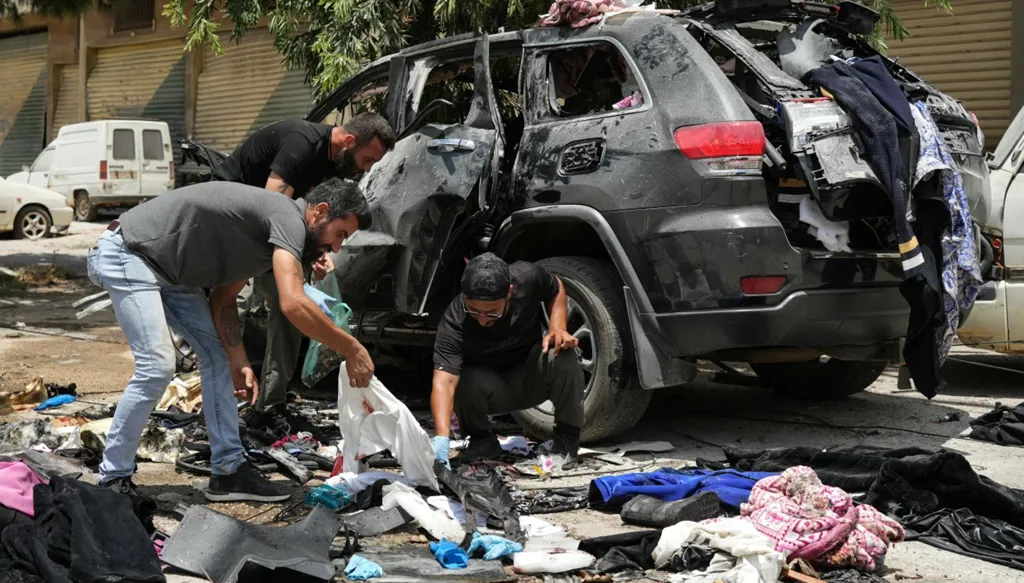
On the ground, southern Lebanon remained tense despite a decline in the pace of hostilities. An Israeli drone struck a Jeep Cherokee on the road near the Teachers' House in Nabatieh Al-Fawqa. The Ministry of Health announced that four people were killed, including three women.
According to available details, Esperanza Ghader, principal of the official school in Nabatieh Al-Fawqa, was with her mother, her foreign domestic worker, and a Syrian worker inspecting the family home in the town. As they were returning, a drone fired a guided missile near the Teachers' House, killing all four instantly.
A drone strike was also reported in Kfar Tibnit, while another raid targeted Ali al-Taher. The Israeli army carried out house demolitions in the town of Kounin in the Bint Jbeil district. Another drone strike targeted Brachiht in the same district, alongside intermittent artillery shelling and sweeping operations with automatic weapons. A drone dropped two bombs on Nabatieh Al-Fawqa within less than fifteen minutes. Reports also indicated that the Israeli army advanced toward the vicinity of the Hadatha cemetery while firing bursts of gunfire.
Separately, a drone dropped a sound bomb on a wooded area near the town of Mansouri, coinciding with medium-altitude drone flights over the Tyre district and its surrounding areas.