

Iran after Khamenei: Between internal rivalries and foreign power projection



 Messenger
 Whatsapp
 Threads
 Email
Email
 Print
Print
 X
X
 Facebook
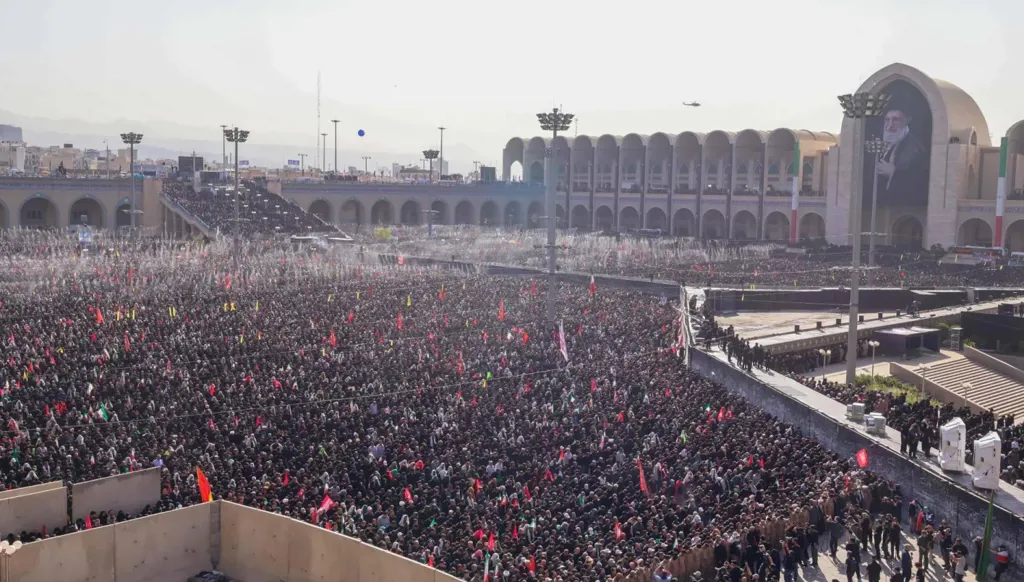


The funeral of the late Iranian leader is intended to project a “strong” return of Iran after a period marked by two wars that exposed and weakened it militarily, alongside sanctions that have drained its economy and continue to do so, and amid ongoing regional actions that have deepened mistrust with various parties.
States rarely avoid diplomatic obligations of mourning, especially when invited by Tehran, while Western countries did not send representatives after Iran considered them unwelcome. This raises questions about how the situation will evolve after the funeral, whether Iran will emerge from its previous isolation, and what changes might occur in the regime’s behavior.
Through the funeral, Iran also sought to emphasize the high stature of Ali Khamenei, affirm the continuity of its regime, and underscore the durability of its extended influence through its “branches” and “proxies.”
Calls for Revenge
On the margins of the mourning, popular calls for “revenge” have emerged—not without context, as the new leader Mojtaba Khamenei was the first to vow revenge for his father, who died in the early moments of the war. The plan, described as Israeli-backed and supported by the U.S., aimed for a swift and decisive outcome, but the regime did not collapse; instead, it neutralized the effectiveness of assassination strategies often attributed to Israel, and even disrupted the logic of the war itself, forcing the U.S. president to call for an end to it, though without success.
Calls for revenge appeared in multiple forms, most notably from Iranian army commander Amir Hatami (“We will avenge Khamenei’s death”) and Parliament Speaker Mohammad Bagher Ghalibaf (“Avenge Khamenei by widely participating in his funeral”), while on the streets the rhetoric was more explicit, including calls for the assassination of Donald Trump, echoing similar chants that followed the killing of Qassem Soleimani. These threats are likely to remain a tool for emotional mobilization, regardless of their practicality or effectiveness.
In the absence of Mojtaba Khamenei—who may appear on the final day of the funeral in Mashhad—key regime figures including the president, parliament speaker, judiciary chief, and foreign minister gathered to receive prominent foreign mourners, accompanied by Quranic recitations carrying political messages. This scene, along with the massive crowds, aimed to project an image of cohesion and unity in loyalty, essentially conveying that “the leader is dead, long live the leader.”
A unified stance was previously imposed during the war, even among opposition groups inside and outside the country, but this unity has begun to fragment as discussions emerge about the post-war phase, the funeral’s aftermath, and the direction of negotiations with the United States.
Iranian negotiators have remained aligned with the framework set by the leader. The “Memorandum of Understanding” was not initiated or signed by President Masoud Pezeshkian except with the leader’s approval, though he reportedly expressed a “different perspective” on it, while still allowing its signing because “the president and other officials emphasized their responsibility to protect the Iranian nation’s rights and the resistance front.”
Following protests against the memorandum in Qom—reportedly supported by the Revolutionary Guard—Friday sermons criticizing it, and slogans in mourning gatherings opposing negotiations and their outcomes, Pezeshkian pointed to “currents attempting to tarnish the negotiators’ image.” While the dominant view is that the Revolutionary Guard is behind the objections, the reference to “currents” suggests emerging internal factions testing one another, indicating a broader power struggle even within the Guard and the regime itself.
Internal Debate
Several sources indicate that what the Revolutionary Guard primarily sought from the negotiators was progress toward “ending the war” and establishing sovereignty—already effectively exercised—over the Strait of Hormuz. However, the text of the “Memorandum of Understanding” has itself become a tool in factional struggle, with criticism escalating into accusations of “treason” and “disobedience to the leader,” alongside populist rejection of negotiation on the grounds that it is unacceptable to “reach an understanding with the killer of the martyr leader.”
Since the memorandum is not a finalized agreement and still requires detailed negotiation, the debate surrounding it has diminished its clarity and deepened contradictions, with opponents describing it as a “new poisoned chalice,” while official discourse alternates between portraying it as a “victory” or emphasizing that it fulfills Iran’s expectations and demands.
Based on the “difference” highlighted by Mojtaba Khamenei, responsibility now falls on Iranian negotiators—described by Trump as “rationalists”—to secure Iran’s gains as reflected in the memorandum. However, the United States is not offering unconditional concessions; even steps such as easing oil export sanctions or releasing frozen assets are tied to progress toward a new nuclear agreement.
At the same time, issues such as control over the Strait of Hormuz and the end of the war in Lebanon are not likely to be resolved in line with Tehran’s expectations. Meanwhile, internal debate in Iran is expected to continue and intensify, becoming even more complex as decisions on the nuclear program approach, with any real change in the regime likely to become visible only after a final agreement is reached.
Disclaimer: The opinions expressed by the writers are their own and do not necessarily represent the views of Annahar.