Lebanon left facing heavy consequences after 1,000 days of Gaza conflict

Opinion 04-07-2026 | 12:31

Lebanon left facing heavy consequences after 1,000 days of Gaza conflict

A reflection on how regional war dynamics reshaped Lebanon, deepened its internal crisis, and revived questions about state authority and armed power.


Lebanon left facing heavy consequences after 1,000 days of Gaza conflict
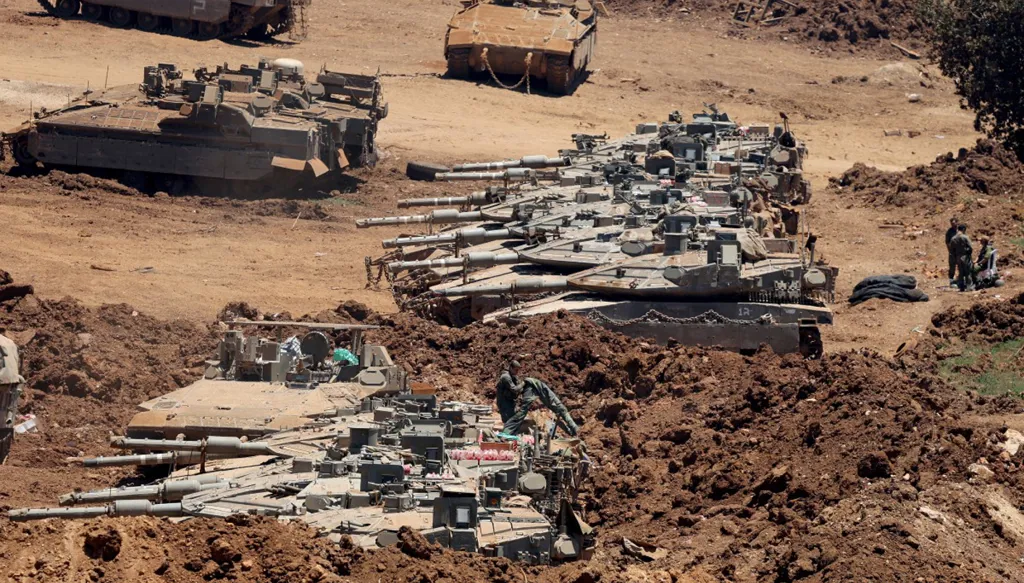
Israeli army tanks deployed along the Israeli-Lebanese border on July 1, 2026. (AFP)
Smaller Bigger


After a thousand days since the October 7 attack, the region looks fundamentally different. However, Lebanon appears to have paid the highest price relative to the scale of the challenges that the “Axis of Resistance” took risks for.


From the moment Hezbollah decided to open a “support front,” Lebanon entered a war whose decision was not in the hands of its state and whose objectives were not tied to its national interests, but rather to the calculations of the axis led by Iran.


Today, after a thousand days, it is difficult for any observer to ignore the fact that Israel has emerged from the war with an army that is more experienced, better prepared, and more capable of operating on multiple fronts at the same time, while Lebanon has emerged with a weaker state, a more collapsed economy, a devastated south, and a population that has paid a heavy price in terms of security, livelihoods, and future prospects.


Since October 8, 2023, the question in Lebanon was not whether the front should be opened, but who has the ability to bear its costs. Hezbollah took the decision to go to war alone, outside constitutional institutions, just as it previously took the decision to possess weapons. Here lies Lebanon’s core dilemma: the state was not the one making the decision of peace or war, yet it became the one paying the bill.


Southern villages were destroyed, infrastructure was damaged, the economy lost billions of dollars, and investments evaporated, while the Lebanese government had no real ability to influence the course of events.


Assessments may differ regarding the scale of Israeli military achievements, but it is difficult to deny that Israel succeeded in delivering heavy blows to Hezbollah’s leadership and military structure. It also managed to significantly reduce part of its offensive capabilities and imposed a new security reality not only on the border but also on the Lebanese state itself.


As for Lebanon, it achieved no national gains in return for these losses. No new land was liberated, the state’s conditions did not improve, and the economic burden on Lebanese citizens was not lifted. On the contrary, Lebanon’s problems increased, international confidence in its ability to fulfill its commitments declined, especially Resolution 1701 and the restriction of weapons to the state, and future dealings with its right to restore sovereignty became tied to its success in experiences it agreed to undergo.


Iran: the political winner and the strategic loser


Tehran viewed Lebanon as one of its most important spheres of influence in the Middle East, but the war also revealed the limits of this influence. The axis that Iran sought to present as cohesive was hit simultaneously in Gaza, Lebanon, and Syria, and became forced to rearrange its priorities.


The thousand-day experience once again reveals that Lebanon’s problem does not begin with war, but with weapons outside the state’s control.


The existence of a military organization that holds the decision of war and peace effectively means the existence of a parallel state, with its own strategy, alliances, and calculations, even if they contradict the interests of the Lebanese state. This is not merely a security issue, but the root of political and economic collapse. Investment does not flow into a country whose state does not monopolize the security decision, reforms do not succeed under dual authority, and institutions do not regain citizens’ trust as long as the final decision remains outside them.


After a thousand days, southern Lebanon still faces a dual challenge. Reconstruction requires billions of dollars, while the international community conditions major assistance on political and security reforms first.


At the same time, Hezbollah does not appear ready to give up its weapons, while Israel insists it will continue military operations whenever it perceives a threat to its security, and it will not abandon a security buffer zone it has established and cleared of buildings, population, and infrastructure.


Perhaps the most important lesson revealed by this war is that the equation “weapons protect Lebanon” has been severely tested. The practical outcome has been a weaker state, a more collapsed economy, and wider emigration, while Lebanon’s dependence on external actors for financial and political rescue has increased.


The experience has proven that any weapon outside the framework of the state, regardless of the slogans it carries, turns the state itself into the weakest link.


After a thousand days, the real question does not appear to be who won the military battle, but who paid the highest price.


And the answer for Lebanese citizens is clear: the Lebanese state, the Lebanese economy, and Lebanese society were the biggest losers.


As for exiting this cycle, it will not come through a new military round, nor through slogans of “resistance” or “victory,” but through restoring the state’s full monopoly over weapons and the decision of war and peace and building a foreign policy that stems from Lebanon’s national interest rather than the priorities of regional axes.


Around a thousand days later, Lebanon needs a state more than it needs a new military front.


Disclaimer: The opinions expressed by the writers are their own and do not necessarily represent the views of Annahar.