

Syria's geopolitical role between Ankara and Tel Aviv
A shifting regional balance reshapes Syria’s role amid Turkish-Israeli tensions and competing international constraints.



 Messenger
 Whatsapp
 Threads
 Email
Email
 Print
Print
 X
X
 Facebook
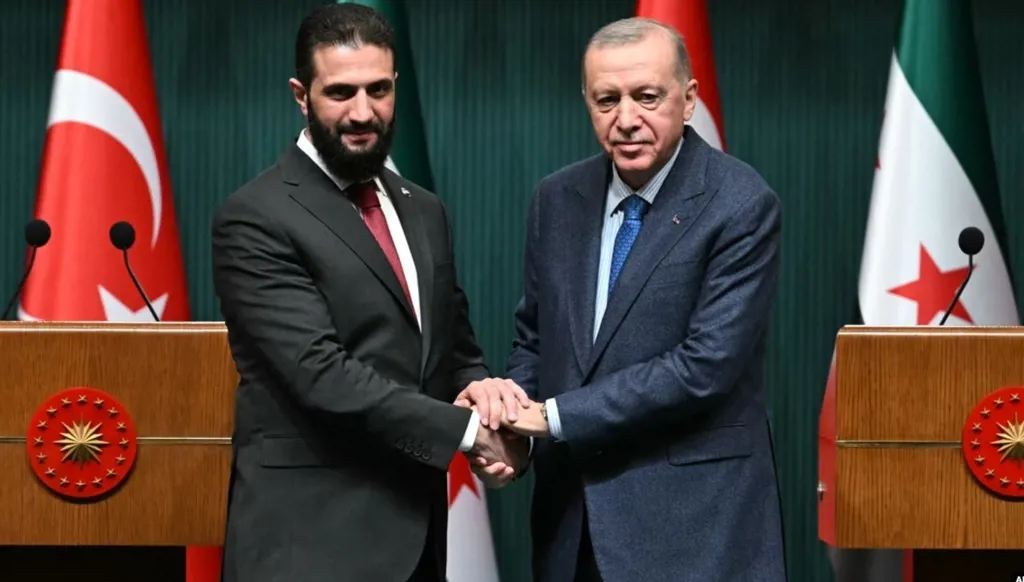


In a prominent geopolitical shift, the axis of security coordination between Ankara and Damascus has moved from northern Syria, where the historical focus was on fighting Kurdish factions, to the southern front, with the aim of blocking Israel’s route and preventing its expansion in the Golan and the buffer zone.
Recent security talks between officials of the two countries confirmed the beginning of drafting a broad amendment to the historical Adana Agreement signed in 1998. Under the expected amendment, the concept of Turkish national security would no longer be limited to securing the northern borders to a depth of 15 km but would be extended to include the formation of a joint defensive barrier in southern Syria to prevent any single side from dominating the area.
This anticipated shift places Israel before a new field equation that turns southern Syria into an indirect strategic defensive line for Turkey under Russian oversight, despite expected American rejection of any threat to Israel’s security.
Adana Agreement and the future of Syrian sovereignty
Researcher and political writer Ahmed Farhad unpacks these developments by returning to the roots of the agreement, which was originally created to address the file of the Kurdistan Workers’ Party.
Farhad says, in an interview with Annahar, that Turkey’s push into Syrian depth enjoys a temporary and interest driven acceptance from Damascus and Moscow to confront Israeli expansion in the south, but it faces strong international constraints, as the United Nations rejects any military cover while insisting on respect for sovereignty, and Washington raises a veto against Turkish expansion to protect oil fields and the security of its ally Israel.
Farhad draws a picture of intersecting regional red lines, where the north becomes a red line for Turkey and the south a red line for Israel, while the Syrian government pays the price of weakness in an international chess game in which it appears unable to impose its decision amid the spread of factions and gangs tied to external agendas, in a bitter reproduction of the Iraqi scenario.
Turkey’s pragmatism: betting on Washington
On the other hand, researcher specializing in Turkish and regional affairs Mahmoud Alloush approaches the scene from a different angle, considering the Adana Agreement “the structural cornerstone for establishing a new relationship between Damascus and Ankara.”
Alloush explains, in an interview with Annahar, that Turkey’s desire to update the understandings “stems from the need of both countries to curb terrorism and protect their shared security, and it is not directed against any third party.” Although the formulations integrating the Syrian Democratic Forces have addressed some of Turkish concerns, the agreement remains the longer term guarantee for an unresolved Kurdish file that has not yet stabilized.
At the geopolitical level, Alloush points out that the Israeli presence in the south reflects a readiness for a broader clash of influence stretching from Syria to the Eastern Mediterranean. From here, Turkish efforts are currently focused on leveraging its strategic relationship with the administration of US President Donald Trump, as President Recep Tayyip Erdogan prepares to present Israel’s expansionist objectives and its attempts to impose buffer zones in Lebanon and Syria to the White House, based on Ankara’s new security doctrine: “Turkey’s security begins in Beirut and Damascus.”
Alloush also notes that rebuilding the Syrian army faces major complexities linked to regional and international balances.
/WhatsApp%20Image%202026-07-02%20at%209.44.31%20AM.jpeg)
Risks of turning Syria into a regional defensive line
In contrast to pragmatism, Professor of International Relations Bassam Abu Abdullah offers a highly cautious critical assessment, stressing that the mutual visits between the two sides go beyond the traditional framework and establish an “unequal relationship” due to the imbalance in power and the dominant Turkish influence.
Damascus, with its emerging institutions, “may offer border security guarantees in the north in exchange for a political and economic umbrella of Turkish support that protects it from a geopolitical vacuum.”
On the southern dilemma, Abu Abdullah, in an interview with Annahar, rules out any direct military confrontation with Tel Aviv due to its intelligence and military superiority, suggesting instead “a Turkish retreat toward diplomatic pressure to contain the realities of the buffer zone.”
The most serious point, according to Abu Abdullah’s reading, is his categorical rejection of the idea that the “new Syrian army” can play the role of a guardian of Turkish national security. He describes it as “an emerging army dominated by a single ideological color, lacking social diversity, in addition to weak logistical armament and its full dependence on Turkish training and coordination.”
Abu Abdullah warns that turning Syria into a field of conflicts and a defensive wall for Turkey “will entrench instability amid a depleted economy and internal divisions, delaying the imperative of building a unified national state.”