

Donald Trump and the 250th anniversary of the United States
How long-term structural changes in politics, media, and society have eroded public discourse and reshaped leadership norms in the United States and beyond.



 Messenger
 Whatsapp
 Threads
 Email
Email
 Print
Print
 X
X
 Facebook


Dr. Hassan Mneimneh
The memorandum of understanding he pushed to be signed between the United States and Iran may be the clearest illustration of his conduct and approach. This is especially so because many of his supporters and admirers try to read genius into his actions, interpreting what may look like chaotic improvisation as hidden strategy and long-term planning, comprehensible only to the experienced and initiated.
In practice, Trump has conceded to Iran nearly everything it sought in exchange for reopening the Strait of Hormuz. The arrangement reportedly includes ending the regional war according to Iranian preferences, releasing frozen Iranian funds, providing compensation, lifting sanctions on Iran and on those dealing with it, ending the blockade on its ports, and withdrawing forces deployed against it, among other provisions.
In return, Iran reiterates its longstanding declaration that it does not seek nuclear weapons and expresses willingness to negotiate guarantees on this point, while also agreeing in principle to reopen the Strait of Hormuz after a transitional phase. One is left wondering where exactly the achievement lies for the man celebrated as the author of "The Art of the Deal". It appears to be a remarkable deal indeed, but one that clearly favors the other side.
Yet Trump himself has stated that he does not consider the signed document binding, even while describing it as the best ever. The memorandum does not address missile capabilities or support for armed groups, but when asked about this he said these issues could be added later. If Iran refuses, then the deal is meaningless and a return to war is possible. In other words, the document itself carries no real authority or binding force; it is merely a performance within an unfolding political theatre, subject to additions or removals without reference to any fixed framework.
Trump has repeatedly made clear that he recognizes no authority beyond himself and no limits on his actions except those he chooses to impose. He is not bound by what he says or by the positions he takes. He can do whatever he wants. During his first presidential campaign, he even declared that he could stand in the middle of Fifth Avenue, one of the most famous streets in New York City, and shoot someone, and he would still not lose any voters.
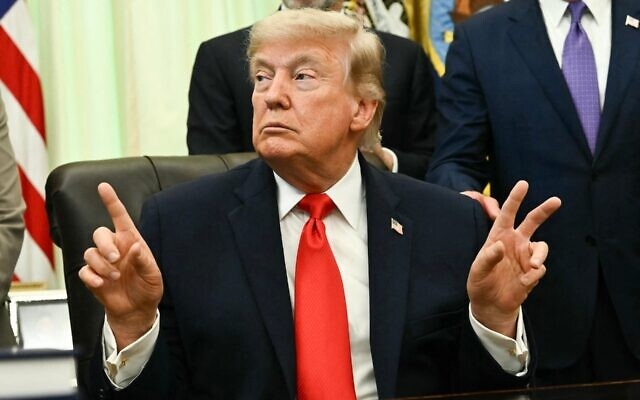
With Donald Trump, the United States and other countries are living in a world where the bizarre has become routine, and rudeness, insults, fallacies, and outright lies have become common modes of communication.
However, it would be unfair to place the blame for these developments on Donald Trump alone. One can point instead to a wide range of structural changes that have driven political reality into this state. These include the growing entanglement between politics and money, and the dominance of private interests in their ability to influence the electoral process.
They also include a cultural fragmentation rooted in diverging interpretations of history and society, a divide that has been greatly intensified by social media, as well as a general tendency toward a race to the lowest common denominator, accompanied by a sense of disconnect between the interests of rulers and the governed, which has been successfully exploited by those able to benefit from it.
In 1920, the political satirist Henry Louis Mencken warned that the nature of the American political system was moving toward an increasing convergence between the president and the voters, writing that “on a great and glorious day, the common people will finally get what they want, and the presidency will be occupied by a man who is wholly a fool.”
Donald Trump may in fact be the hidden genius rather than the wholly foolish man Mencken envisioned, or even the greatest president in the country’s history, unjustly misunderstood by his contemporaries who failed to recognize his greatness.
Yet the more plausible view is that he reached the presidency as a result of the structural deterioration within the United States, and then further amplified that deterioration through his words and actions, allowing its effects to spread into the weak points of the entire world.
One can only hope that history will judge him and the world he inhabits more gently, and that he will not turn out to be the harbinger of collapse whose signs any objective observer can already discern at both the level of the United States and the world as a whole.
Disclaimer: The opinions expressed by the writers are their own and do not necessarily represent the views of Annahar.
Read more in our 250th Anniversary of the United States dossier :