

Damascus repositions itself amid Lebanon’s weapons debate
Syrian messaging signals a shift toward supporting state institutions and regional stability over armed influence, as Beirut confronts renewed calls to restrict weapons to state authority.



 Messenger
 Whatsapp
 Threads
 Email
Email
 Print
Print
 X
X
 Facebook
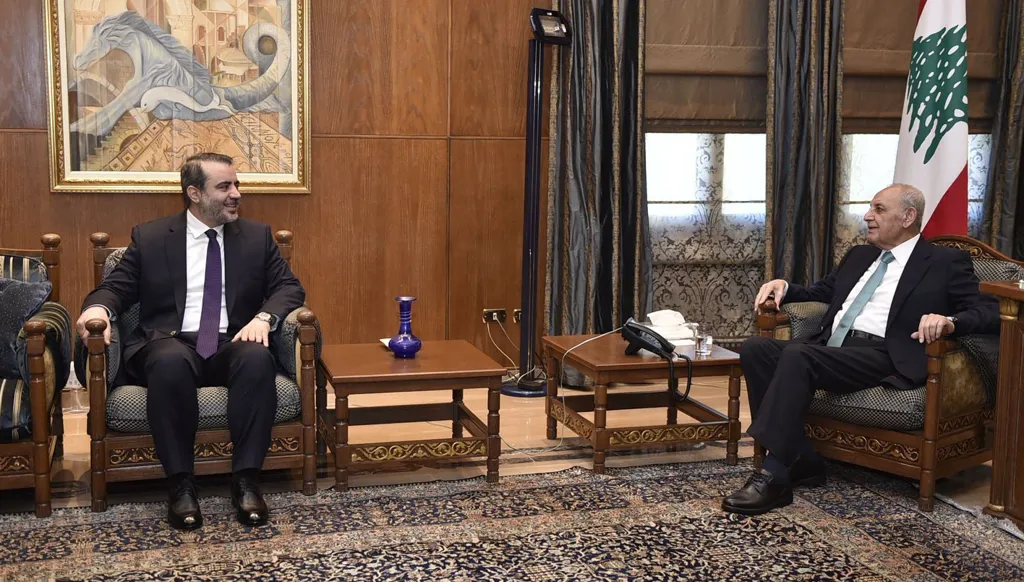


The visit of Syrian Foreign Minister Asaad al-Shaibani to Beirut went beyond being a simple stop within the framework of rebuilding Lebanese–Syrian relations, and became an occasion to raise one of the most sensitive issues in Lebanon: restricting weapons to the state.
The leaks that preceded it spoke of a political initiative prepared by Syrian President Ahmed al-Sharaa, titled support for the Lebanese state and assistance in completing the implementation of the Taif Agreement, including addressing the weapons issue through dialogue and consensus.
Although there has been no official announcement of a written initiative, available information indicates that the new leadership in Damascus wants to present itself as a partner in stabilizing Lebanon, not a party in its internal conflict, and is seeking to draw a completely different image from the role associated with the former Syrian regime.
A message of reassurance
At the core of the Syrian approach, there is no talk of any military role inside Lebanon. On the contrary, reports indicate that al-Shaibani is carrying reassurance messages to various Lebanese political forces stating that Syria does not intend to interfere in security or military affairs and sees no interest in confrontation with Hezbollah or any Lebanese component.
In return, Damascus is proposing enhanced security cooperation between the two countries, especially in controlling borders and preventing smuggling, in a way that preserves the security of both Lebanon and Syria.
This approach is based on the Taif Agreement itself, which not only establishes the principle of special relations between the two countries, but also emphasizes the principle that weapons must be exclusively in the hands of the state, and that neither country should be used as a passage or base for any activity that threatens the security of the other. From this perspective, it appears that Damascus is reintroducing itself as a state calling for the full implementation of Taif in all its provisions, not a selective application of it.
Reports indicate that al-Shaibani carries a vision based on encouraging the Lebanese to launch an internal dialogue that would lead to the integration of all forces, including Hezbollah, within state institutions, based on the Syrian belief that the continued existence of any weapons outside state legitimacy weakens the state and makes it more vulnerable to external interference.
However, this approach is accompanied by an emphasis on the need to provide political and security guarantees for all Lebanese components, so that the weapons issue does not become a gateway to internal confrontation.
A new Syria-Lebanon equation
It is difficult to interpret what Damascus is bringing as a veiled threat through the Syrian channel. All the leaked messages speak of a rejection of any military action and of the new Syrian leadership’s determination not to reproduce the conflicts that exhausted both countries.
It appears that President Ahmed al-Sharaa wants to establish a new equation based on the idea that Syria’s security begins with Lebanon’s stability, and that any Lebanese instability would directly reflect on the Syrian internal situation.
This shift is also connected to the regional climate imposed by recent agreements and Arab and international pressure to strengthen the authority of the Lebanese state. In this context, Damascus appears keen to be part of the solution and to present itself as an Arab partner in supporting state institutions, rather than reinforcing the reality of weapons outside the state.
This approach, in part, aligns—according to sources close to Parliament Speaker Nabih Berri—with his repeated position, which links any resolution of the weapons issue to a halt in Israeli attacks and the completion of withdrawal from Lebanese territory, followed by a dialogue on a defensive strategy that would ultimately lead to restricting weapons to the state through gradual steps and under the supervision of legitimate institutions.
Cooperation rather than confrontation
On the other hand, Damascus is trying to send a direct message to Hezbollah that it does not consider it an adversary and does not seek to target its base of support, and that it does not object to keeping communication channels open if this helps preserve stability in both countries. In doing so, it seeks to dispel fears that the new Syria could become a platform for security pressure on Hezbollah, while affirming that its project is based on cooperation between the two states, not confrontation.
The importance of al-Shaibani’s visit may not lie in whether or not there is a written initiative, but in the fact that it reflects, for the first time, Damascus shifting from its position as a regional ally of the weapons axis to a position of open support for the principle of the state and its institutions.
If these messages are translated into official positions during the visit, they would signal a political transformation that goes beyond Lebanese–Syrian relations and becomes part of a broader reconfiguration of regional balances in a new phase defined by strengthening the state, not multiplying centers of power within it.