

Opposition to 'Framework Agreement' in Lebanon remains fragmented
Inside the growing parliamentary rifts in Lebanon as calls for a nationwide opposition front face political fragmentation, sectarian calculations, and regional considerations.




 Messenger
 Whatsapp
 Threads
 Email
Email
 Print
Print
 X
X
 Facebook
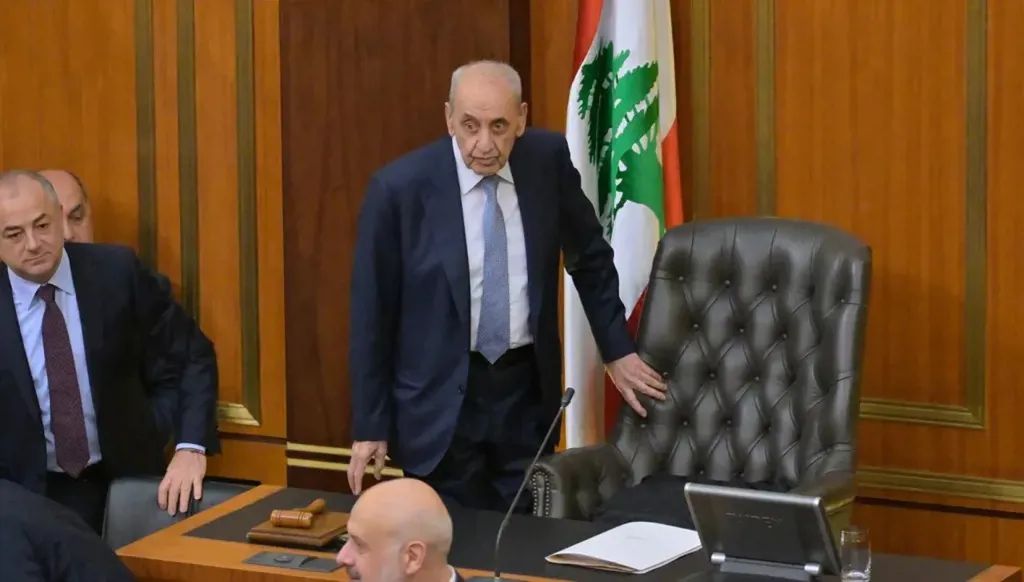


After the political polarization triggered by the framework agreement between Lebanon and Israel, often compared to the 1983 “May 17 Agreement,” despite differences in today’s circumstances, tools, and challenges, recent days have seen growing discussion about forming a parliamentary-political front to oppose the deal.
The idea draws on the experience of the “National Salvation Front,” established in 1983 to block the May 17 Agreement at the time. That front brought together the late Presidents Suleiman Frangieh and Rashid Karami, Speaker Nabih Berri, Walid Jumblatt, and political forces aligned with Syria, with Hafez al-Assad acting as the main architect behind its formation.
Today, voices are calling for the formation of a similar initiative, with Speaker Nabih Berri reportedly receiving several messages, even from non-Shiite figures, urging him to take such a step. Former MP Najah Wakim discussed the idea with him but did not receive confirmation that it would be pursued, while efforts continue to oppose what has been agreed with Israel and what Washington is currently outlining.
After Berri expressed his clear rejection of the agreement, saying he does not expect Israel to withdraw easily from the south and referring to the proposed pilot zones as “sabotage zones,” he told Annahar that there is no intention to form any such front, adding: “I have expressed my position on the agreement, and anything else attributed to me does not represent me.” The discussion followed MP Gebran Bassil’s visit to Ain el-Tineh, amid reports that Berri had received multiple calls from MPs and political figures expressing opposition to the authorities’ approach toward Israel.
Why Doesn't Such an Opposition Front Emerge?
Although the 27 Shiite MPs fully oppose the framework agreement, there are other parliamentary and political blocs that do not align with the “duo” in their stance toward Aoun, yet share similar criticisms to those voiced by Bassil and Jumblatt regarding the negotiations.
If an opposition front were to be formed with Shiite forces as its backbone, Walid Jumblatt would likely refrain from joining in order to avoid reviving the image of “March 8.” The Progressive Socialist Party seeks to preserve its political distinctiveness, while Gebran Bassil would also be unlikely to participate in an opposition framework led primarily by Shiite factions, despite not opposing President Aoun’s negotiations, even though his bloc did not support his election.
Meanwhile, several parties and movements outside parliament, such as the National forces, the Communists, Talal Arslan, and the Islamic Group, do not support negotiations with Israel. This shifts attention toward Sunni representation, although some Sunni deputies are aligned with the “duo’s” position of objection.
There are three Sunni MPs within the last two blocs, while some Sunni figures share their positions without formally joining any front. In addition, several Christian MPs, including Elias Jaradeh, also oppose the ongoing negotiations. Among the Sunni MPs who reject the process are Osama Saad, Jihad al-Samad, Halima al-Kaakour, and Hassan Murad. MP Bilal al-Hshaimi reflects this broader objection, arguing that “a wide segment of Sunnis does not accept this form of negotiations, even if they do not align with Hezbollah’s performance or Iran’s policies.” He further questioned, “Have those concerned read that under the agreement, Netanyahu and his circle of killers cannot be prosecuted?”
A former MP says that before the Taif Agreement, had a version of the deal been submitted to parliament for a vote, it would likely have passed, as Western and Arab messages would reach MPs urging them to support it as a “binding directive” to approve the agreement, noting that it never reached the status of a treaty requiring parliamentary ratification.
He adds that 23 of the “gray” MPs before Taif, most of them Muslims, had initially objected in closed-door discussions to the “May 17 Agreement,” but later received calls urging them to suspend their position as developments unfolded that ultimately led to the agreement’s failure, in a process attributed to the strategy of Hafez al-Assad.