

Washington agreement and the struggle for Lebanese sovereignty: Between militias, statehood, and regional power
A framework agreement reshapes Lebanon’s political and security landscape, exposing deep internal contradictions and opening a contested path between state restoration, militia power, and regional influence.



 Messenger
 Whatsapp
 Threads
 Email
Email
 Print
Print
 X
X
 Facebook
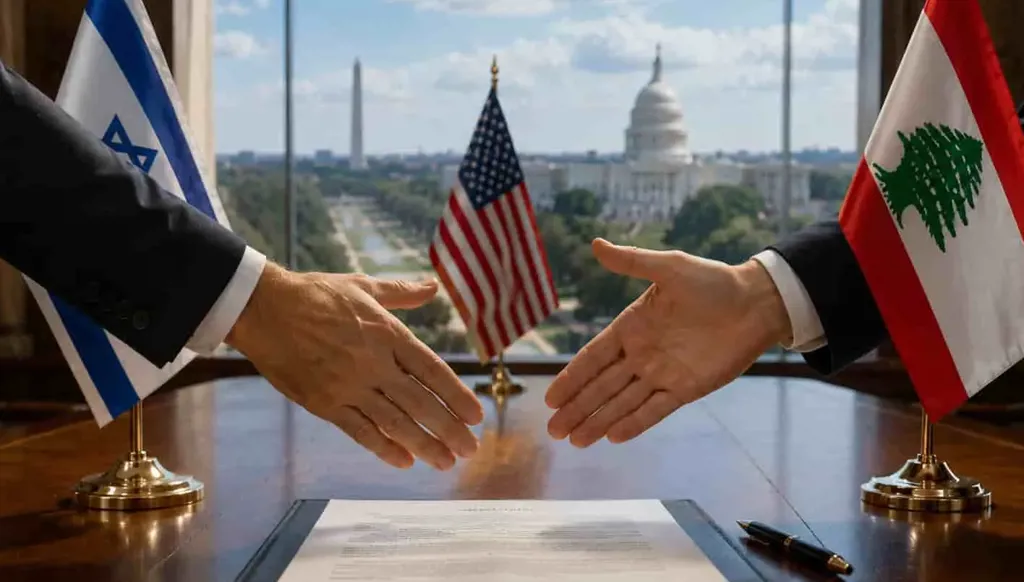


The framework agreement between Lebanon and Israel is not merely a tool for stopping hostilities; it is a re-establishment of the Lebanese homeland and sovereignty, in whose name many violations have long been justified. The real importance of this moment lies in the fact that it shifts the Lebanese issue from the logic of a conflict managed by militias to the logic of state responsibility.
The agreement, signed in Washington on June 26, 2026, creates a practical foundation for an Israeli withdrawal, the deployment of the Lebanese Armed Forces, the disarmament of Hezbollah, and the dismantling of militia infrastructure.
US Secretary of State Marco Rubio described the process as an organized effort to restore Lebanon’s sovereignty and enable Israel to return to its borders once the threats posed by Hezbollah are removed. This is not a peace agreement, but it is certainly a historic one, creating an institutional possibility for peace.
Once again, the Islamabad agreement revealed the historical collusion between Iran and Hezbollah on the one hand, and Israeli messianic extremists on the other. With the Israeli extremist minister Itamar Ben Gvir declaring that the “agreement is a major mistake,” the overlap of interests between him and Iran-Hezbollah became clear, together reinforcing their shared destructive game of legitimizing an endless ideological conflict at the expense of displaced people, society, and the Lebanese state.
The Islamabad agreement effectively grants Lebanon freely to Iran, turning it into a field for Iranian deterrence and ideological play, while Hezbollah and its apparatus continue to operate while retaining a veto over Lebanese sovereignty.
However, the Washington agreement, signed under the authority of the US State Department, breaks this organic link and goes beyond this Trump-era blind spot shaped by Barack, Kushner, and Witkoff, in an attempt to turn Lebanon into merely an item in Iranian negotiations, to include Lebanon in the “broader front,” according to the Pakistani expression, and to transform Lebanon contractually into a perpetual bargaining chip in Iran’s hands.
The agreement carries many risks
These risks lie in the game of operational timelines, step for step, between Israeli withdrawals and progress in clearing the south of Hezbollah’s weapons. This therefore requires continued Lebanese political and diplomatic vigilance to contain Hezbollah’s maneuvers, and firmness in negotiations with Israel.
The decisive struggle inside Lebanon will take place within bureaucratic institutions, security structures, border economies, patronage networks, municipal influence, and reconstruction channels, as well as within fear itself. It is not enough to deploy soldiers in the south; there must also be sustained efforts to dismantle the militia-based administrative infrastructure. The greatest burden will fall on the army, whose legitimacy depends on a national doctrine that is anti-militia, yet supportive of and inclusive toward the Shiite community.
Hezbollah may not launch an immediate coup, but it will attempt to paralyze and intimidate the government and political system, infiltrate implementation mechanisms, or provoke Israel. Here lies the importance of external support, as a backing force rather than a substitute for Lebanese political courage.
Three scenarios now define the path ahead:
The first is the sovereignty scenario, in which the Washington agreement becomes a lever for the gradual but irreversible restoration of state authority. It would strengthen the army and ensure that reconstruction funds are channeled through the state, supported by Arab and Western backing. This scenario does not end all conflict over Lebanon’s survival, but it changes the direction of history.
The second is the sabotage scenario. Hezbollah mobilizes its base and threatens civil conflict, forcing the state to retreat. Israel resumes strikes, and Lebanon returns to the cycle of escalation.
The third is the frozen hybrid scenario, in which the agreement formally remains in place but is not substantively implemented. Israel remains in security zones, Hezbollah retains hidden capabilities, the army deploys only partially, and the international community becomes hesitant about the new direction’s effectiveness.
Unless Lebanese political leadership and society act with decisive and historic national skill, this third scenario is the most likely in the short term.
The fundamental question for Lebanon’s political class is not whether it supports stability, peace, and prosperity, but whether it is willing to abandon the legacy system and its interests, and support the rebuilding of a sovereign Lebanese state.
The historical importance of the Washington agreement does not lie in guaranteeing peace for Lebanon, but in exposing the central contradiction of Lebanon’s postwar system. Lebanon cannot liberate its land from Israel without liberating it from Iran. Sovereignty is the essential condition for achieving territorial liberation.
Disclaimer: The opinions expressed by the writers are their own and do not necessarily represent the views of Annahar.