

Heat crisis: When Chirac’s warning comes back to haunt France
Twenty-three years after “our house is burning,” Europe’s record heatwaves expose a system still unprepared for a climate emergency that is no longer exceptional, but the new normal.



 Messenger
 Whatsapp
 Threads
 Email
Email
 Print
Print
 X
X
 Facebook
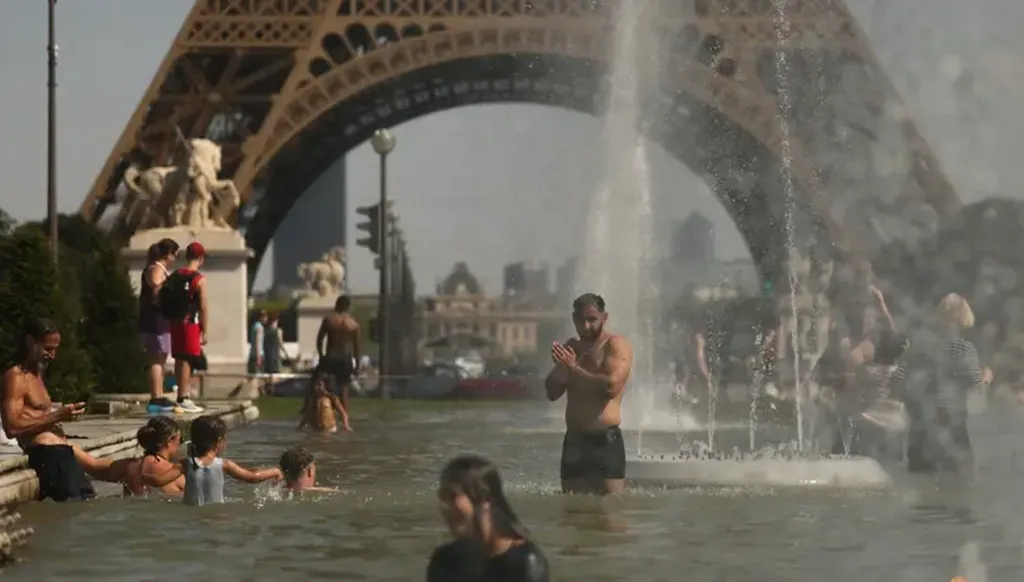


Twenty-three years ago, the late French President Jacques Chirac issued an unforgettable warning from Johannesburg: “Our house is burning and we are looking the other way.”
A few months later, the summer of 2003 claimed the lives of about fifteen thousand French people within a few weeks. It was a national disaster that many believed would serve as a wake-up call and push the country to change course.
Twenty-three years have passed, and history appears to be repeating itself. France and Europe are facing another historic heatwave, with unprecedented temperatures causing hundreds of casualties and suffocating conditions that now feel closer to the deserts of Saudi Arabia than to the traditionally mild French climate. The unsettling conclusion is that the country seems not to have learned the lessons of the past.
Total Paralysis
It now takes only temperatures exceeding forty degrees for France to slip into a state of near-total paralysis. Trains come to a halt due to the heat. Schools send students home because they lack air conditioning. Companies rapidly switch to remote work.
Even building elevators, including those in high-rise buildings, become inoperative, while maintenance services struggle to respond for days. This last detail stands out as a striking symbol of collective neglect, where a person may find themselves trapped for hours in a stifling elevator cabin without any response. In a country that sees itself as a great power, such an image is as alarming as it is absurd.
In the face of this situation, the political class reacts, but mainly by exchanging accusations rather than offering solutions. Parties shift responsibility back and forth, and disputes intensify. Meanwhile, hospitals, the healthcare system, transport networks, and schools remain unprepared for heatwaves that are now predictable and increasingly frequent.
Here lies the core of the problem: these events are no longer surprises. Scientists have been tracking them, warning about them, and modeling them for decades. What is missing is the political will to transform knowledge into action.
Between Lebanon and France
There is a striking contradiction in this comparison. Lebanon, a country worn down by wars, economic collapse, and years of bombardment, has developed a culture of adaptation and improvisation, finding alternative solutions out of necessity and absence of a reliable state. Its citizens manage to cope despite everything. France, by contrast, possesses extensive financial, technical, and institutional resources.
Yet every summer heatwave or winter snowstorm triggers the same pattern: shock, paralysis, and improvisation. The issue is not capability, but a political and administrative culture that struggles to think long-term when the electoral calendar prioritizes the short term.
France can no longer treat climate crises as exceptional events. They have become the new normal. Large-scale investment in climate adaptation—from improving insulation in public buildings, greening urban spaces, and equipping schools and hospitals with cooling systems, to reinforcing health protocols and upgrading transport infrastructure—is no longer an environmental luxury, but a vital necessity.
Twenty-three years after Chirac's statement, the house is still burning. And we are still looking the other way.
Find out more about Europe’s heatwaves below: