

Lebanon’s framework agreement with Israel signals historic shift toward sovereignty
The landmark deal aims to end decades of conflict, curb Hezbollah’s military role, and redefine Lebanon’s political future despite fierce domestic opposition.



 Messenger
 Whatsapp
 Threads
 Email
Email
 Print
Print
 X
X
 Facebook
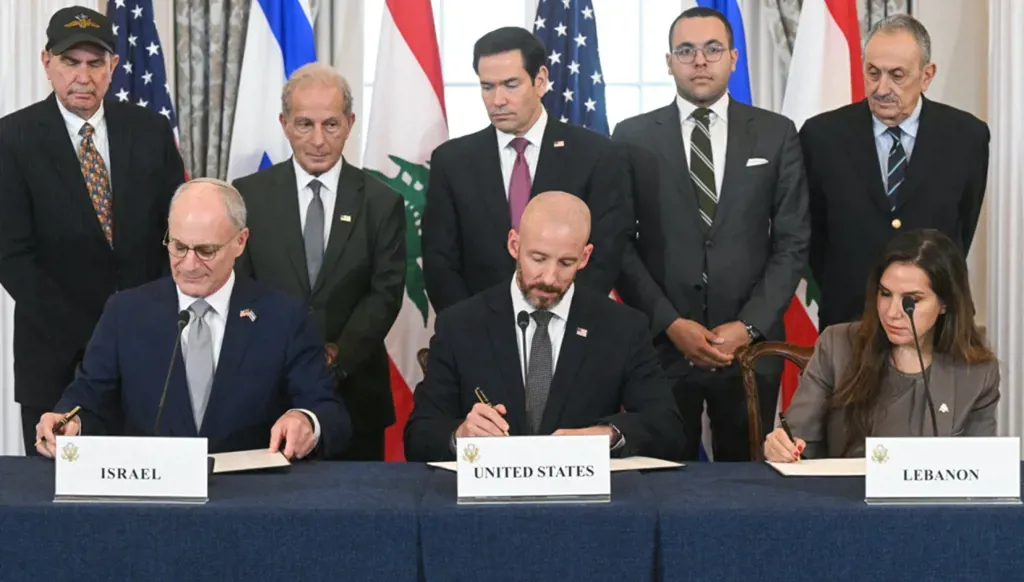


The authorities displayed considerable courage and determination through their delegation in Washington, led by Ambassador Simon Karam, in pursuing a framework agreement with Israel. They were fully aware that the agreement would face significant criticism, just as criticism of the U.S.-Iran memorandum of understanding has continued in the United States.
At the forefront of the opposition is Hezbollah, whose secretary-general continues to claim he speaks on behalf of half of the Lebanese people, despite this not reflecting reality. In fact, half the Lebanese—and likely many more—want the war in Lebanon to end.
Criticism and threats of civil war have become part of the party’s familiar rhetoric, reflecting its rejection of ending its role as an armed group loyal to Iran in Lebanon. Diplomatic sources stress that the negotiating team spared no effort in securing Lebanon’s rights and defending its interests, while remaining mindful of the balance of power resulting from the war.
This is particularly relevant given Hezbollah’s repeated assertions that battlefield realities dictate political outcomes, despite the fact that Israel’s occupation of southern Lebanon cannot be considered a negotiating advantage.
U.S. Secretary of State Marco Rubio described the framework agreement as "the beginning of the beginning." It outlines the broad principles and serves as a preliminary step toward future negotiations, during which substantive issues and detailed provisions will be addressed.
Meanwhile, Lebanon faces urgent challenges in seizing this opportunity before it slips away, as further delays are not in its interest. Developments on the ground have demonstrated Hezbollah’s inability to halt Israeli advances, while Iran’s capacity to provide the support the group requires has steadily diminished.
As a result, Hezbollah’s future has become increasingly tied to ongoing Iranian negotiations, making Lebanon’s future dependent on the outcome of nuclear talks that could extend beyond sixty days. Lebanon, however, can no longer afford to remain in this position or subordinate its national decisions to Iran.
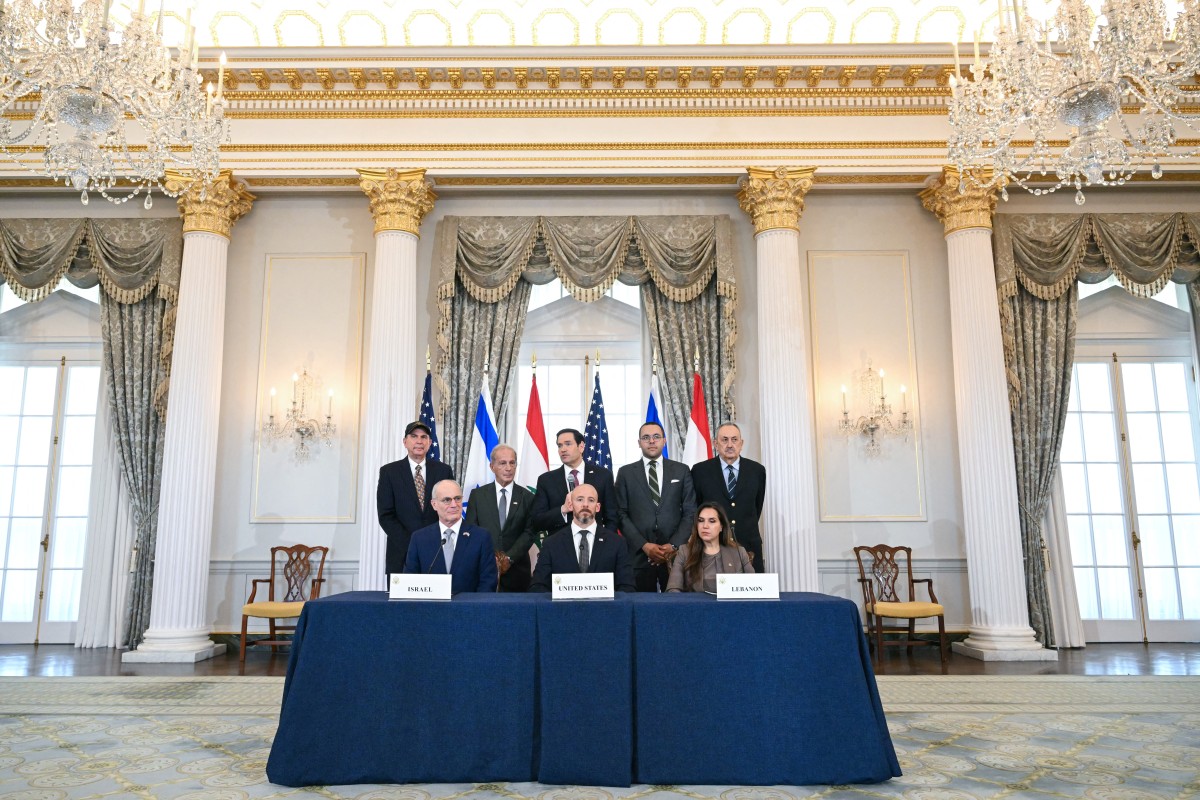
The agreement signed by Lebanon ensures that the state retains exclusive authority and prevents other actors from exercising dominance over its decisions. More importantly, the Lebanese people expect a decisive move by the state to assert full control—an expectation shared by several friendly countries that are awaiting the restoration of Lebanon’s sovereignty before providing greater support and assistance.
Many Lebanese initially hesitated over the agreement with Israel signed in Washington, as overcoming the psychological barrier surrounding such an agreement is not easy for many. The surprise surrounding the signing was heightened by the fact that it came after the fifth round of negotiations attended by the Israeli government under U.S. pressure.
At the same time, the agreement generated a positive surprise by countering what many viewed as dangerous provisions in the U.S.-Iran memorandum of understanding. Under that memorandum, Washington granted Tehran a decisive seat on the committee monitoring the ceasefire in Lebanon, raising serious concerns that Lebanon—not only Hezbollah—could become a bargaining tool in the hands of Iranian negotiators, strengthening Tehran’s position in the nuclear talks.
The framework agreement signed by Lebanon goes beyond reaffirming the ceasefire and discussing buffer zones. It establishes the foundations for a final agreement between Lebanon and Israel that, if successfully implemented and obstacles are overcome, could bring about an unprecedented historic transformation affecting not only Lebanon but the wider region. It would close the southern front, preventing wars unrelated to Lebanon from being fought on its territory and blocking the involvement of local or externally backed organizations.
It marks the beginning of a new phase in which weapons are held exclusively by the state while guaranteeing Israel’s withdrawal from occupied territories. This represents a historically significant and exceptionally bold step by the Lebanese authorities as they confront major domestic challenges while seeking to free Lebanon from both Israeli and Iranian regional agendas.
Lebanon did not compromise on affirming within the framework agreement that Israel’s withdrawal remains the ultimate objective of the negotiations. The agreement also emphasizes that the Lebanese Army is the only legitimate authority authorized to deploy in areas vacated by Israeli forces. Nevertheless, significant obstacles may still arise.
By describing the agreement as "the beginning of the beginning," U.S. Secretary of State Marco Rubio acknowledged that serious challenges are likely to emerge quickly. Chief among them is Lebanon’s responsibility to dismantle Hezbollah’s military infrastructure, which is viewed as the only path to ensuring not only Israel’s withdrawal but also the restoration of the Lebanese state’s sovereignty and independent decision-making.
The coming days are expected to clarify issues that go beyond the agreement’s basic headlines. The U.S.-Iran memorandum of understanding granted Tehran significant influence in Lebanon, presenting a major challenge to the Lebanese state.
The 14-clause framework agreement seeks to reverse that gain by removing this advantage. Hezbollah officials are therefore expected to reject the agreement, arguing that it contradicts the memorandum of understanding and maintaining their refusal to disarm or relinquish the party’s weapons.
Given Israel’s inability to impose such an outcome unilaterally, and considering the limitations of Lebanon’s military capabilities in this area, any lack of action or insufficient political resolve could turn Hezbollah’s disarmament into an obstacle. This could provide Israel with justification for extending—or even making permanent—its military presence in southern Lebanon, potentially reviving scenarios reminiscent of previous historical periods.
Israel has celebrated the agreement as a historic achievement, particularly in the context of its broader confrontation with Iran. This places greater importance on translating the agreement into tangible results rather than allowing it to remain a symbolic accomplishment, especially in light of past failures that remain fresh in public memory.
Its success ultimately depends on genuine commitment to implementation, particularly by Israel, whose interests have repeatedly converged with Hezbollah’s in ways that have come at the expense of the Lebanese state. It also depends on sustained U.S. support throughout the implementation process.
Lebanese citizens now look to President Joseph Aoun, who is overseeing the negotiation file, to address the nation and clarify the concerns that many have raised regarding the wording of certain provisions of the agreement. The framework agreement represents a historic achievement by every measure and serves as the first step toward restoring Lebanon’s sovereignty.
At the same time, it is essential to ensure that neither the Israeli narrative nor those seeking to exploit it dominate public discourse. Achieving this requires the broadest possible domestic support for the state’s official position, alongside strong Arab and international backing.
Such support has already grown, but it must continue to expand through a broad coalition similar to the one Secretary of State Marco Rubio relied upon during his meeting in Manama with the Gulf Cooperation Council, where he sought to build regional support for advancing the framework agreement.