

Lebanon caught between external rivalries and internal deadlock
A framework agreement whose implementation remains uncertain, shaped by ongoing regional rivalries between Iran and Israel, internal disputes over Hezbollah’s weapons, and concerns that external pressures may further weaken Lebanon’s already fragile political and institutional balance.



 Messenger
 Whatsapp
 Threads
 Email
Email
 Print
Print
 X
X
 Facebook
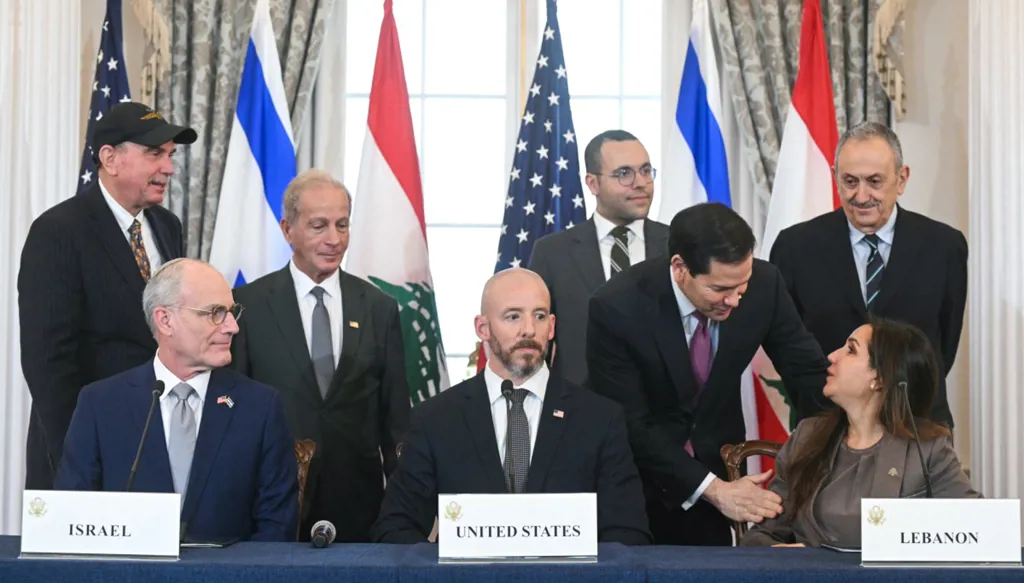


Axios perfectly sums up the situation. Given its identity and connections, it recognizes, as we all do, the scale of the challenges facing Lebanon, whether there is a framework agreement or not. This is especially true if the agreement signed between Lebanon and Israel under American sponsorship effectively legitimizes Israel's occupation of southern Lebanon.
The possibility of implementing the agreement brings us back to the classic chicken and egg dilemma. Which comes first? Israel is expected to withdraw only after weapons are brought under state control, meaning after Hezbollah is disarmed. Hezbollah, meanwhile, says it will discuss a supposed national security strategy only after a complete Israeli withdrawal from Lebanon, without making any explicit or clear commitment to give up its weapons. It also remains unclear whether the anticipated withdrawal would include the Shebaa Farms, which were deliberately left unresolved in 2000 to keep the conflict alive and justify the continued possession of weapons under Syrian Assad regime sponsorship and Iranian backing.
Axios wrote the following:
"Israel and Lebanon signed a framework agreement on Friday after four days of negotiations in Washington, mediated by the Trump administration. The signing is a significant diplomatic breakthrough, but it remains unclear whether the agreement can be implemented as long as Hezbollah remains armed and influential in the country. The framework agreement ultimately aims to end Israel's occupation of southern Lebanon and restore the country's territorial integrity, but that goal appears to be a long way off."
In just a few lines, Axios summed up the likely fate of the agreement by stating that ‘it remains unclear whether the agreement can be implemented’ and that achieving its ultimate objective ‘appears to be far from being achieved.
This also means that the situation will remain as it is, if not move toward worse conditions.
Iran, which has invested in Hezbollah for more than forty years and has lost other cards in the region, most notably the former Syrian regime, will not easily accept a new reality that eliminates its most important forward defense force. It will continue to fight until the last Shiite in Lebanon, continuing what it is currently doing. This struggle will take different forms and methods and will of course not bring stability to Lebanon and the Lebanese people until God brings about what has been decreed.
The party, which internally feels the scale of the pressure being directed against it without questioning the reasons that led to this situation, will not accept surrender or handing over its weapons. It has tied these weapons to its survival, turning them into an existential issue, without which it believes there is certain death.
Israel, however, which holds influence within the so called deep American administration despite all the public warnings from US President Donald Trump to Israeli Prime Minister Benjamin Netanyahu, and who could himself be abandoned personally, will not accept the continued presence of Hezbollah’s weapons near its borders. It will not withdraw under this agreement, as the conditions for withdrawal are not likely to be in place in the near future.
Thus, Israeli and Iranian interests converge in Lebanon. Each serves the other directly or indirectly, and the country remains hostage to larger external calculations.
The concern, the real concern, is that the agreement could backfire internally, producing negative consequences that may gradually accumulate and eventually paralyze state institutions, from the Council of Ministers to the Parliament.
Is this what is meant by sectarian strife, as stated by Speaker Nabih Berri? Perhaps. But avoiding such strife requires a different approach to this long standing and highly complex issue, especially since Speaker Berri himself launched the first national dialogue table in March 2006, which was disrupted by the July 2006 war, followed by repeated failures to reach any internal agreement on a defensive strategy that would prevent external interference.