

Understanding the Trump-Netanyahu Rift in US-Israel Relations
Bound by a dense web of strategic, military, and political ties, the US–Israel relationship has long been described as unbreakable—but evolving regional power balances and rising political frictions are exposing the limits of unconditional alignment.



 Messenger
 Whatsapp
 Threads
 Email
Email
 Print
Print
 X
X
 Facebook
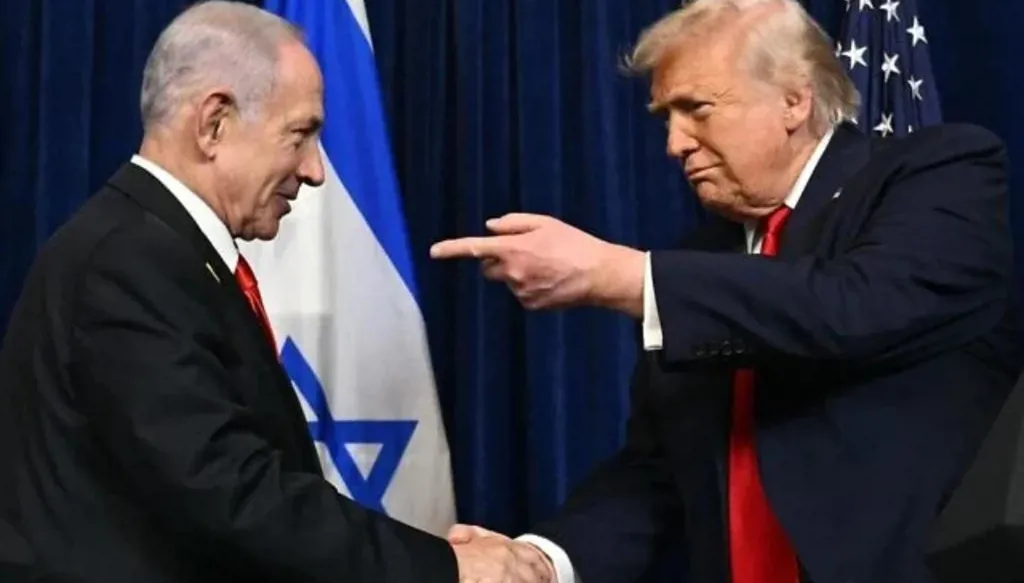


The Israeli analyst Zvi Bar’el summarized the tension between US President Donald Trump and Israeli Prime Minister Benjamin Netanyahu in the following terms:
“Millions of viewers are invited to watch on screens… everyone waits for Washington’s star in white and red… he adds entertainment to his short comedic performances when he tells how he reprimanded Netanyahu, humiliated him, crushed him, chewed him up and spat him out… and told him to leave… There is no prime minister or state that his close friend bullies in the same way he deals with the leaders of the Jewish state. It is true that he described French President Macron as ‘stupid’, criticized Zelensky as ‘ungrateful’, and said of the British prime minister that he is ‘not Churchill’… describing him as weak and hesitant, but he did not treat any of them with the same contempt as a ‘pet dog that carries out my orders’… US presidents have known how to disagree with Israeli policy and how to reject it… and how to get angry with its leaders and impose sanctions on it, but their behavior was always within the framework of agreed rules of the game, which state that maintaining Israel’s security is a supreme value.” (Haaretz, 10/6/2026)
Free hand
The problem is that this is happening between Netanyahu and Trump, who are similar in almost everything, and under whose leadership the Israeli–American relationship reached its peak across various fields. Trump’s first term (2017–2021) was marked by his absolute support for Israel in all respects, including withdrawing US sponsorship of the Palestinian Authority and the Oslo Accords, legalizing settlements, recognizing the annexation of the Golan Heights, closing the Palestine Liberation Organization office in Washington, and stopping funding to UNRWA.
In his second term, Trump provided massive military, technological, intelligence, political, and financial support to Israel, which is carrying out a war of extermination against the Palestinians. However, that situation, or the blank check, was withdrawn after the second round of the war on Iran, due to several factors, most importantly:
First, the collapse of the so-called “axis of resistance,” including the weakening of Iran’s regional influence after two rounds of war against it, the first in June last year and the second beginning in late February 2026, which eventually led to a framework agreement.
Second, the rising role of Saudi Arabia, Egypt, Turkey, the UAE, and Qatar in shaping regional equations at the expense of Iran and Israel.
Third, the framing of Israel as a political, security, economic, and moral burden internationally, including within the United States itself, which has begun to weigh on President Trump and on the chances of Republican success in the upcoming elections.
Fourth, following the above, the US administration has become freer in its policies in the region, after ensuring Israel’s long term strategic security and after the emergence of new regional allies. This contrasts with Netanyahu’s boast about Israel’s ability to act independently of US decision making.
By a web of countless ties
It is well known that Israel is tied to the United States by a thousand threads and threads—political, military, moral, and material—and that it has owed it guarantees of its security and superiority over its surroundings since its establishment (1948) until today.
By way of reminder, relations between Israel and the United States have witnessed many periods of tension, due to US administrations’ realization that Israel does not make US policies in the Middle East easier, or that it acts in ways that are irresponsible and threaten Israel’s security and, consequently, the stability of American interests.
This occurred when the United States forced Israel to withdraw from Sinai and the Gaza Strip (1956), after the tripartite aggression against Egypt, under the Eisenhower administration (1953–1961), which is considered the first president to clash with Israeli policies. It also happened during the Camp David Accords with Egypt (1978), under President Carter (1977–1981), who pressured Menachem Begin to withdraw from Sinai and dismantle the settlements there.
It was repeated under President George H. W. Bush (1989–1993), when the United States launched the war to expel the Iraqi army from Kuwait (1991) and prevented any Israeli intervention. It also occurred when President Bush forced Yitzhak Shamir, then Israeli Prime Minister, to participate in the Madrid Peace Conference (1991) despite his opposition, under the threat of cutting loan guarantees.
This also took place during the Obama administrations (2009–2017) and then under the Biden administration (2021–2025), when relations with Israel saw their highest levels of tension, in confrontation with Netanyahu’s government, as he played on internal US divisions between Democrats and Republicans. These disputes centered on demands to freeze settlement activity and on the 2015 nuclear agreement with Iran, which Israel strongly opposed. Tensions increased further under Biden, who opposed judicial reforms in Israel and Netanyahu’s attempt to reinforce Israel’s identity as a Jewish state over its democratic character, while seeking to marginalize the judiciary and control all branches of power in Israel.
The tension between Trump and Netanyahu may indicate, if it continues, that Netanyahu’s political era is nearing its end, and it also confirms that the era of unconditional American patronage of Israel is no longer available as it once was.
Disclaimer: The opinions expressed by the writers are their own and do not necessarily represent the views of Annahar