

Exploring the Complex US-Israel Relationship Dynamics
A critical reading of decades of cooperation and friction between Washington and Tel Aviv, where shared strategy often collides with diverging ambitions over war, diplomacy, and regional control.



 Messenger
 Whatsapp
 Threads
 Email
Email
 Print
Print
 X
X
 Facebook
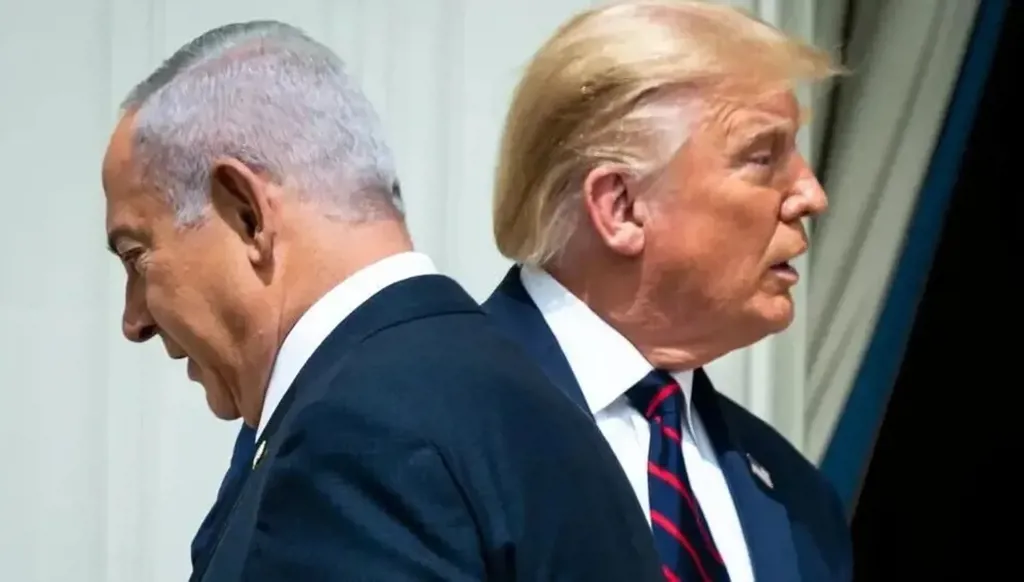


US President Donald Trump did not hesitate to rebuke Israeli Prime Minister Benjamin Netanyahu and force him to stop his destructive war on Lebanon, and to create an opportunity to consolidate the memorandum of understanding with Iran and bring the state of war to a final end. The “close friends” suddenly turned overnight into “bitter enemies,” divided by interests and visions, and the future of American Israeli relations has become at stake, at least during Trump’s term, who will not accept Netanyahu, who said that without America his state would not exist, sharing dominance over the Middle East. Trump returns to the undeniable truth: Israel is a state protected by the United States. Washington does not need to take the opinion of its prime minister on every detail related to American interests, and he must understand his own limits.
The establishment of Israel was the result of the convergence of interests between the Zionist movement and traditional colonial powers, especially France and Britain, at a historical moment that reshaped the world, removed empires, and changed borders after the First World War. At that moment, Britain granted Jews permission to immigrate to Palestine, promising them a national homeland there, based on the claim that it was a land without a people for a people without a land. The author of the promise, British Foreign Secretary Arthur Balfour, did not love Jews or seek to reward them, but rather disliked them and wanted to get rid of them, so he cast their burden onto Palestine and the surrounding region with a calculated intent whose consequences would become clear over time.
To be fair, Balfour was not alone responsible for the catastrophe that befell the Palestinians and the entire Middle East. Europe as a whole wanted to get rid of the Jews, who were seen as a social, religious, economic, and political problem, amid a wave of mutual hostility between them and Christians that lasted for centuries and reached its peak during the Second World War, when the Nazi leader Adolf Hitler killed large numbers of them.
In the aftermath of direct colonialism following the Second World War, the United States took the lead of the Western world and assumed the role of guardian father of the newly born entity, which also continued to enjoy European support as an act of atonement for an “imaginary guilt complex” that Zionist propaganda worked to implant in the minds of Europeans. Entire peoples and governments were drawn into the Zionist narrative about historical victimhood in Europe, and later about alleged Arab and Muslim hostility toward them and their supposed intent to exterminate them and throw them into the sea, exploiting statements and positions of Arab leaders and parties that adopted a hardline liberation discourse against the Israeli occupation of Palestine.
The United States continuously supported Israel with money and weapons, establishing air bridges and deploying fleets to protect it and supply it with the most destructive types of arms during its wars with the Arabs. It shielded it in the Security Council by using the veto against any resolution targeting it, and fought on its behalf against the International Criminal Court, the International Court of Justice, and human rights organizations. Although no American president deviated from viewing Israel as a base or even an American state, relations between the two countries witnessed several tensions, most of which stemmed from differences in vision regarding peace in the region and the failure of Israeli governments to respond to American plans in this regard.
The first tension in relations between the two countries occurred during the tripartite aggression against Egypt after the nationalization of the Suez Canal in 1956 and the occupation of the Sinai Peninsula, when US President Dwight Eisenhower forced Israel to withdraw, for reasons related to France and Britain, Israel’s partners in the aggression, threatening to cut off aid to them.
President Gerald Ford pressured Israel in 1975 to withdraw from Sinai, which it had occupied in the June 1967 war, but it did not respond to his pressure until it signed the Camp David Accords with Egypt under President Jimmy Carter in 1979. The United States later objected to the bombing of the Iraqi nuclear reactor in 1981, the bombing of Beirut during the 1982 invasion, and the expansion of settlements in the West Bank. George H. W. Bush forced Israeli Prime Minister Yitzhak Shamir to attend the Madrid Peace Conference, and the US administration imposed the Oslo Accords on both Israel and the Palestinians. However, all those tensions were unable to restrain Israeli governments from continuing their wars and Judaization plans in the Palestinian territories, and from annexing Jerusalem and the Golan Heights and obtaining US recognition of them under Donald Trump, whom Netanyahu considered Israel’s most loyal friend.
Disclaimer: The opinions expressed by the writers are their own and do not necessarily represent the views of Annahar