

Ceasefire Brings Return for Many, but Thousands Still Have No Home to Go Back To
Uncertain return conditions for displaced families as updated figures remain unavailable and widespread destruction prevents many from going home



 Messenger
 Whatsapp
 Threads
 Email
Email
 Print
Print
 X
X
 Facebook
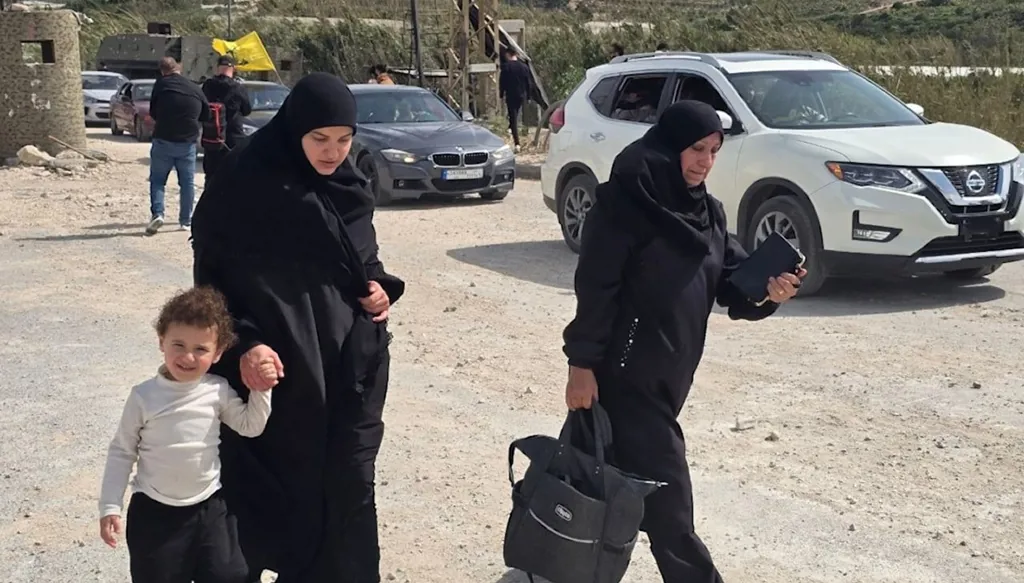


The current ceasefire does not resemble Lebanon’s previous attempts to stabilize truces since the announcement by President General Joseph Aoun on Friday evening, April 17, of last year, of a ceasefire in Lebanon after 45 days of extensive Israeli aggression. However, the question remains: what are the conditions of the displaced people, have they returned to their homes, and where will those whose towns were destroyed return?
No figures
The Ministry of Social Affairs has not, to date, issued any updated statistics on the number of displaced people in shelter centers or on the number of those who left these centers after the latest ceasefire. Annahar attempted, without success, to obtain data from the ministry regarding the numbers, the places to which returnees went, and whether there is a plan to establish shelter centers in towns where residents lost their homes.
According to the latest available figures on the number of displaced people in shelter centers, more than 137,000 people were residing in around 700 shelter centers in Beirut and other Lebanese regions. Most of these centers were schools, in addition to the Sports City stadium. The number of displaced people in shelter centers represents less than 13 percent of the total displaced population, which reached 1.1 million, one third of whom are children.
However, United Nations organizations report that many families have left shelter centers and returned to their original communities, whether in the southern suburbs of Beirut or in the south.
According to researcher Mohammad Shams al-Din, the number of people returning from shelter centers is around 60 percent. He told Annahar that out of 135,000 displaced people in shelter centers, 80,000 have left those centers, leaving the current number at 55,000 displaced people to date. He notes that many displaced people have lost their homes and therefore have nowhere to return to.
He points out, for example, that in relation to completely destroyed buildings, 4,500 housing units were fully destroyed in the southern suburbs of Beirut, meaning that the owners of these units will not return to their original homes and will either have to remain in shelter centers or seek a new place to live.
In the south, many towns have been completely wiped out, and their residents have lost their places of residence. In frontline border villages, destruction in some areas has exceeded 90 percent, meaning that owners of destroyed homes have lost the places they were supposed to return to, if withdrawal from those towns takes place.
As for towns outside what is known as the “yellow zone,” tens of thousands of housing units have been destroyed or severely damaged and are no longer suitable for living. This means that tens of thousands of families have lost their places of residence and are forced to search for new housing, either by relying on municipalities to provide shelter centers within those towns, staying temporarily with relatives, which is not a preferred option, or turning to the market system and renting housing at high prices under supply and demand pressures.
Shams al-Din indicates that the number of housing units completely or partially destroyed in the south and Nabatieh reaches 68,750 units, while 58,900 units have suffered damage.
It is noted that some municipalities may begin establishing temporary shelter centers for returnees, in addition to the possibility of opening schools that were not destroyed or damaged to serve as temporary shelter centers.