

Netanyahu’s push for military self-reliance puts US-Israel alliance under strain
Between political messaging, strategic dependence, and shifting US dynamics, analysts say Israel’s talk of defense independence remains more theory than reality, tightly bound to Washington’s support system.



 Messenger
 Whatsapp
 Threads
 Email
Email
 Print
Print
 X
X
 Facebook
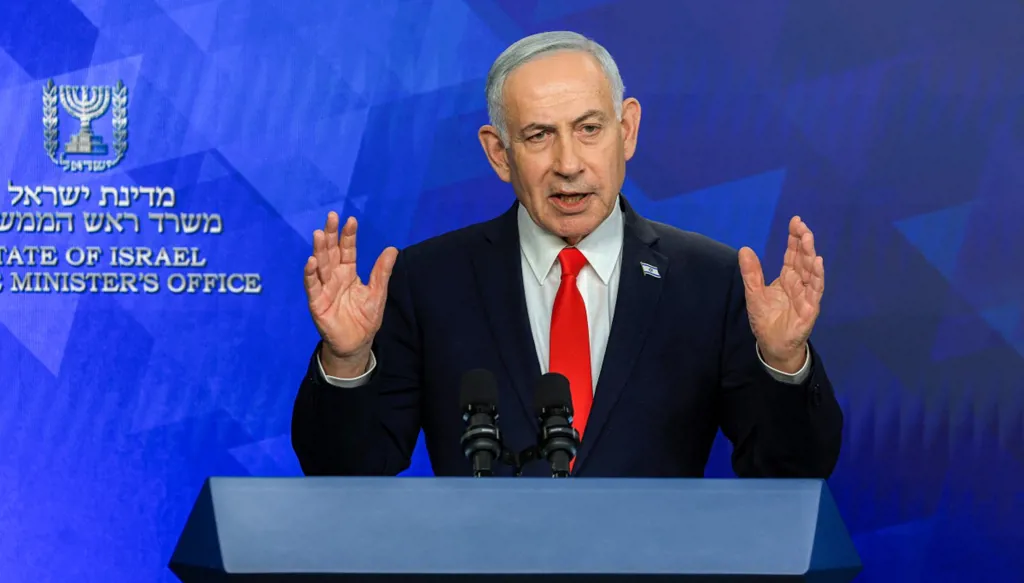


The efforts of Israeli Prime Minister Benjamin Netanyahu to end reliance on American weapons and build an independent defense manufacturing system place the strategic relations between Israel and the United States before an unprecedented test.
The danger of this approach lies in the fact that it directly affects the Israeli national security equation, which is based on American support. While the project is presented as a strategic step to free military decision making from American restrictions and conditions, the realities on the ground, along with the deep technical and economic interdependence with Washington, impose challenges that could make the plan for independence almost impossible.
This structural gap raises a complex question: Is Netanyahu moving according to an alternative and viable armament vision, or is the announcement nothing more than a political maneuver to reshape the margins of maneuver with the US administration?
The American test of Netanyahu’s gamble
The journalist specializing in US affairs, Mohammad Al Satoohi, told Annahar that US Israeli relations are currently going through a real crisis.
He points out that Netanyahu has historically relied on strengthening his relationship with the United States through an alliance with the right wing and the Republican Party, as well as the ideological right represented by evangelical Christians. This allowed him to maneuver against Democratic administrations from within, as happened in 2015 during the crisis over the signing of the Iranian nuclear deal under former President Barack Obama, when Netanyahu delivered a speech before Congress at the invitation of the Republican leadership at the time.
Al Satoohi explains that Netanyahu’s current dilemma lies in Donald Trump’s dominance over the Republican Party, which has eliminated previous room for maneuver when disagreements arise.
He supports this by pointing to attacks launched by right leaning newspapers closely connected to Republican donors, such as Israel Hayom, owned by billionaire Miriam Adelson, one of the main funders of Trump’s campaign. He sees this as an indicator of a desire within influential American circles and major pro-Israel political figures, such as Mark Levin and Ben Shapiro, as well as the American Israeli Public Affairs Committee AIPAC, to curb Netanyahu’s efforts to disrupt Trump’s strategy regarding the Iranian file.
Limits of military independence
On the military and logistical level, Al Satoohi believes that talk of Israel gradually dispensing with American aid and weapons is theoretically possible but extremely difficult in reality. Despite Israel having a highly advanced weapons industry that forms a key pillar of its technological exports, it still relies entirely on the United States for advanced systems such as the F 35 and F 15 aircraft, as well as ammunition and aerial refueling.
In this context, Al Satoohi reveals a leaked report from the US Central Intelligence Agency (CIA) issued weeks ago, stating that the American missile defense system intercepted more missiles during the recent war against Iran and Hezbollah than Israeli defense systems did, which confirms that Israeli dependence remains.
He also considers American diplomatic support to be even more important than military support, citing Washington’s repeated use of its veto power in the UN Security Council to prevent any resolution condemning Israel during the Gaza war.
/WhatsApp%20Image%202026-06-24%20at%208.23.55%20AM.jpeg)
An election speech and messages to Washington
On his part, researcher and expert on Israeli affairs Nizar Nazzal offered, in an interview with Annahar, an analysis focusing on Netanyahu’s statements about the near achievement of military self-sufficiency, considering that they are primarily directed at the Israeli domestic audience and the American political elite.
Nazzal argues that Netanyahu is trying to market this idea as a “major strategic achievement” in order to attract voters in the “gray zone,” those who have not yet decided their voting preferences between centrist and right-wing parties, such as Yair Lapid and Gadi Eisenkot. The goal is to secure political gains ahead of the elections scheduled for October 20.
He adds that Netanyahu aims through this messaging to pressure the American elite to align with his vision regarding the management of the Lebanon, Gaza, and Iran files.
A stable alliance and a tactical disagreement
Nazzal asserts that the current dispute is a “tactical disagreement between political elites, not a disagreement between two states,” emphasizing that the alliance between Washington and Tel Aviv remains strategic and stable.
He explains that the current contradiction lies in party calculations, as the American ruling elite believes that resuming war with Iran would harm Republican Party interests, while the Likud Party and Netanyahu see that stopping the war would harm their immediate political interests.
Nazzal points out that Israel is facing a state of international isolation, particularly with the issuance of arrest warrants by the International Criminal Court against its leaders, and the emergence in the United States of a growing current that views Israel as a “burden” after the recent war.
He concludes that Israel, not being a permanent member of the UN Security Council, is unable to protect itself diplomatically, legally, or face the international community alone if it were to lose the American umbrella, making the idea of dispensing with Washington unworkable.