

The only thing Lebanon can thank Iran for
As Iran places Lebanon at the center of its regional calculations and negotiations with Washington, a growing debate emerges over whether its influence has protected the country, or contributed to occupation, destruction, and the weakening of state institutions.



 Messenger
 Whatsapp
 Threads
 Email
Email
 Print
Print
 X
X
 Facebook
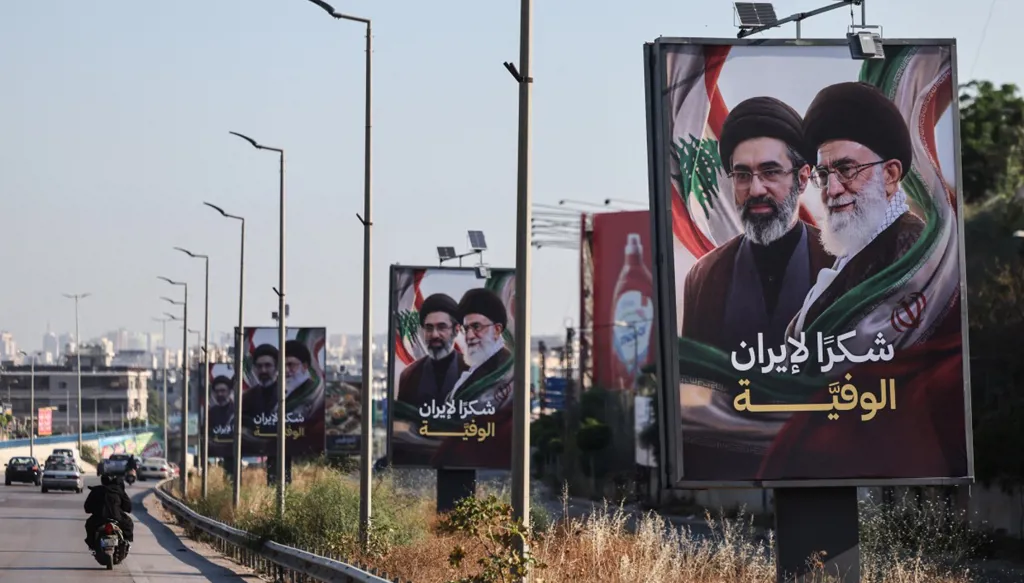


Lebanese people are often left searching for a reason to thank Iran, especially in light of its role since members of the Revolutionary Guards entered the city of Baalbek in the summer of 1982 and took over a Lebanese Army barracks, the Sheikh Abdullah Barracks, as their headquarters.
This, in itself, means that the Islamic Republic has consistently targeted Lebanese state institutions and worked to undermine them, one after another, for more than four decades.
In 2026, however, the confusion dissipated, not because Iran gave the Lebanese a reason for gratitude, but because it became clear why some might be expected to thank it. The reason is both obvious and deeply troubling: the Islamic Republic's efforts have effectively contributed to the return of Israeli occupation to South Lebanon.
Hezbollah shows no hesitation in raising signs along the road to Beirut's Rafic Hariri International Airport thanking Iran. Iranian audacity regarding Lebanon appears boundless. For Tehran, Lebanon serves primarily as a bargaining card to be used in negotiations with the United States in pursuit of an agreement that secures the future of the regime.
What Iran seeks is American recognition of its hegemonic role in the region, without regard for a changing regional reality—one in which Syria has broken away from Iranian control and Lebanon has chosen direct negotiations with Israel rather than remaining a subordinate element in talks between the Islamic Republic and the "Great Satan" in Switzerland, mediated by Pakistan and Qatar.
The Bitter Truth
Ultimately, the blame does not lie with Iran alone. It also lies with those in Lebanon who continue to accept the remedies offered by Tehran. Those who believe that the Islamic Republic can do something positive for Lebanon overlook a bitter reality.
That reality is reflected in Israel's occupation of roughly ten percent of Lebanese territory, the destruction of around one hundred villages, and the displacement of approximately 1.2 million Lebanese from their lands, villages, and towns. The overwhelming majority of those displaced belong to the Shiite community.
These developments were the direct outcome of Iranian intervention in Lebanon and its complete control over Hezbollah, which sought revenge for the killing of Ali Khamenei, Iran's Supreme Leader, on February 28 of last year, starting from South Lebanon.
It is particularly striking that Iran chose to place Lebanon at the forefront of negotiations between a delegation led by Mohammad Bagher Ghalibaf and Abbas Araghchi and an American delegation headed by Vice President J.D. Vance. The Islamic Republic's objective was simple: to trade Lebanon as a negotiating card.
Any Lebanese citizen applying basic logic understands that Iran has little to offer the country. What it can offer, however, is the continued consolidation of Israeli occupation.
Iran Fleeing Responsibilities
By putting Lebanon at the center of its rhetoric and claiming to defend it, Iran seeks to evade the major responsibilities it will inevitably have to confront.
Among these questions: Is Iran a normal state or not? Will it permanently abandon its nuclear program aimed at developing a nuclear bomb? Will it give up its ballistic missile program? Will it abandon the network of armed groups it supports across Iraq, Lebanon, and Yemen, foremost among them Hezbollah?
These are responsibilities that cannot be avoided indefinitely. They also include Iran's relationship with its Arab neighbors, especially after it became evident that the regime has never abandoned its hostile approach toward the region, particularly the six member states of the Gulf Cooperation Council.
Whether Lebanon thanks Iran or not, what ultimately matters is that the Islamic Republic stop treating Lebanon as nothing more than a card in service of an expansionist project that now belongs to the past.
That project worked systematically to weaken Lebanese institutions and spread a culture of death throughout the country. The Lebanese resisted the Iranian project and continue to resist it. Before that, they resisted the Syrian project backed by the late Hafez al-Assad and later by his son Bashar al-Assad, who ultimately ended up as a refugee in Moscow.
There is only one service Iran can provide that would genuinely merit Lebanese gratitude: persuading Hezbollah to abandon its weapons—if it truly wishes to see the end of Israel's occupation of part of Lebanon.
Beyond that, Iran serves only the continuation of the Israeli occupation in South Lebanon, as well as the destruction and displacement carried out by the Israeli state in that cherished region of the country.
Disclaimer: The opinions expressed by the writers are their own and do not necessarily represent the views of Annahar.