

UAE Signs Agreement to Boost Financial Compliance and Anti-Money Laundering Expertise
Partnership between Ministry of Economy and Tourism and Emirates Institute of Finance aims to enhance national capabilities in AML, governance, and financial oversight aligned with FATF standards.



 Messenger
 Whatsapp
 Threads
 Email
Email
 Print
Print
 X
X
 Facebook
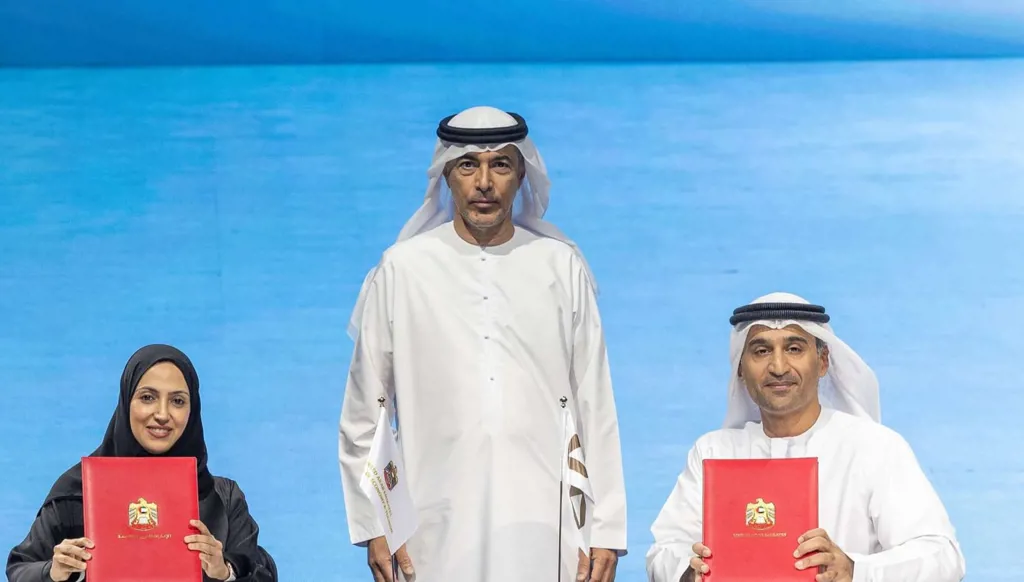


The UAE Ministry of Economy and Tourism signed a memorandum of understanding with the Emirates Institute of Finance aimed at strengthening institutional cooperation in the areas of financial training and qualification, building national capabilities, and exchanging expertise and knowledge in financial supervision and management, as well as in combating money laundering and financial crimes. The agreement also supports initiatives related to governance and institutional compliance.
Safia Al Safi, Assistant Undersecretary for the Commercial Control and Governance Sector at the Ministry, told the Emirates News Agency “WAM” that the memorandum reflects the Ministry’s commitment to strengthening national partnerships aimed at developing human capital and enhancing the readiness of national talent to keep pace with the rapid changes in the business environment and the financial sector, as well as addressing money laundering and combating terrorist financing. This supports the country’s objectives of building a competitive knowledge and innovation-based economy.
Al Safi added that the memorandum establishes an integrated framework for designing and implementing specialized training programs to qualify compliance personnel in business sectors and designated non-financial professions. This includes advanced programs in combating money laundering, terrorist financing, and proliferation financing, as well as enhancing their capabilities in risk assessment, applying due diligence measures, and monitoring suspicious transactions in accordance with the standards of the Financial Action Task Force “FATF”.
The Financial Action Task Force is an international reference body that sets standards for combating money laundering, terrorist financing, and proliferation financing. It defines best practices that countries and institutions rely on to strengthen compliance systems and financial oversight. Reference to its standards is important for measuring the readiness of relevant entities to detect risks and deal with suspicious transactions in a way that supports transparency and strengthens market confidence.
Marwan Al Muhairi, Chief Executive Officer of the Emirates Institute of Finance, noted that signing the memorandum represents a strategic step toward strengthening joint cooperation in building and developing national expertise in financial and regulatory fields. He stressed that the partnership reflects a commitment to empowering national talent through specialized training programs aligned with the highest international standards.
He stated that the memorandum focuses on developing specialized skills in the areas of combating money laundering and terrorist financing, which enhances the readiness of national talent in risk assessment and monitoring in line with FATF standards. He also noted the institute’s aspiration to expand cooperation in training and the exchange of knowledge and expertise.
The memorandum provides for the development and implementation of specialized training programs in financial and economic fields, the execution of joint initiatives to enhance institutional capabilities and develop modern frameworks and methodologies in financial management and governance, as well as the exchange of studies, research, and technical reports, and the organization of joint workshops, seminars, and conferences.