

The Risks of Turning Syria into Washington’s Enforcer in Lebanon
From Syria’s shifting ambitions to Lebanon’s fragile sovereignty, the region risks repeating old patterns where external “protection” turns into internal collapse.



 Messenger
 Whatsapp
 Threads
 Email
Email
 Print
Print
 X
X
 Facebook
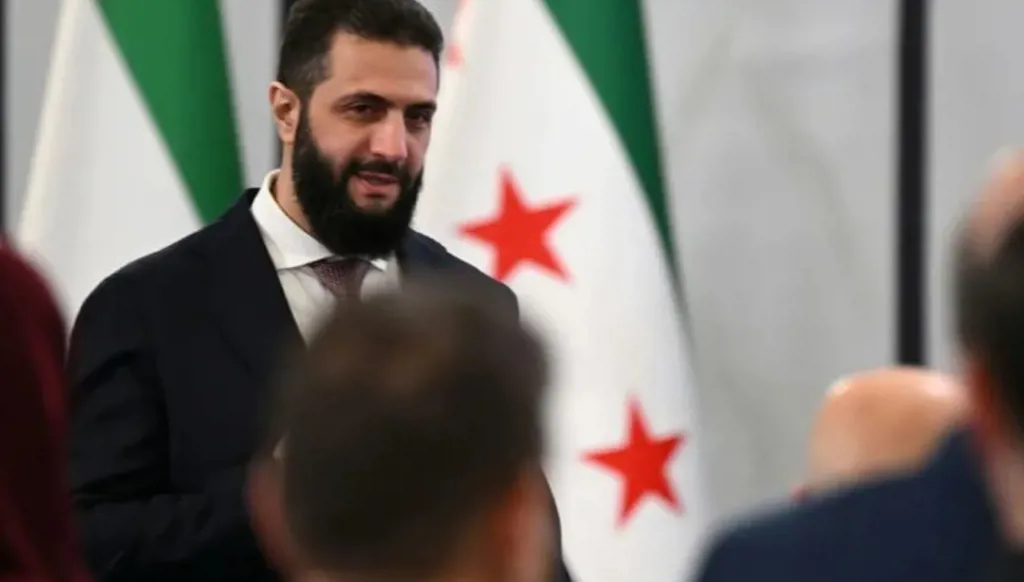


It is no longer a secret that the American and Syrian decision to impose Syrian guardianship over Lebanon has been made. Rather, it has become a practical reality whose signs are visible in the movements of “undisciplined” fighters in northern Lebanon. It seems that the Syrian authorities are voluntarily moving into a crisis that leads to an even greater crisis.
In his recent interview with Al Mashhad TV, Ahmad al-Sharaa presented himself as someone who possesses a superior diagnosis of the Lebanese crisis: “some Lebanese,” “prisoners of the past.” Traditional solutions are over. Lebanon needs a comprehensive framework of political, economic, social, and security solutions.
Hezbollah must find its place within the state. The Shiite component needs reassurance. Israeli concerns cannot be ignored. These are fine-sounding words, not unlike those of Hafez al-Assad when he entered Lebanon, but this is not the language of a harmed neighbor; it is the language of a guardian appointed over Lebanon.
What if Hezbollah does not lay down its arms?
Does al-Sharaa believe that this discourse will convince Hezbollah to give up its arms? And if it does not lay down its weapons, does al-Sharaa see in the Syrian army the capacity to once again manage an internal civil war?
During the Assad era, the Syrian people came to understand what it means for Syria to become the region’s “big bully.” That experience turned into blind brutality by internal security apparatuses, the strengthening of corrupt joint mafias, and a deepening fragmentation on both sides of the border, and so on.
For his part, al-Sharaa clearly needs recognition, funding, and a role. And here he is offering the services of his “army” to Washington and Tel Aviv as a “reliable” regional policeman.
While Syria continues to boil and erupt with contradictions and crises, and while it struggles on a difficult path toward building a state, legitimacy, a social contract, and national unity, al-Sharaa prefers to escape forward. He is even tempted by the game of civil wars in other people’s countries, entering under the pretext of sponsoring a top-down settlement by force of arms into a country where the legitimate Lebanese authorities face major difficulties in monopolizing weapons and the decision of war and peace in Lebanon.
As Donald Trump turns his back on the Middle East, he looks for proxies. And this, frankly, is the essence of the mission he assigns in Lebanon.
The so-called agent is theoretically required to disarm Hezbollah, and this will not be done with the kind words seen in the interview on Al Mashhad TV, but with iron, fire, and jihadist fighters. And it will be done at the expense of the Lebanese state, to teach the Lebanese the art of “national reconciliation” and civil peace.
What appears to be an opportunity from Washington is in fact nothing but a trap for Damascus. Trump can shift alliances at any moment, and the one who turned against Germany, France, and Britain will not be restrained by Tom Barrack’s whispers from overturning the table in the face of the Syrian authority, while Trump himself now seems like a lame duck.
From guardianship to occupation: a dangerous precedent
Trump will leave soon, but Syria and Lebanon cannot leave geography. And what begins as a political assignment will inevitably turn into clashes, killings, and war. With whom and against whom? With Israel? With Iran? With Trump? What irony. And what begins as a soft form of guardianship will end in a war for which no one holds the key to stop it.
Under the same slogans, Assad entered Lebanon in 1976: “to prevent collapse and control the civil war.” After that, Syrian and Lebanese blood exploded, and the Lebanese economy turned into a branch of Syrian mafia networks. It did not produce national reconciliation, but rather built a system of security balances that reinforced hidden sectarian war.
At times it fought the Palestinians, at times it balanced the Maronites, at times it contained the National Movement, and it left each sect with enough fear to keep it dependent on Damascus.
The result was that both Lebanon and Syria were deeply damaged. The Syrian presence did not prevent Israel’s invasion nor the expansion of Hezbollah, and Lebanon became a diminished state trapped in cycles of corruption and failure. A permanent civil war structure was entrenched in Lebanon.
Today’s dilemma is even more dangerous. In Assad’s time, Syria was a centralized security state with a cohesive Soviet-equipped army. How can a new army of a state still in formation, emerging from a long civil war, whose military and security institutions are fragmented, ideological, and revenge-driven, and part of which still depends on various funding sources, succeed in a mission that failed America, France, Israel, and Iran alike—especially in a country whose memory is still bleeding from previous Syrian guardianship?
Hezbollah loses if it confronts the Lebanese state over its weapons, but it gains if pressure comes from outside. Its weapons will gain the legitimacy of “resisting the American–Israeli project,” but this time against Syria. Thus, the Syrian role becomes a political gift to Hezbollah.
After that, we move to regional civil war. Lebanon is not a purely internal arena. Sunnis, Shiites, Christians, Druze, Palestinians, Syrians, Iranians, Israelis, Americans, Turks, and Arabs will all enter maps of fear and conflict.
Any friction between Syrian factions with jihadist Islamist backgrounds and Hezbollah will not remain a border skirmish. It will revive the memory of the Syrian war inside Lebanon, Hezbollah’s war against the Syrian uprising, Arab–Iranian conflict narratives, as well as Israeli fears and Turkish calculations. At that point, the elements of a regional civil war are complete: societies fighting by proxy for states, states mobilizing militias, and militias swallowing states.
In the end, there are two scenarios: either Sunni and Shiite political Islam converge against the nation-state, citizenship, and freedom in the region, or the two projects collide in Lebanon and across the region. In all cases, neither Syria nor its state will be spared the fire.
In wars, politics is not measured by “soft” words, but by the claws sunk into the body of the region. And in a time when the world stands on the threshold of a third war, part cold and part hot, it is naïve to think the logic of guardianship can still work after the region has opened its doors to the world’s demons fighting their wars by proxy and directly. The Levant is skilled at turning tools into burdens.
Rebuilding Lebanese sovereignty and statecraft
Lebanon should realize that it is not enough to reject Syrian guardianship alone; it must reject all forms of guardianship. Sovereignty is indivisible. Lebanon does not need someone to save it from above; it needs a state that rebuilds itself from within, with support rather than external tutelage.
For Washington, it may seem like a smart tactical move to throw Syria into this furnace as a card to play, but the lifespan of such an adventure will not last longer than that of Donald Trump, who has already become a lame duck. Sooner or later, Israel will not accept the presence of a jihadist force along its northern border.
As for Syria, it does not need to be assigned a new regional role before it rebuilds itself. Time and again, those who entered Lebanon believing it would offer a solution soon found themselves leaving it after both Lebanon and they were burned.
Disclaimer: The opinions expressed by the writers are their own and do not necessarily represent the views of Annahar.