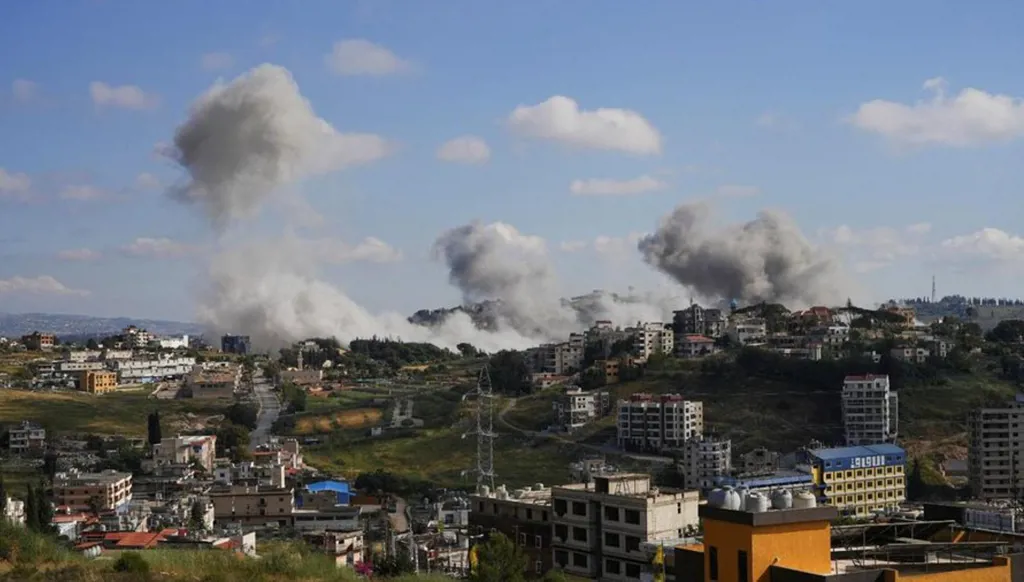
Has Israel abandoned its bid to seize Ali al-Taher hill?

Lebanon 22-06-2026 | 15:46

Has Israel abandoned its bid to seize Ali al-Taher hill?

Amid continued Israeli airstrikes and questions over post-ceasefire dynamics, analysts debate whether Israel is still pursuing its objective of controlling Ali al-Taher Hill and the surrounding highlands.


Has Israel abandoned its bid to seize Ali al-Taher hill?
Israeli airstrikes on southern areas
Smaller Bigger


After the intensity of military operations in the south eased over the past few hours, the key question remained: Could Israel have abandoned its objective of taking control of the strategically important Ali al Taher hill?


Several weeks ago, strategic expert and retired Major General Abdul Rahman Chehailti assessed that "the ultimate objective of this offensive is to seize Ali al Taher hill and the connected and supporting highlands, namely Dabsha, Toura, and Kfar Tebnit, extending to Sajd and Al Rihan, with the aim of establishing control over the heights of the Iqlim al Tuffah region, including the Mleeta landmark.


This is based on two considerations. The first is military, through gaining control of Hezbollah's largest fire base, which is positioned on and beneath these elevated areas. The second is symbolic, consisting of raising the Israeli flag over the Mleeta landmark, which Hezbollah has turned into a site displaying its war trophies."


Although Israel deliberately refrained from publicly stating its objectives from the beginning of the offensive, the movement of its units on the ground suggested that they were advancing toward achieving this goal.


Chehailti added: "This explains the Israeli celebration of the capture of Beaufort Castle, followed by its advance to Kfar Tebnit on the outskirts of Ali al Taher hill."


According to military information, Ali al Taher hill, which Israel had launched six attempts to capture up until recently and where it sustained acknowledged losses, remained under Israeli control until its withdrawal from southern Lebanon in 2000.


The hill was an almost daily target for Hezbollah, which lost dozens of fighters in efforts to liberate it because it posed a threat to both its forces and the city of Nabatieh and its surrounding villages.


The hill rises approximately 700 meters above sea level, making it about 100 meters higher than Beaufort Castle. It overlooks the Khardali crossing and commands views of the heights of the Iqlim al Tuffah region on one side and Nabatieh and its villages on the other.


Based on these strategic realities, following Israel's withdrawal in 2000, Hezbollah transformed Beaufort Castle, Ali al Taher hill, the surrounding hills, the heights of Iqlim al Tuffah, and parts of the Jezzine highlands and the Western Bekaa into fortified positions. This was facilitated by the area's dense woodland terrain and its near absence of population centers, in addition to the existence of multiple access routes that make encirclement difficult.


It is also worth noting that Hezbollah held its first symbolic military parade in this area. In 2022, the group invited around 200 local and international journalists to attend a display by its fighters at an open training camp there. At the time, the event was seen as a challenge to Israel, while Israel viewed it as tantamount to a declaration of war against it. It was not long before those expectations appeared to be confirmed.


It is no secret that in the period following the ceasefire agreement of November 27, 2024, Israel concentrated its airstrikes and drone attacks on the area stretching from Beaufort Castle and Ali al Taher hill to the heights of the Iqlim al Tuffah region.