

Lebanon navigates economic reconnection and rising uncertainty in the South
Lebanon’s fragile recalibration between economic reopening and southern security tensions.



 Messenger
 Whatsapp
 Threads
 Email
Email
 Print
Print
 X
X
 Facebook
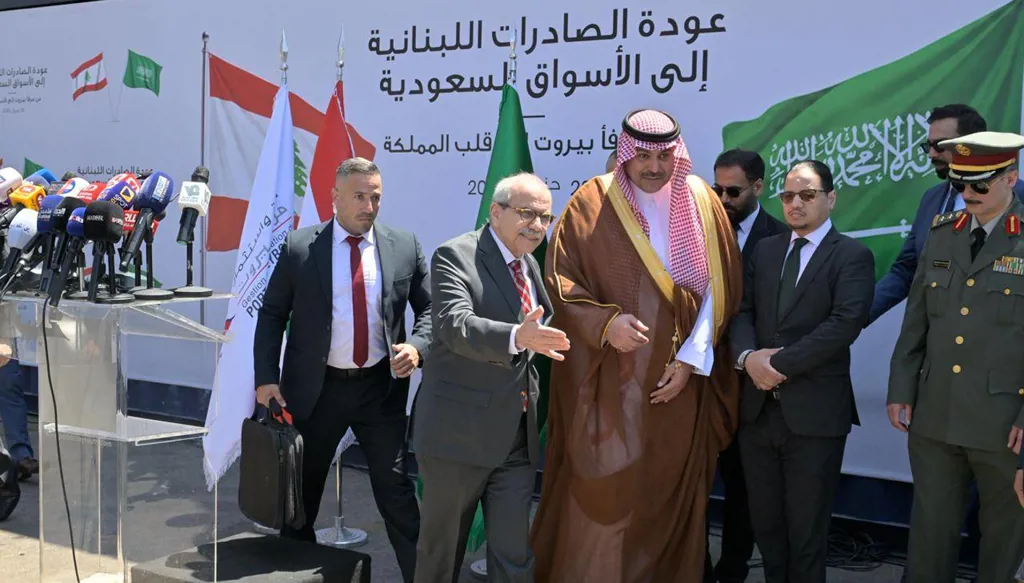


The Saudi ambassador Fahd bin Abdulrahman Al Dossari presented his credentials to Lebanese President Joseph Aoun on June 19, following days after Crown Prince Mohammed bin Salman instructed the resumption of Lebanese exports to the Kingdom.
President Aoun expressed his deep gratitude and appreciation to the Saudi Crown Prince, considering the resumption of importing Lebanese products into the Kingdom as a reflection of the Saudi leadership’s commitment to supporting Lebanon and its people during a phase of recovery and renewal.
Prime Minister Nawaf Salam viewed the lifting of the ban as a decision that opens a practical path for the economy, not merely a diplomatic signal. He said it confirms Riyadh’s efforts to support the state in Lebanon through various means, aiming to enable it to achieve security and stability.
At the Port of Beirut, with the launch of the first container bound for the Islamic Port of Jeddah, Prime Minister Salam said that Lebanon is witnessing a long-awaited moment, stressing that Beirut will not allow Lebanon to become a launch point for any harm to Arab brothers.
Ambassador Fahd Al Dossari said that the relaunch of exports confirms Saudi Arabia’s support for Lebanon’s stability, the strengthening of its sovereignty over its entire territory, and the wellbeing of its people. He said it also reflects confidence in the Lebanese state’s ability to prevent the use of its territory as a platform to harm its brothers.
He added that Saudi Arabia does not separate the economy from security, and that while it is reopening its market to Lebanese exports, it is doing so because Beirut has become more capable of controlling ports, the airport, and border crossings, in full coordination with Riyadh, to counter any prohibited goods that some parties or criminal groups may attempt to smuggle into Saudi territory.
Restoring trust with the Gulf states
These developments give the Lebanese government a margin of action, even if some consider it limited, but it remains important and indicates that the state is taking steps toward broader structural and administrative reform.
Gulf trust will be reinforced day after day through more efficient customs management, technical monitoring of shipments, direct cooperation with Saudi authorities, and the drying up of smuggling routes.
The success of this mechanism would turn the Saudi decision into a broader gateway for reconnecting Lebanon with its Arab economic environment, whereas any failure would bring the discussion back to the initial point of doubt, raising again the question of the state’s ability to control its ports and borders with strictness and precision.
Ongoing hostilities in the South
At the same time, the situation in southern Lebanon remains the most dangerous factor. The announcement of a ceasefire between Israel and Hezbollah, brokered by the United States and Qatar, remains fragile, despite the fact that Israel’s political leadership said it had informed the military command to halt combat operations while maintaining positions inside Lebanese territory.
The Iranian American negotiations in Switzerland show that Tehran insists in its discussions on implementing the first clause of the memorandum of understanding, namely a ceasefire across all fronts, including Lebanon, while Tel Aviv seeks to retain freedom of action.
This turns the southern arena into something like a “message box” exchanged between the two rivals, Iran and Israel, through which each side tries to impose a new reality that serves its political and security interests and improves its future bargaining position.
The situation in Lebanon is complex, but the government continues to rely on diplomacy as a way out of the war, paving the way for the withdrawal of Israeli occupation forces, the return of displaced people, the start of reconstruction, and the restriction of weapons to the state alone.
This path is a difficult one, that requires sustained effort, patience, and a combination of diplomacy with bold national decisions supported by friendly countries.
Disclaimer: The opinions expressed by the writers are their own and do not necessarily represent the views of Annahar.