

Serwan Baran: Painting the aftermath of war between Baghdad and Beirut
From Hamra Street to the ruins of memory, the Iraqi artist turns the human body into an archive of violence, exile, and survival after war.




 Messenger
 Whatsapp
 Threads
 Email
Email
 Print
Print
 X
X
 Facebook
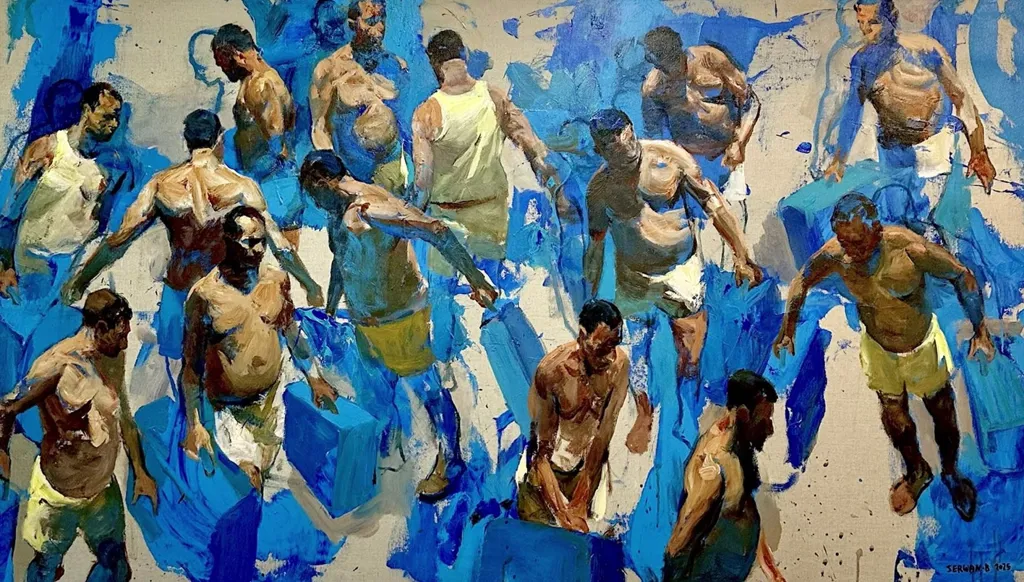


In Hamra Street, traversed by poets, exiles, journalists, and Arab playwrights, Iraqi artist Serwan Baran lives as if in a station unsuited for return and offering no promise of stability. Around him are paintings, bodies, faces, soldiers, dogs, and heavy forms, as though war has escaped daily life in Iraq, followed him to Beirut, and finally settled into the elements of his work.
Baran was born in Baghdad in 1968, in a country where the twentieth century unfolded as a sequence of intertwined wars, coups, blockades, invasions, and collapses. This forms the deep framework within which his visual imagination was shaped. Babylon, in the imagination of a contemporary Iraqi artist, raises questions about the collapse of cities and the relationship between ancient glory and modern ruin.
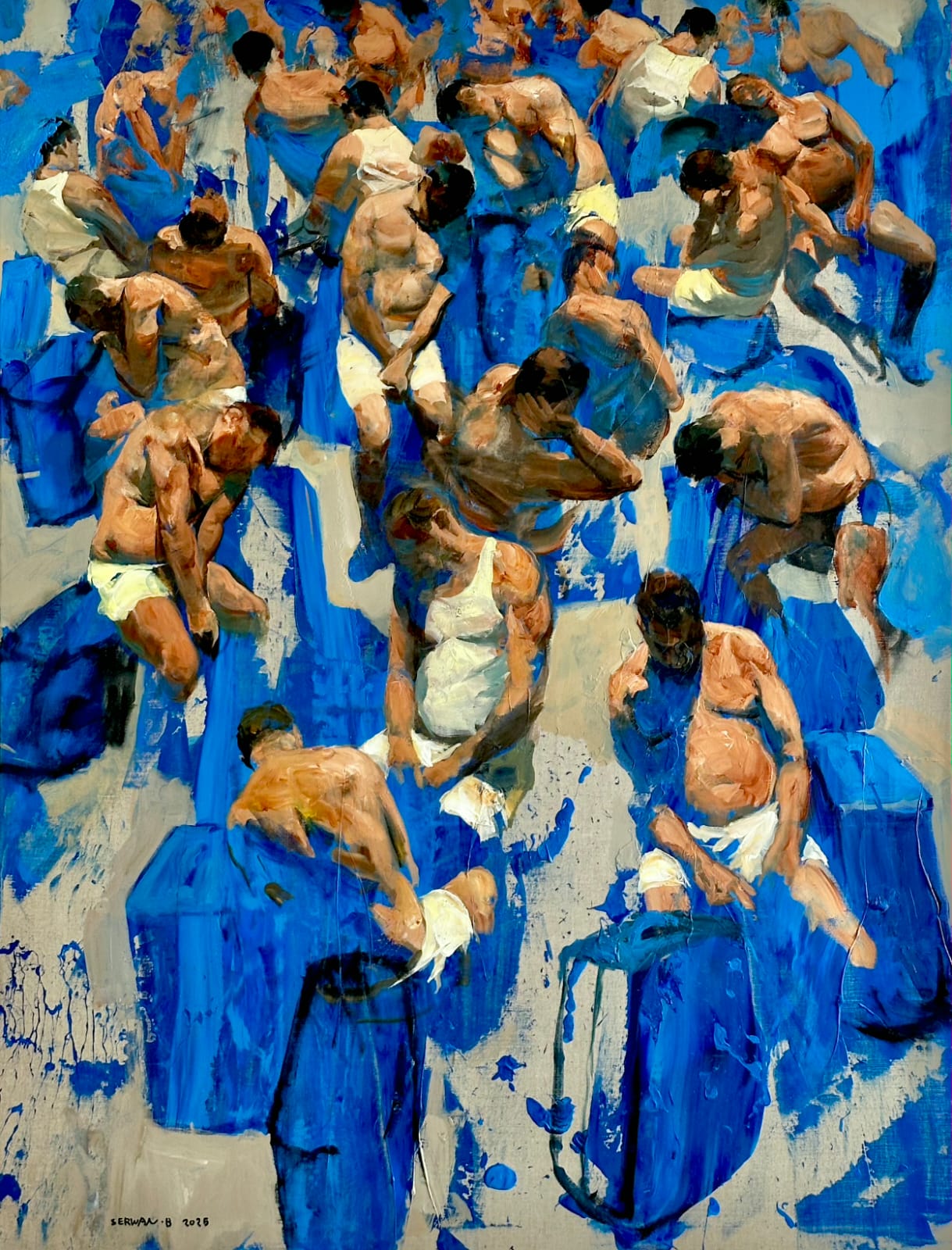
Baran lived within the structure of war rather than observing it from a safe distance. He witnessed how a human becomes a number, the body a tool, and the face a mask of obedience. He was expected to produce images of heroism—the victorious soldier, the resolute leader, the state that does not tremble. Instead, he produced the opposite of illusion and its ecstasy: fatigue, fear, futility, waiting, faceless faces, extinguished eyes, and bodies crowded and trapped within fabrics larger than themselves.
The Body as an Archive of Violence
The central idea in his work does not lie in painting war itself. Many have done so, from Goya to Otto Dix and Anselm Kiefer. For Baran, war is an experience that passes through a person and leaves them alive but incomplete. He does not paint the war as an event, but the human after war has passed through them. The harshness of his work emerges in what remains of the being after losing the ability to gather their thoughts and make sense of what happened.
Exhausted bodies recur throughout his paintings; for him, the body is an archive of war. Everything is stored in a drooping shoulder, a bowed head, a hand that has lost its function, and an incapable foot. It is a psychological and political body, not merely anatomical: a body that has learned fear, been trained in obedience, and accumulated a confused memory within. In this sense, Baran occupies a space between academic painting and a nightmarish vision, between formal discipline and internal explosion.
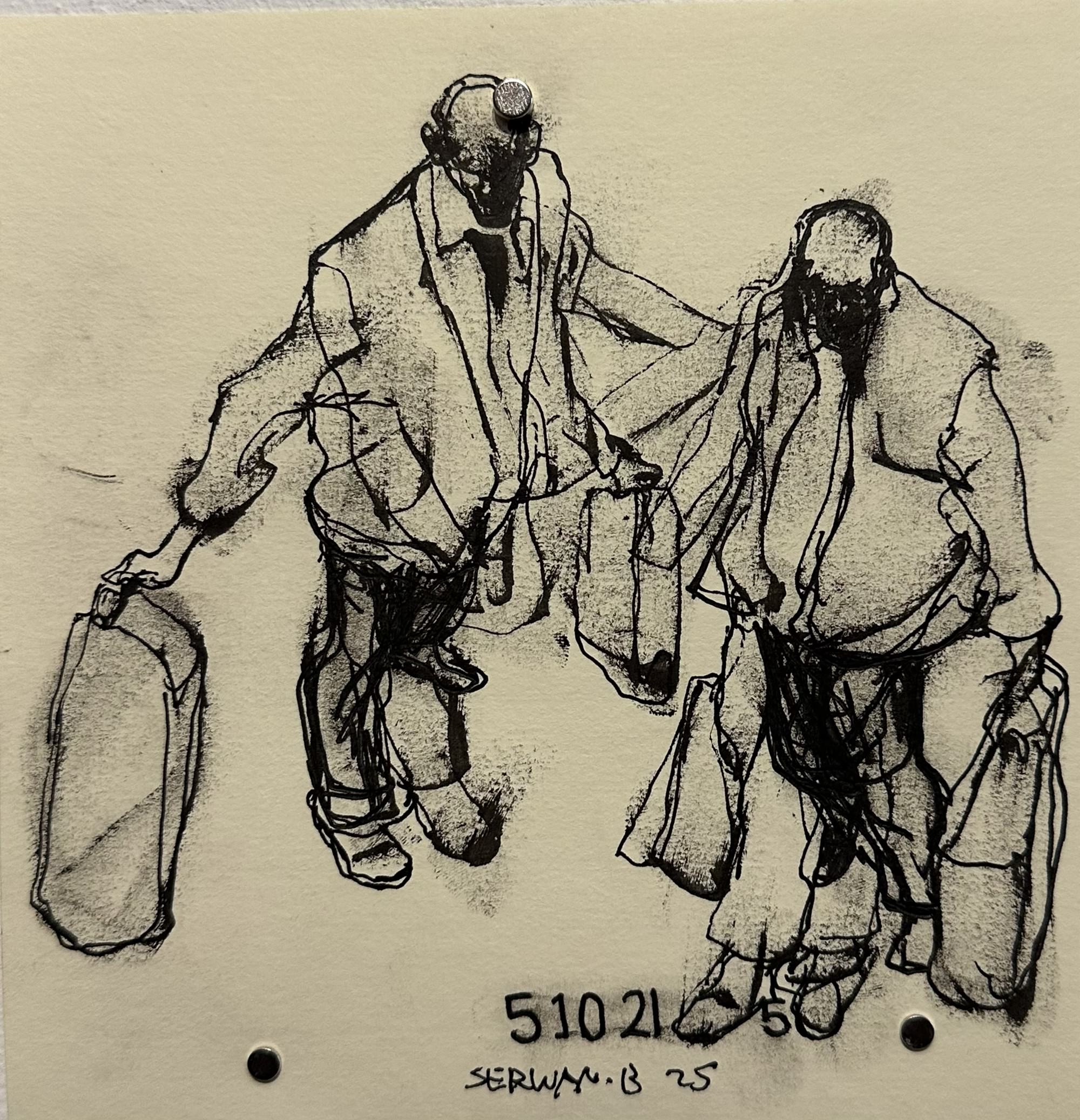
Silence in Baran’s paintings is essential. His faces do not speak or plead; they either look or withdraw, rarely offering the viewer easy sympathy. It is as though the artist refuses to turn pain into consumable emotional material. He does not ask for pity, but for testimony. The viewer is not left as an innocent bystander but enters a space of questioning: what do we do in front of images of violence when news can no longer awaken us? How do we look at the exhausted body without turning it into another image in the archive of disasters?
Exile as an Existential State
Displacement is present in his work, but uprooting appears as an internal condition more than an external subject. The figures lose their place before they lose their land. They stand in undefined spaces, without a clear home, horizon, or sign of stability. They are displaced even within the painting itself. Even when still, they feel expelled from meaning. This is the deepest form of alienation: exile not as a place one reaches, but as an existential condition that seeps into consciousness, making every place temporary and every belonging fragile.
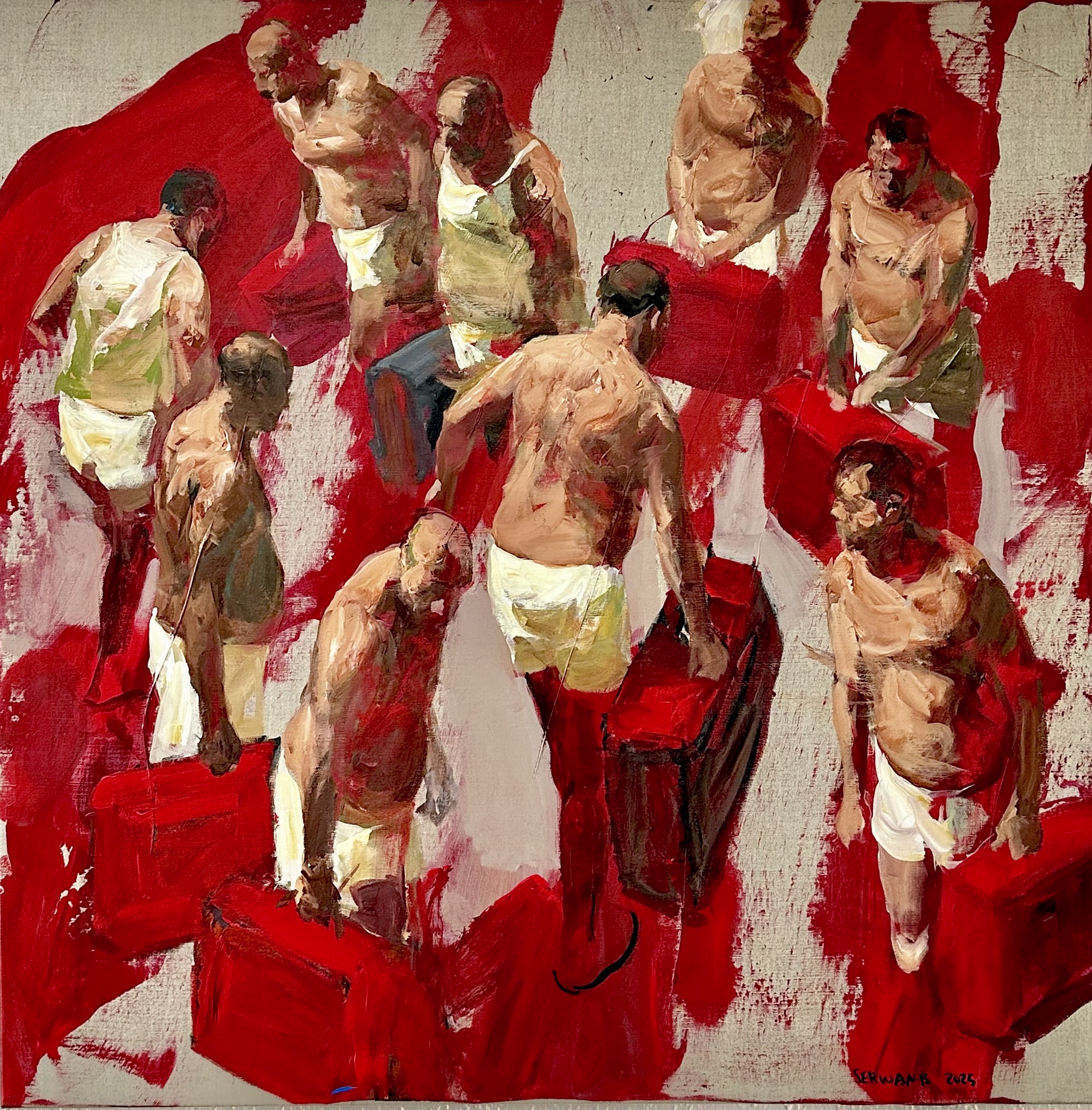
Hamra Street holds particular significance; Baran lives his personal experience within the city’s broader memory. Beirut becomes a temporary shelter, a laboratory of freedom, and a fragile space that constantly receives the wounds of others while bearing its own. Hamra is not an escape from war—it is a mirror reflecting its horrors from another angle.
What Remains After the War?
In his work, alienation extends beyond geography to become a structural element in vision. Exile is not simply leaving one’s land, but realizing that the land has also left you, or that it is carried within the body like a memory that cannot be unloaded at any border. The canvas becomes a space where what cannot exist in reality resides: silent faces, fear without language, and power that changes names but not nature.