

Lebanon’s shifting map: War and the displacement of people
Beirut and Mount Lebanon absorb the majority of displaced families as evacuation zones expand, revealing a rapidly changing geography of refuge across the country.



 Messenger
 Whatsapp
 Threads
 Email
Email
 Print
Print
 X
X
 Facebook
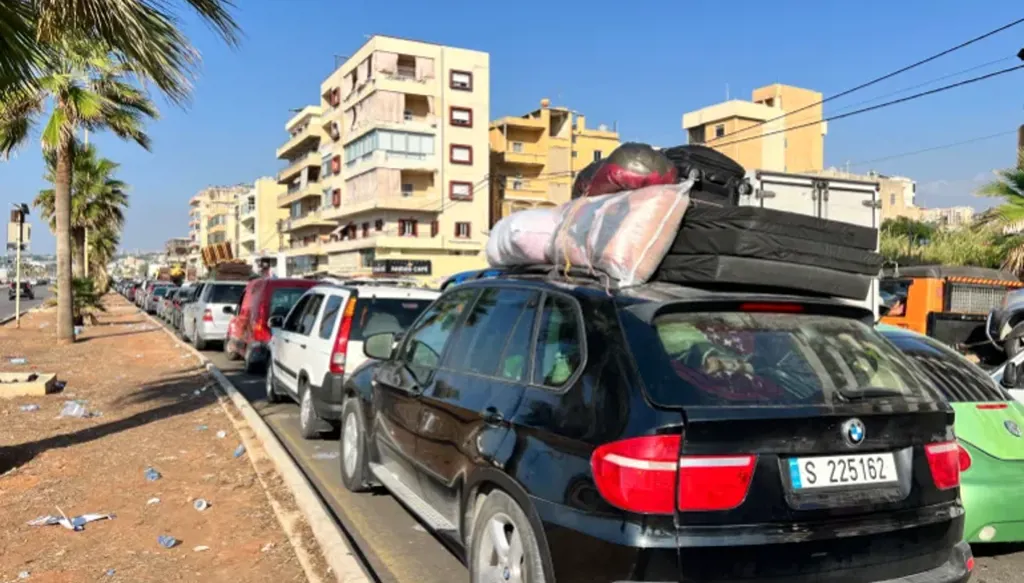


The spaces of Lebanon seemed to narrow with the displaced. Warnings followed, evacuations expanded, and the Lebanese fled to places that appeared temporarily safe, which soon became threatened.
It is the rolling geographic and regional path of displacement that reshaped the geographical map. So how did the geographical distribution appear?
Al-Duwaliya for Information sketches an approximate map of the file. Researcher Mohamed Shams al-Din reveals the following picture in numbers:
- 30% of the displaced were received by Beirut.
- 60% were received by the Mount Lebanon governorate, particularly the districts of Baabda, Aley, and Chouf.
- 10% was the northern region's share of the displaced.
There is no doubt that Lebanon witnessed during the last war a kind of spatial dilemma amid escalating military operations and the expansion of evacuation zones.
In recent days, more than 45 geographical points between cities, towns, and villages were evacuated southward towards the north of the Zahrani River. The city of Tyre also received warnings that reached the depths of the city, alongside villages that were fully evacuated, including the Sidon and Zahrani areas, with warnings extending to Nabatieh and Iqlim al-Tuffah.
?What Areas Did the Displaced Resort to
Shams al-Din notes that “about one million and three hundred thousand displaced people were distributed between Beirut and Mount Lebanon, with a few relocating to the north, while Sidon attracted about 200,000 as the warning areas expanded southward.”
The contraction of options has become an imposed reality on the displaced. In previous wars, the geographical margin for refuge was wider, but today the developments of the war come within a heavier displacement crisis.
On the side of the Ministry of Social Affairs, the ministry documented the displaced in officially adopted shelter centers, while the majority, who spread regionally, exceeded by far the shelter centers.
According to a report issued by the Office of the Prime Minister entitled “The Comprehensive National Response of the Lebanese Government to War and Internal Displacement”, about one million people left their homes from the south, Nabatieh, and the southern suburbs towards Beirut.
By the end of last May, the number of displaced had reached 141,440 within 692 shelter centers.
In the initial stages of displacement, the Lebanese resorted to safer villages within the same governorate. However, with the expansion of targeting zones, some were forced to move to Mount Lebanon or the northern areas.
Below is an approximate map of the displacement movement:
Mount Lebanon: It tops the geographical scene of displacement, hosting the largest percentage, gradually including the districts of Aley, Chouf, Metn, and Keserwan.
Beirut: Receives large numbers in shelter centers distributed in neighborhoods, schools, and public facilities.
North Lebanon: Few numbers of displaced in areas like Tripoli, Batroun, Zgharta, Koura, and Akkar.
Beirut and Mount Lebanon generally receive displaced people from the south, while displacement convoys move from Bekaa to Zahle first, and some might later move to Metn, Keserwan, and Jbeil.
According to the National Council for Scientific Research, housing units damaged by the war, until May 8th, showed that 61,056 units were completely or partially destroyed, meaning the scale of destruction cost a lot in terms of humans and materials and resulted in a reshaping of geographical displacement.
Thus, the last war drew changing patterns of displacement, especially since 85% of the displaced were outside shelter centers, and the extent of the destruction did not spare comprehensive areas from the depths of the south, Bekaa, and the southern suburbs.