

Trump's touted involvement of Syria: a fallacious solution to Lebanon’s crises
Calls for Syrian involvement in addressing Hezbollah’s weapons risk reopening old wounds, deepening regional tensions, and dragging both Lebanon and Syria into a new cycle of instability, argues the author.



 Messenger
 Whatsapp
 Threads
 Email
Email
 Print
Print
 X
X
 Facebook
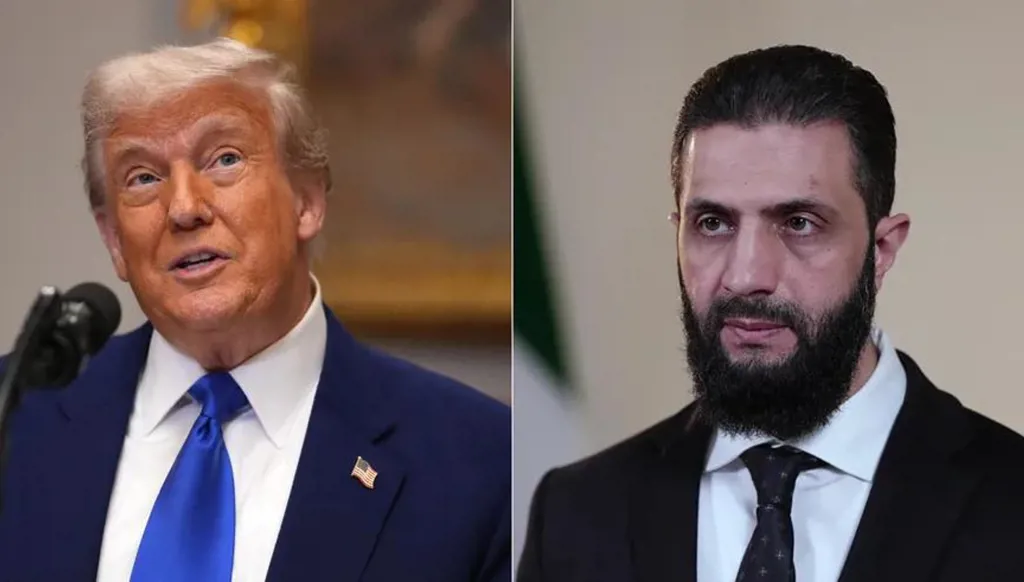


I do not wish to label U.S. President Donald Trump with any of the descriptions often attributed to him, but he would be committing a grave mistake—indeed, an unforgivable sin—if he believes that the solution to the issue of Hezbollah's weapons in Lebanon lies in enticing Syrian President Ahmad Al-Sharaa to return to Lebanon.
Rather than helping resolve the Lebanese crisis, such a move would only expand it, increasing the number of parties involved, multiplying its dangers, and plunging both Syria and Lebanon into unprecedented civil, sectarian, and religious wars.
We all remember the tragedies that followed the entry of the Syrian army into Lebanon, and what the ill-fated Syrian regime did to Lebanon's political, social, economic, and humanitarian life. It transformed Lebanon into a hub of death, killing, fragmentation, corruption, terrorism, disasters, and tragedies.
At that time, Syria was entirely under the grip of that unfortunate and oppressive Baathist regime. The new regime in Syria today must be fully aware of the structural problems it faces within Syria itself—with the people of the Syrian coast, the people of Jabal al-Arab, as well as its issues with the "remnants of the previous regime," the Kurds, and the lurking Iraqi militias.
Is there any logic in inviting the Syrian president to enter the Lebanese quagmire and drown in its coagulated, stagnant, and bloody swamps?
Lebanon today is burdened by two major problems: Hezbollah's weapons on one hand, and the Israeli aggression and occupation of parts of the south on the other.
This is already a highly complicated equation. Bringing Syria into the equation again does not solve it; rather, it pushes Lebanon into a more dangerous phase, making the country captive to a triangle of interlocking crises: Israel to the south, Syria to the east and north, and Hezbollah—with its weapons and the Iranian influence behind it—within.
What logic suggests dealing with one external intervention by introducing another? What wisdom is there in inviting a new regional player into a Lebanese scene already crowded with interventions and contested spheres of influence?
Lebanon has paid dearly to emerge from the era of guardianships. The Syrians themselves have paid tremendous prices in history, blood, and destiny. How, then, can going backward become a plan for resolution? How can returning to the Lebanese quagmire become a prescription for stability?
The suggestion to call on Syria to resolve the issue of Hezbollah's weapons is not a solution to a problem; rather, it adds a new problem to the existing ones. It is not a path to salvation, but a path to reproducing the Lebanese predicament with new names and faces, while Lebanon itself continues to pay the price.
Every day, I become more convinced that there is no solution to the Lebanese problem except by neutralizing Lebanon from the outside—all of the outside—and neutralizing it from within. These two conditions cannot be effective except through a unifying hand and a consensus among the members of the Security Council, even if that requires placing Lebanon temporarily under international guardianship.
The principle that should govern any serious approach is to neutralize Lebanon, not to drown it further. Neutralizing it from Israel as well as Iran, from Syria as well as from other regional axes. Neutralizing it from any external hand that seeks to turn it into a stage, a card, or a frontline. At the same time, freeing it from any internal weapons or influence that makes its national decision hostage to non-Lebanese interests.
What Lebanon needs is a fully sovereign Lebanese state, exercising authority over its land, borders, and decisions. No Israeli guardianship, no Syrian guardianship, no Iranian guardianship, nor any other form of guardianship.
My advice to the new regime in Syria is simple: Do not enter Lebanon. Entering it today is not a path to influence or resolution, but a path to drowning alongside it in the same predicament. Beware!