Trump’s Syria–Lebanon proposal raises regional war fears and strategic questions over Damascus’s role

Region 18-06-2026 | 14:00

Trump’s Syria–Lebanon proposal raises regional war fears and strategic questions over Damascus’s role

Analysts warn the idea of pushing Syria into confrontation with Hezbollah could deepen instability, reshape regional alliances, and fuel wider proxy conflicts across the Middle East.


Trump’s Syria–Lebanon proposal raises regional war fears and strategic questions over Damascus’s role
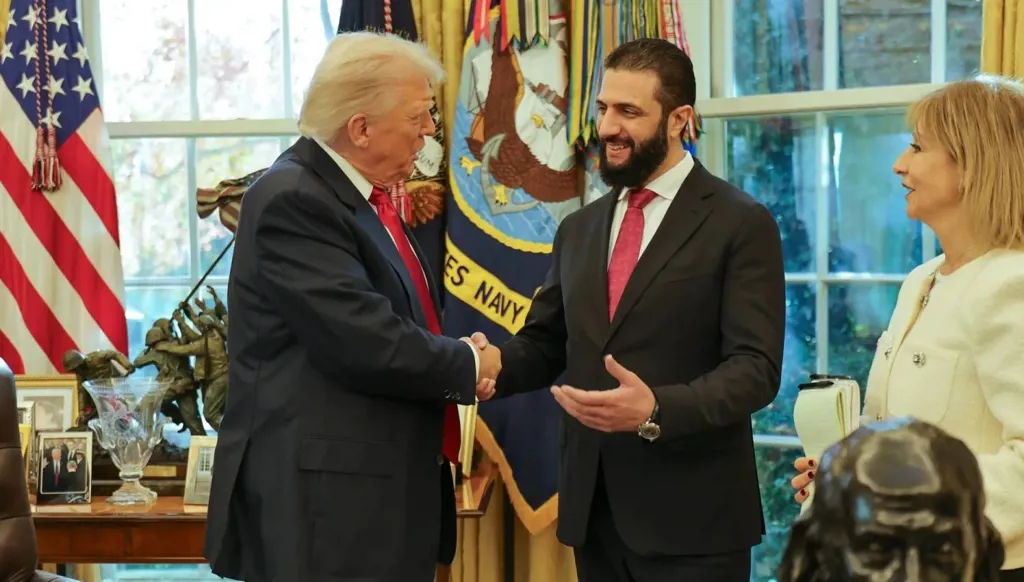
Syrian President Ahmad Al-Sharaa shakes hands with U.S. President Donald Trump in Washington, November 10 (Syrian Presidency)
Smaller Bigger


On the sidelines of the G7 summit, U.S. President Donald Trump put forward an idea that initially appeared fleeting but may signal a potential shift in Washington’s approach to regional issues: allowing Israel to leave Syria to “deal” with “Hezbollah,” as he believes it “would carry out the task better.”


This was not an isolated remark; it was repeated publicly twice within a week, following earlier discussions in March about a possible Syrian incursion into eastern Lebanon, which was met with reservations from Damascus. When an idea moves from a slip of the tongue to a repeated proposal, it shifts from an impromptu comment to a vision being publicly tested before potentially being shaped behind the scenes.


The significance of this proposal lies in its engagement with some of the most sensitive fault lines of a Syria still emerging from a prolonged war, while also reviving longstanding questions about Syria’s role in Lebanon and the limits of its capacity to assume regional responsibilities. The key question that arises before such a vision translates into policy is twofold: can Syria enter this conflict, and should it?


To understand the weight of this proposal, it is necessary to revisit the context from which it emerges. The relationship between Damascus and Beirut is not an ordinary neighborly relationship, but one shaped by a long history of guardianship and influence. The Syrian army entered Lebanon in the mid-1970s under the pretext of “maintaining security,” remaining for nearly three decades, during which it exercised influence far beyond its official mandate, leaving deep scars in Lebanese collective memory that have yet to heal.


The fall of the previous regime later turned the equation upside down. Hezbollah, which had long been tied to the Damascus–Tehran axis, lost both its strategic depth and land supply routes with that regime’s collapse, as well as part of its narrative as a “protector” against extremist groups.


Conversely, the new Syrian authorities inherited an exhausted country, a military with severely diminished capabilities, and an economy on the brink of collapse, alongside the daunting task of rebuilding the state from its ruins. In this volatile context comes the American proposal to push Syria into a confrontation with “Hezbollah.”


Here, the proposal is assessed in terms of capacity rather than ambition. Those who imagine deploying Syrian forces into Lebanon as a controlled security operation are reading the map with only partial vision. Any direct Syrian–Sunni–Shiite confrontation on Lebanese soil would not remain a limited clash between two disciplined forces bound by rules of engagement; instead, it would quickly devolve into sectarian tensions with unpredictable and uncontrollable consequences.


Once ignited, these suppressed memories resurface all at once: scenes of violence, sectarian revenge rhetoric, and narratives of “oppression” that extremist factions on both sides of the conflict feed upon. More dangerously, the repercussions would not remain confined to Lebanon’s borders. Iraqi militias, the Houthis in Yemen, and wider Iranian-linked networks would all find in such an intervention a ready justification to reactivate their postponed conflicts, expanding what was initially framed as a localized solution in Lebanon from the Syrian coast to Sanaa.


This creates the first paradox that undermines the proposal from within: a Syrian intervention would not weaken “Hezbollah”; instead, it could restore what it lost following the fall of the previous regime.


A Syrian Sunni force entering Lebanon would turn into a gift that restores that narrative in full: not as a sectarian militia, but as a “defender” of a community that feels it is under threat.


In this sense, the proposal risks effectively creating the very opponent it claims to dismantle. The second paradox is both economic and military: the Syrian army emerging from years of conflict is not the force depicted on maps. What remains of its capabilities has been repeatedly targeted by Israeli strikes, stripping it of much of its air defense systems and heavy weaponry. The lira has lost most of its value, infrastructure lies in ruins, and reserves are nearly depleted. Financing a war under these conditions is more than an uncalculated gamble; it is a direct threat to any chance of recovery.


The deeper paradox is political: the most difficult question is not whether Damascus wants this war, but to what extent it can refuse such an American request. And when Trump praises President Ahmad Al-Sharaa, saying he has “protected all requested,” it does not merely amount to a certificate of good conduct, but rather sets a subtle trap: each previous concession becomes a precedent that is invoked with the next demand, until the party concerned is cornered by praise that steadily narrows the space for refusal. Today’s rewarded compliance becomes tomorrow’s expected restraint.


The repercussions of this proposal would not stop at Lebanon’s borders but would also extend to the fragile infrastructure of Syria itself. Entering an external war would mean diverting resources and attention away from the country’s internal struggle for survival, potentially triggering internal instability faster than it could resolve external challenges, in a state still grappling with the task of unifying multiple zones of loyalty and managing the files of returnees, displaced persons, and scattered factions.


In this sense, Syria would find itself, by entering a conflict endorsed by the United States and Israel, in a position where it may gain temporary favor in Washington while risking the loss of its relations with Tehran, Moscow, and large parts of the Arab and Islamic world, at a time when it is already struggling to gradually break its isolation and rebuild its diplomatic standing.


In a broader sense, a deeper dimension of the proposal begins to emerge: the primary target may not be Lebanon, but Israel. Trump, expressing dissatisfaction with Netanyahu’s handling of the war, appears to be using Syria as a strategic lever in a message directed at Tel Aviv. The paradox lies in the fact that Damascus, in this scenario, could be asked to pay a real price in blood and stability for a largely symbolic maneuver in which it has no direct stake.


Between the impossibility of acceptance and the cost of refusal, the solution is neither an outspoken “no” that provokes escalation nor a “yes” that becomes entanglement, but rather a form of quiet diplomacy that raises the cost of the idea even for Washington itself. Damascus would be required to persuade its ally, diplomatically rather than confrontationally, that such an intervention would generate far greater instability than it claims to resolve, and that convincing the ally that its own proposal is self-damaging, even before it is harmful to Syria, may prove more effective than outright rejection.


In assessing possible scenarios, it appears most likely that Damascus would avoid direct military involvement, relying instead on managing American pressure through delay and negotiation, as this remains the least costly option and the one most consistent with its current balance of capabilities.


The most dangerous, though less likely scenario is that the new authorities find themselves compelled to make a symbolic concession that could open a door which becomes difficult to close later. Between these outcomes, the wager on stability rests on Damascus’s ability to turn its apparent weakness into a bargaining chip rather than an invitation to further pressure or leverage.


The entire region remains on the brink of a wider explosion as long as Israel operates under an American umbrella, and the Lebanese state remains unable to take serious steps to control Hezbollah’s weapons. The American proposal to push Syria into the confrontation is not a solution, but rather additional fuel for a fire that has not yet been extinguished.


History shows that proxy wars do not end when major powers decide they should, but when the endurance of smaller actors is exhausted. Syria, still attempting to rise from its ruins, cannot afford to carry others’ wars on top of its own wounds.