

G7 backs Ukraine, eyes Gulf security as Trump shapes post-war agenda
From renewed support for Kyiv to plans for securing the Strait of Hormuz, Gulf leaders joined G7 talks as Donald Trump emerged as a central player in discussions on regional stability, energy security, and the future of global supply routes.



 Messenger
 Whatsapp
 Threads
 Email
Email
 Print
Print
 X
X
 Facebook
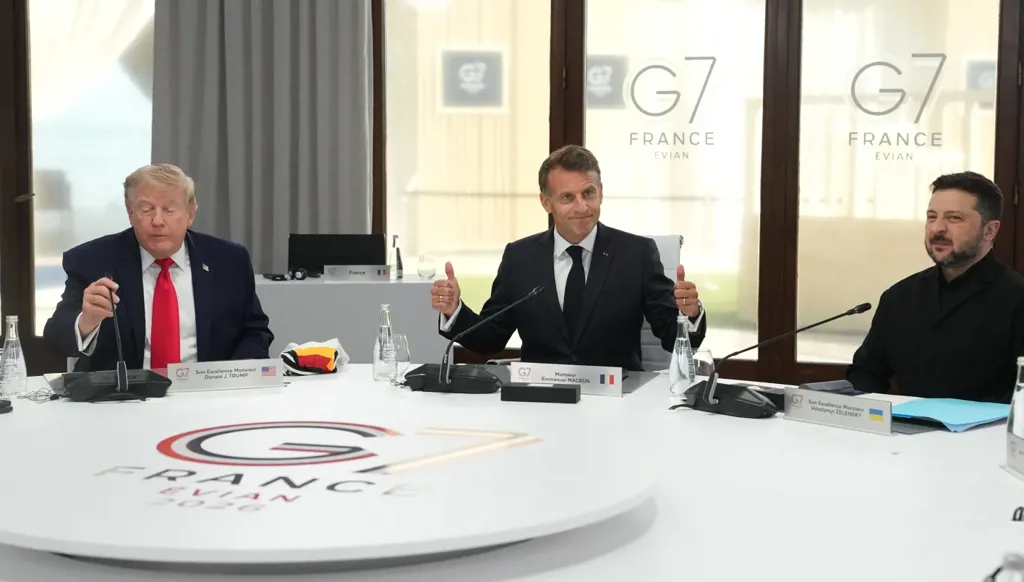


Washington's allies at the G7 summit hosted by France succeeded in securing U.S. approval to continue supporting Ukraine. Given President Donald Trump's relatively neutral stance toward both sides of the conflict, the outcome represents an initial gain for Kyiv and its allies.
The statement read: "We, the leaders of the G7, stand united in our unwavering support for Ukraine in defending its freedom, sovereignty, and territorial integrity."
G7 countries and the Strait of Hormuz
Participants briefly welcomed the preliminary agreement reached by Trump with Iran to end the war. The statement added: "We consider this moment an opportunity to pursue additional (economic) measures," noting that Trump had presented an agreement supported by the group to reopen the Strait of Hormuz.
European hesitation during the war regarding the reopening of the strait had frustrated Trump, who said he did not need European intervention. Nevertheless, European involvement remained welcome from the American perspective and necessary in practical terms.

The statement also welcomed an international mission to secure navigation through the strait, led by Britain and France. However, questions persist about Europe's willingness to lead such an effort, or the circumstances under which it would do so. French President Emmanuel Macron said France would intervene upon a formal request from the United States, as well as from Iran and Oman. Meanwhile, participants called for exploring alternative energy routes and discussed Canada's potential contribution of additional capabilities in this area.
Trump and the Ukraine War
Although the atmosphere at the summit was constructive, according to Reuters citing European diplomats, two other diplomats told the same agency that Trump did not commit to imposing sanctions. German Chancellor Friedrich Merz, however, said Trump was in a "cooperative" mood.

The leaders pledged "to increase the delivery of defensive, interceptive, and long-range capabilities" to Ukraine. Particular attention will be paid to potential U.S. deliveries of Patriot missiles following the end of the Iran war.
Ukrainian President Volodymyr Zelensky expressed optimism, saying Trump was very positive about the possibility of providing Ukraine with additional defensive missiles. Trump, who met Zelensky on the sidelines of the summit, described the meeting as "very good" and said that "Russia must make a deal," adding that he would do his best to achieve that outcome.
For Trump, supplying defensive weapons to Ukraine may prove easier than imposing sanctions on Moscow, especially as Europe is paying for the weapons purchases. Zelensky also stated that the group's leaders were unanimous in their view that Russia "does not win the war."
G7 and the Arab Gulf
According to Politico, a British diplomatic official said there was little value in discussing Gulf security, the Strait of Hormuz, and energy issues without Gulf countries being present at the G7.
As a result, UAE President Sheikh Mohammed bin Zayed Al Nahyan, Qatar's Emir Sheikh Tamim bin Hamad Al Thani, and Egyptian President Abdel Fattah el-Sisi joined the summit.

The discussion extends beyond energy security. Once the war ends, issues related to reconstruction, investment, and the development of a new architecture for energy corridors and supply chains will come to the forefront.
The Gulf states continue to emphasize their central role in ensuring the success of this emerging framework. In that sense, the level of participation at the G7 summit reinforced the region's geopolitical importance in linking Europe with its Arab and Gulf partners, helping shape a new future for the region whose contours are gradually, yet steadily, taking form.