

Lebanon’s economic recovery plan faces three major obstacles, French sources warn
From banking reform to fiscal overhaul, experts say Lebanon’s future now hinges on politically sensitive decisions that could make or break IMF support.



 Messenger
 Whatsapp
 Threads
 Email
Email
 Print
Print
 X
X
 Facebook


A high-level analysis from French financial sources familiar with the Lebanese situation offers a detailed view of Lebanon’s financial reform path, concluding that the country is currently facing three successive hurdles, all of which must be overcome before any economic recovery becomes possible.
The First Hurdle: The Banking Settlement Law
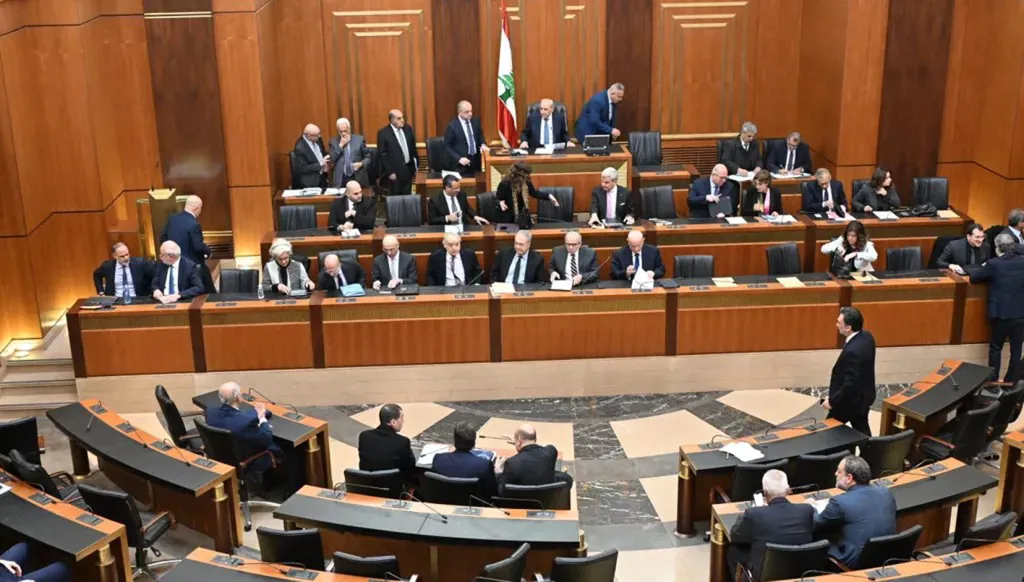
At first glance, this hurdle may appear the simplest, yet its passage is not guaranteed. It concerns the approval of the new draft banking settlement law, which has already begun discussion in the Lebanese Parliament.
The initial version of this law was approved in late July 2025, but the International Monetary Fund (IMF) raised significant objections, triggering extended rounds of revision and negotiation until Lebanese authorities and the IMF eventually agreed on a more stable version.
However, French sources warn that passing the law through Parliament is far from certain, as several MPs have expressed substantive objections, particularly regarding the composition of the Higher Banking Commission, which some consider controversial.
The most worrying aspect is that failure to adopt this law would send the worst possible signal to the international community, reinforcing the perception that Lebanon is unable to implement reforms, even limited ones.
The Second Hurdle: Amendment of the "Financial Gap" Law and Liquidity Issues:
This hurdle is more complex in both technical and financial terms. The current version of the “Financial Gap” law is considered financially unworkable and requires substantial amendments, which the Lebanese government is reluctant to undertake, stating that it has already fulfilled its responsibilities. As a result, the responsibility for these amendments falls on Parliament.
Where will the money come from? French sources estimate two main sources:
• The Central Bank of Lebanon, with foreign currency assets of approximately $6 billion available for mobilization.
• Commercial banks, which bear part of the responsibility and cannot avoid contributing, with amounts estimated between $3 billion and $4 billion.
Regarding easing the liquidity crisis, the sources propose several technical measures, most notably extending repayment periods for deposits above $100,000 gradually according to deposit size:
Deposit Size
Repayment Period
From $100,000 | 4 years |
From $100,000 to 1 million dollars | 5 years |
From 1 million to 5 million dollars | 6 years |
Over 5 million dollars | 7 years |
The same sources also raise a fundamental ethical issue: why should individuals who withdrew $40,000 under Circulars 158 and 166 be allowed to withdraw a full $100,000 again, without accounting for previous withdrawals?
They note that total withdrawals under these circulars since their issuance have exceeded $6 billion, a fact not reflected in the current draft law.
The Third Hurdle: Redrawing the Public Finance Path
This is the most complex and longer-term hurdle, relating to the trajectory of Lebanese public finances in the coming years. French sources state that all work carried out by the Lebanese Ministry of Finance and the IMF in this area has become obsolete in light of recent developments.
Previous expectations were based on a positive growth scenario, whereas it is now confirmed that growth in 2026 will be negative and severe. In addition, projections for significant revenue increases have not materialized, with the first four months showing stagnation or decline. At the same time, reducing expenditures has become impossible under the current conditions.
As a result, the entire medium-term fiscal framework (MTFF) must be fully revised on the basis of principles entirely different from those used prior to last March.
Possible Light at the End of the Tunnel...
Despite the bleak outlook, French sources express cautious optimism. They believe that IMF leadership, due to its political pragmatism, may show implicit flexibility toward Lebanon, focusing only on what is realistically achievable.
If Lebanon succeeds in overcoming these three hurdles, an agreement with the IMF would become attainable, unlocking between $3 billion and $5 billion in funding, equivalent to at least 10% of GDP. This would also pave the way for a donor conference expected to generate an additional $7 billion to $12 billion.
In conclusion, Lebanon’s financial recovery path is theoretically possible, but it necessarily depends on passing through these three hurdles. Any failure in even one of them would be enough to close the door on the entire reform process.