

U.S.–Iran Agreement at Risk: Middle East Tensions Rise
A high-stakes U.S.–Iran understanding risks collapse as regional flashpoints from Lebanon to the Strait of Hormuz test its stability.




 Messenger
 Whatsapp
 Threads
 Email
Email
 Print
Print
 X
X
 Facebook


Hezbollah and the Revolutionary Guard: The Most Dangerous Stalemate in the U.S.-Iran Agreement
Here, Hezbollah enters through the widest door. The group is not merely a Lebanese ally of Iran, nor simply an armed organization benefiting from funding, training, and weapons, but rather part of Iran’s broader influence architecture in the Levant. Its relationship with the Quds Force of the Revolutionary Guard is not one of ordinary external support, but an organic connection, often described as an extension of the same body.
For this reason, no U.S.–Iranian agreement can treat Lebanon as a peripheral issue. In Tehran’s calculations, Lebanon is not a distant arena, but a forward line of contact with Israel, a bargaining chip in negotiations with Washington, and a measure of the Revolutionary Guard’s weight within Iran’s internal decision-making.
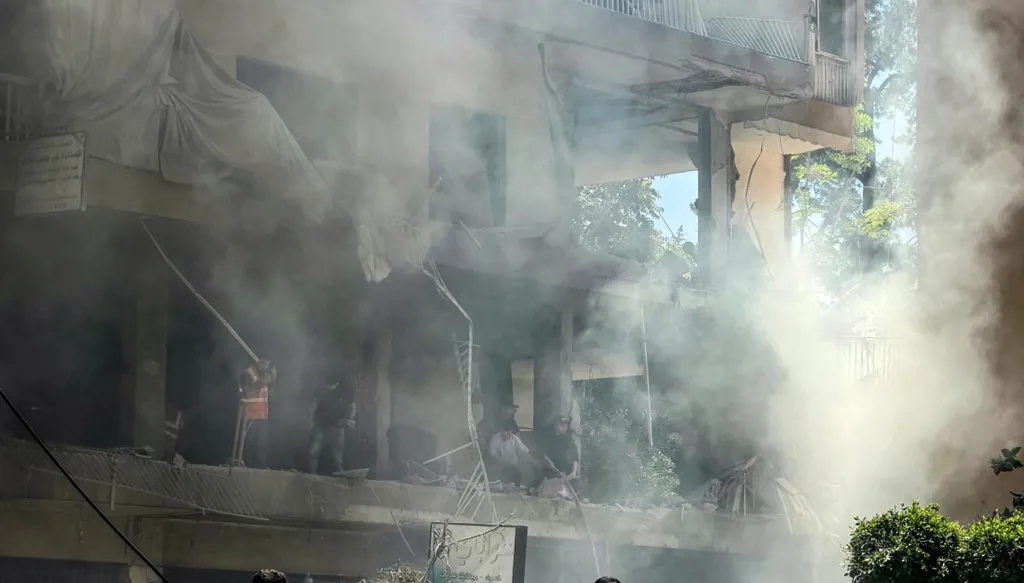
The recent bombing of the southern suburbs clearly exposed this underlying reality. Israel aimed to signal that any agreement, if signed, would not grant Hezbollah immunity in Beirut or the south. Its message was twofold: there would be no truce with the group outside strict security conditions, and no acceptance that a U.S.–Iran settlement could serve as a shield for rebuilding its capabilities.
In response, Iran’s threat of retaliation carried an opposing message: no agreement would be viable if it appeared to leave Hezbollah exposed to Israeli strikes.
The primary “big devil,” therefore, is Hezbollah. It seeks not only calm but guarantees from any agreement. It aims to emerge from the war politically unbroken, even if materially weakened. Its objective is to halt Israeli strikes and to prevent any internal Lebanese arrangements that could lead to its disarmament, push it away from the border areas, or place its military decision-making under full state control.
From its perspective, any international agreement that excludes Lebanon is incomplete, and any agreement that includes Lebanon without securing its position is inherently dangerous.
Yet the problem is that what Hezbollah seeks is not necessarily what Lebanon needs: namely, an end to the war, the restoration of sovereign decision-making, and the prevention of Lebanese territory becoming an extension of Washington–Tehran negotiations.
Here, the Lebanese dilemma appears in its starkest form: the state seeks a ceasefire in order to survive, while Hezbollah seeks a ceasefire in order to preserve the balance of arms. The gap between these two objectives reflects the difference between a state striving for sovereignty and an organization seeking to maintain a regional role.
Israel and the Agreement with Iran: Why Does Tel Aviv Fear the New Settlement?
The second major “devil” is Israel. It does not necessarily view a U.S.–Iran agreement as an opportunity, but rather as a potential threat. From its perspective, any easing of sanctions on Iran, release of frozen funds, or implicit acceptance of Iran’s regional role could ultimately translate into time and resources used to rebuild its network of allies and proxies.
As a result, Israel seeks to establish a parallel operational framework alongside any agreement: even if Washington reaches an understanding with Tehran, Tel Aviv would retain the freedom to strike Hezbollah whenever it perceives a threat.
This freedom of action is precisely what could destabilize the agreement, continuously placing Iran under pressure, either it absorbs the strikes and appears weakened in the eyes of its allies, or it responds and risks collapsing the settlement altogether.
The first “smaller devil” is the Strait of Hormuz. Ostensibly, it is a legal question: Iran and Oman are the coastal states, and navigation through the strait is governed by international maritime rules.
Politically, however, Hormuz functions as a pressure point on the global economy. When Iran calls for a new framework governing the strait rather than a simple return to the pre-war status quo, it is not merely discussing geography, but seeking a political and military redefinition of its role.
In effect, it aims to assert that global energy security cannot be ensured without acknowledging Iran’s position, rather than treating it as something to be contained or bypassed.
The second “smaller devil” is the Iranian nuclear issue. Despite its seriousness, it appears more deferrable at this stage. Agreements can be reached to cap enrichment at a certain level, freeze further expansion, establish negotiation timelines, or introduce phased oversight mechanisms.
However, the danger is that the nuclear file becomes a cover for the broader settlement while regional tensions remain unresolved. In that case, the agreement risks resembling previous ones: effective on paper, but ultimately failing in practice.
Why Could the U.S.-Iran Agreement Fail after Signing?
In depth, the stalemate is not only between the United States and Iran, but also within Iran itself. The Iranian state needs an agreement to ease the blockade and restore access to money, oil revenues, and international markets.
However, the Islamic Revolutionary Guard Corps is reluctant to allow the agreement to appear as a defeat for the regional network it has built over decades. This tension between the interests of the state and those of the ideological-military apparatus is precisely why Hezbollah becomes an unwritten clause in any understanding.
The Guard does not want to bear the cost of the agreement through a loss of regional influence, nor does it want to appear before its domestic base and allied networks as having accepted a reduction in Hezbollah’s role in exchange for oil exemptions or unfrozen funds.
Therefore, the agreement may be possible, but its success is far more difficult than its signing. Signing requires a political decision, but implementation depends on managing Israel, Hezbollah, the Islamic Revolutionary Guard Corps, the Strait of Hormuz, and the nuclear file. These are not separate issues, but an interconnected network of pressure points.
A strike in the southern suburbs can shift calculations in Tehran, a drone from the south can move Tel Aviv, an incident in Hormuz can shake global markets, and activity in an Iranian nuclear facility can quickly pull Washington back into the language of threats.
What can be anticipated is that, if the agreement is signed, it will not mark the end of the war but rather the beginning of a prolonged test of its durability. It would amount to a major truce surrounded by smaller conflicts, leaving Lebanon faced with a choice between remaining an object within others’ negotiations or becoming a state attempting to reclaim its position in a rare regional opening.
The most troubling aspect of this landscape is that not all four “devils” need to act for the agreement to unravel; it is enough for a single one to move for the entire structure to collapse, returning the region to the situation of February 28, 2026.
Disclaimer: The opinions expressed by the writers are their own and do not necessarily represent the views of Annahar.